

Agentic AI in HR.

The ultimate guide to knowing the difference between true innovation and false agents in enterprise talent tech.

True agentic AI replicates the subtle, often invisible cognitive work that people constantly perform: shifting context mid-task, drawing connections across unrelated inputs, and rerouting plans in real time. Without these capabilities, what’s marketed as an “agent” is just prepackaged scripts dressed in hype. This guide offers a clear framework to identify true agentic AI, ensuring your decisions are informed by what it takes to build systems capable of sustaining complex, enterprise-scale talent operations.

Table of contents

Welcome to the age of agentic AI.

Enterprise HR and talent leaders are encountering an influx of AI products marketed as “agents.” But beneath the buzz, most offering lack the essential qualities that define agentic behavior. The danger isn’t just wasting budget on suboptimal technology — it’s embedding brittle, shallow systems into critical workflows that demand flexibility, judgment, and resilience.

True agentic AI replicates the subtle, often invisible cognitive work that people constantly perform: shifting context mid-task, drawing connections across unrelated inputs, and rerouting plans in real time. Without these capabilities, what’s marketed as an “agent” is just prepackaged scripts dressed in hype.

This guide offers a clear framework to identify true agentic AI, ensuring your decisions are informed by what it takes to build systems capable of sustaining complex, enterprise-scale talent operations.

$2.6T to 4.4T

Gen AI is poised to make a significant economic impact, with estimates suggesting it could contribute between US$2.6 trillion and US$4.4 trillion annually to global GDP by 2030 across various sectors. The future of gen AI is agentic, where AI agents collaborate in real-time to automate complex tasks and enhance decision-making.

— PwC, “Agentic AI — the new frontier in GenAI.”

Agentic AI: True vs. false agents

In the race of advanced AI, it’s more difficult than ever to know what is true agentic AI and what is a false agent.

True agentic AI can take action — like clicking or filling out fields — across digital spaces it understands. It can achieve goals without needing every step or data insight to be explicitly coded. It operates more like networks of specialized sub-agents working in sync, each handling a cognitive function. It can monitor for redundancies, identify ethical concerns, detect unexpected behaviors, and dynamically adjust to accommodate changing workflows — even engage in dialogue and adjust in conversations.

Think of these “sub-agents” like parts of your brain undertaking different functions to operate as a whole. These agents can collaborate to navigate nuances and maintain fluidity. Gone are the days of inflexible, pre-programmed chatbots. Agentic AI can take on more tasks like scheduling, coordinating, even interviewing to free up your time to do higher level work.

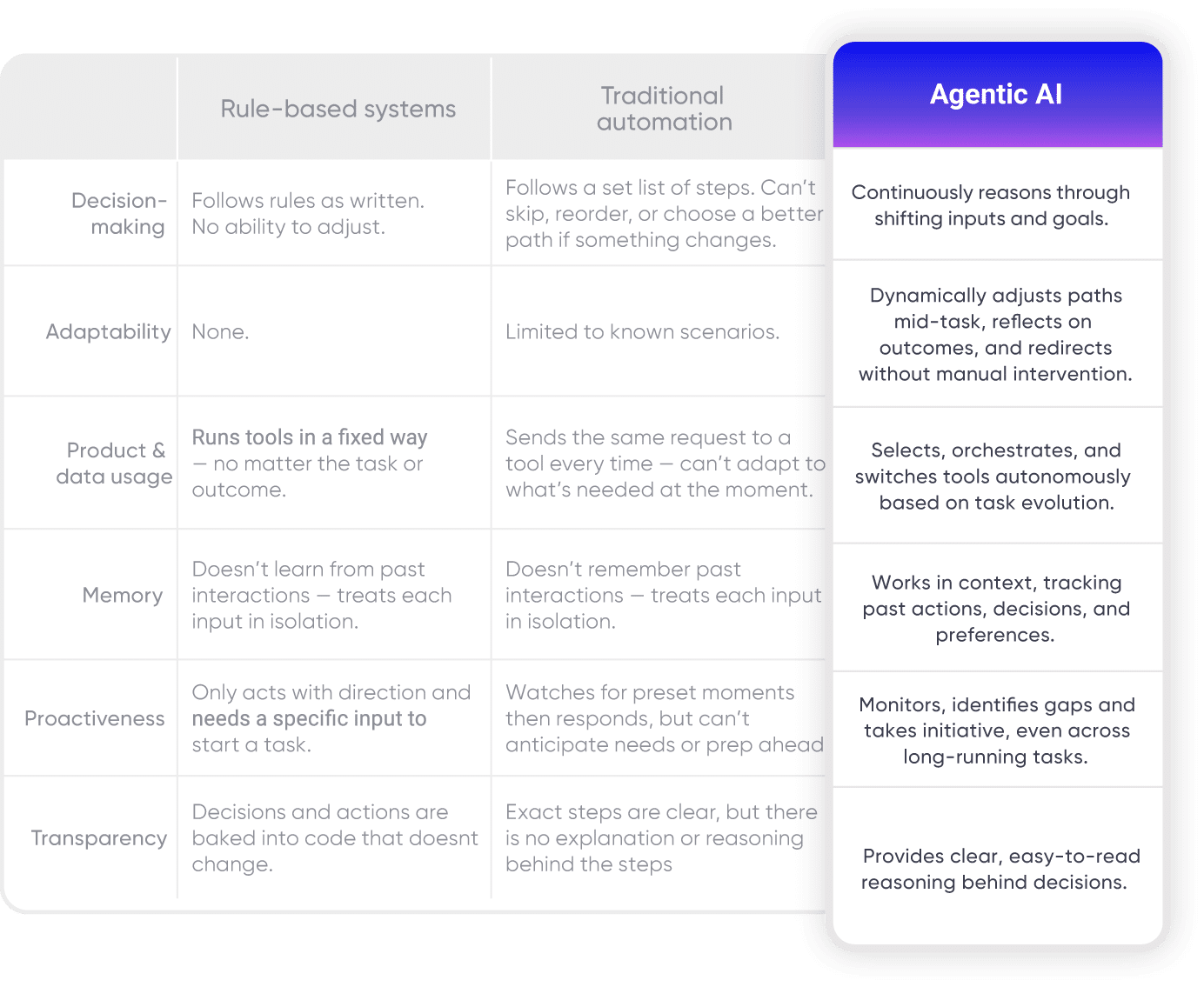
Here’s an easy chart to compare the fundamental differences between true agentic AI and false agents.

Why now is the time for agentic AI

Talent environments aren’t static — your HR tech solution shouldn’t be either.

Modern enterprise talent environments are dynamic, unpredictable, and shaped by incomplete information, ambiguous goals, and constant change. Roles shift. Skills evolve. Career paths are non-linear. Your decisions can’t always wait for perfect data.

Agentic AI is engineered to work in this dynamic environment. It has the ability to help you tame the unpredictable, see the unseen, and work toward solving HR challenges like reducing time to hire and improving candidate matching in real time. It doesn’t just automate steps or follow a pre-programmed path. Agentic AI reasons through complexity, adjusts strategies, and interprets context as it unfolds.

Most false agents rely on predefined flows and single-shot prompts. The reality is that talent work is recursive, often circling back to refine judgments, reconsider priorities, or revisit prior answers. These are all functions where agentic AI thrives.

The world of HR will continue to be more complex as AI and skills evolve. And as complexity scales, only AI that can blend automation with embedded reasoning will keep pace.

Over half (51%) of organizations are exploring the use of AI agents and another 37% are piloting AI agents.

— KPMG, “AI Quarterly Pulse Survey”

Welcome to the new age of HR

Systems of intelligence build upon your systems of record to provide skills-based insights

Systems of record
Built for stability
Structured data
.
Point solutions
Built for a job to be done
Specific results
Specific use case
Systems of intelligence
Built to understand
Uses internal & external data
Automatic & self-updating

True agentic AI in action

Essential capabilities of true agentic AI include:

Multi-step reasoning icon

Multi-step reasoning and planning.

Executes complex goals by breaking them into dynamic subtasks, adapting as new information arises, much like an interviewer adjusting to changes in conversation with a candidate.

Autonomous tool selection icon

Autonomous tool selection and execution.

Selects what tools, product features, or third-party applications it needs — even mid-process — without relying on predefined paths. If one tool fails, it reroutes, selects alternatives, and regenerates outputs without stopping.

Short and long-term memory icon

Short- and long-term memory.

Retains preferences, past decisions, and contextual cues over time. For example, knowing a hiring manager’s preferred scheduling times for interviews without needing reminders in every workflow.

Troubleshooting and course correction icon

Troubleshooting and course correction.

Detects misalignment, redundancy, or ethical concerns. It can identify duplicate questions, or recognizes when answers suggest the need to change the conversation.

Context-aware decision-making icon

Context-aware decision-making.

Maintains flexible flows through hierarchical structures. The agent can seamlessly move between subjects, pause deep dives, or reprioritize based on a candidate's responses.

Developing your own agentic AI would require significant investment, including developing multi-layered systems that coordinate dozens of specialized processes in parallel and ensuring that the agent doesn’t only execute but evolves as it works.

To ensure your journey with agentic AI starts right, know how true agentic AI should work. Whether you’re planning to build or buy a solution, awareness of the key differences will set you on the right path.

Spotting false agents

False agents appear impressive — think slick voice commands or fast first drafts — but fall apart in tougher challenges like staying grounded in changing context, reasoning through unscripted problems, or making decisions without constant oversight.

Here are some top signs you’re looking at a false agent, not true agentic AI:

Warning Icon
Option for extra text goes into these boxes over charts or illustrations.
Warning Icon
Option for extra text goes into these boxes over charts or illustrations.

Warning Icon

Option for extra text goes into these boxes over charts or illustrations.

Warning Icon
Option for extra text goes into these boxes over charts or illustrations.
Warning Icon
Option for extra text goes into these boxes over charts or illustrations.
Warning icon
False Agent Alert: Systems that can’t adjust midconversation or mid-task.
Warning icon
False Agent Alert: Processes that collapse when confronted with unexpected answers or edge cases.
Warning icon
False Agent Alert: Lack of memory between interactions, forcing you to repeatedly enter the same information.
Warning icon
False Agent Alert: No mechanisms for internal reflection or realtime quality monitoring.
Warning icon
False Agent Alert: Systems that feel impressive in demos but fall apart in live scenarios where ambiguity is common.

What this means for your enterprise talent team

For talent teams juggling complexity and high volume, true agentic AI goes deeper than automating clicks or firing off reminders. It runs entire workflows, adapts as things change, and applies human-like judgment across thousands of moving parts.

This isn’t about offloading busywork — true agentic AI expands your team’s thinking powers. That means handling not just tasks, but decisions, adjustments, and reflection. True agents lift both the manual and mental weight by spotting issues early, keeping processes healthy, and giving your team more space to focus on strategy.

False agents trap teams in endless patchwork: constantly rewriting prompts, overseeing brittle flows, and manually correcting what the system failed to catch.

Deloitte predicts that in 2025, 25% of companies that use gen AI will launch agentic AI pilots or proofs of concept, growing to 50% in 2027. 

— Deloitte, “Autonomous generative AI agents: Under development

The cost of getting agentic AI wrong

If you’re looking for a true enterprise agentic AI solution, getting it right the first time is essential to your success. Failing to distinguish true agentic AI from false agents could lead to:

Multi-step reasoning icon

Losing trust from systems that overpromise and underdeliver.

Autonomous tool selection icon

Security and compliance gaps from mishandled sensitive data.

Short and long-term memory icon

Falling behind as competitors deploy adaptive, self-improving systems.

Troubleshooting and course correction icon

Systems that require constant oversight and reconfiguration.

Context-aware decision-making icon

Escalating costs from inefficiencies, redundant work, and continuous patching.

True agentic AI involves the complex orchestration of multiple reasoning layers, persistent memory management, governance oversight, and real-time adaptability. It should replicate human-like behaviors across vast, unpredictable environments. If it seems cheap and fast, it’s probably just automated workflows in disguise.

10 questions to ask about agentic AI

It’s critical to thoroughly vet any HR technology partner. Here are 10 questions to get you started. 

- How does the system handle real-time, dynamic task adjustment?
False agent: We’ve designed dynamic workflows that respond to different user inputs and can reroute tasks through pre-configured branches.
True agentic AI: The agent re-evaluates its plan during execution and adjusts next steps based on live inputs or unexpected changes, without restarting.
+ What memory structures are in place to retain context over time?
False agent: The system remembers recent activity within a session and uses cookies or cached data to personalize the experience.
True agentic AI: The system uses persistent memory to retain context across sessions — storing what’s been done, what worked, and how it should inform future actions.
+ How are decisions explained to end users?
False agent: We provide summaries and high-level justifications for the results, so users understand what happened.
True agentic AI: The agent shows its work — tracing each decision back to the data it used, the steps it took, and the logic behind it — so you’re never left guessing how it got there.
+ What happens when the system encounters ambiguity or incomplete data?
False agent: We’ve trained the model to provide the best possible answer based on available input — even when information is missing.
True agentic AI: It identifies gaps, pauses execution, and either asks clarifying questions or retrieves additional data before proceeding.
+ How does it prevent redundant or irrelevant actions?
False agent: Our workflows are optimized to avoid repeating steps, and we’ve tuned the prompts to be as efficient as possible.
True agentic AI: It continuously monitors task history and context in real time, suppressing duplicate actions and adjusting based on what’s already been done.
+ What governance safeguards continuously operate in the background?
False agent: We follow enterprise-grade security protocols and audit all actions on a scheduled basis.
True agentic AI: There are real-time compliance and safety layers that review every agent action for policy alignment, bias risk, and escalation triggers.
+ How many distinct systems or processes coordinate to make the agent function?
False agent: Our architecture integrates a powerful LLM with automation tools and custom APIs, all in one seamless stack.
True agentic AI: Multiple coordinated components — like planning engines, reflection loops, memory modules, and tool routers — operate together to drive behavior.
+ How does the system monitor and correct itself mid-process?
False agent: If something goes wrong, we have fallback logic that restarts the process or routes it to support.
True agentic AI: The agent checks its work as it goes, tweaking steps or reworking decisions in real time based on what’s actually happening, not just what was expected.
+ What evidence do you have of agentic AI learning over time?
False agent: We regularly fine-tune the model and apply updates based on aggregated user behavior and usage patterns.
True agentic AI: The agent continuously learns as it goes, adapting its behavior based on historical patterns, user preferences, and feedback signals to improve outcomes over time.
+ What operational costs reflect agentic AI’s complexity (compute, monitoring, human-in-the-loop support)?
False agent: Our solution is lightweight and cost-efficient, with minimal infrastructure needed beyond prompt execution.
True agentic AI: Costs include the following: LLM runtime, memory management, orchestration overhead, and continuous monitoring, all reflecting the system’s cognitive workload.

The Final Take

In a market flooded with inflated claims, only those who understand the difference between true agentic AI and false agents will make decisions that stand up to the complexity of modern enterprise talent work. The future belongs to organizations that invest in systems capable of evolving alongside them — reasoning, adapting, and improving without needing to be handheld.

With our history deeply rooted in developing innovations in AI, we are uniquely positioned and qualified to help you understand how the latest advancements in true agentic AI can serve your enterprise’s talent needs.

Let’s talk. Learn more about becoming an Eightfold AI design partner and help us shape the future of agentic AI in HR.

You might also like...

Ready to hire and develop talent to their highest potential?

Experience what the Eightfold Talent Intelligence Platform can do for you today.

Ready to hire and develop talent to their highest potential?

Experience what the Eightfold Talent Intelligence Platform can do for you today.

Share Popup Title

[eif_share_buttons]