

[Ed note: This post originally appeared in Amber Grewal’s Talent Transformed newsletter on LinkedIn.]
As we enter 2026, one thing is clear: AI in HR is no longer about possibility. It’s about performance.
The next phase isn’t about more AI it’s about better design, sharper accountability, and real business outcomes.
Here are 10 predictions that will define HR and HR tech in 2026.
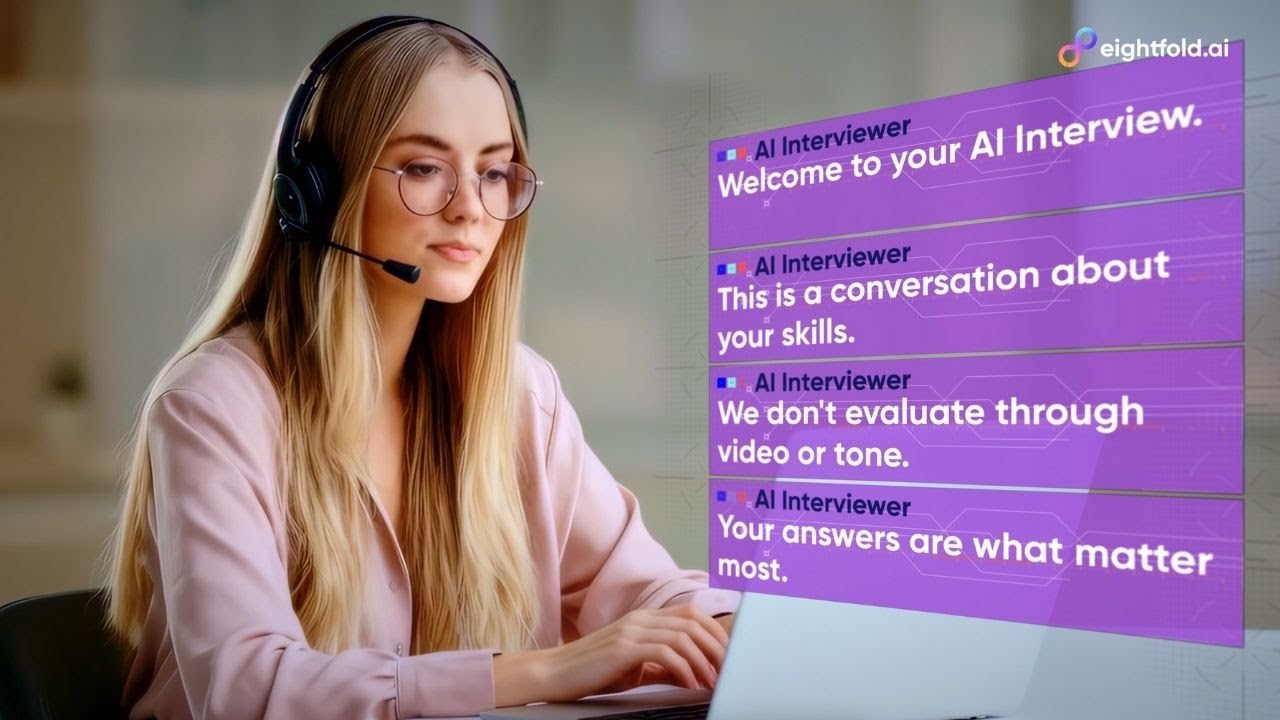
I predict AI interviewing won’t be experimental by the end of 2026 — it will be essential. Learn how the Eightfold AI Interviewer can help your organization.
1. HR moves from “systems of record” to “systems of work”
For decades, HR technology has been about storing information. In 2026, the winning platforms will be judged by how well they do the work.
We’ll see AI agents that orchestrate end-to-end workflows from hiring to onboarding to manager enablement. Not chatbots. Not dashboards. Digital labor embedded directly into how work gets done.
The bottom line: HR tech leaders will differentiate on orchestration, not features.
2. Workforce redesign becomes the No. 1 HR strategy muscle
“AI adoption” is no longer a strategy. Workforce redesign is.
In 2026, HR will be deeply involved in decomposing roles into tasks, re-bundling work between humans and machines, and rethinking operating models.
The World Economic Forum projects AI will create 170 million jobs while displacing 92 million. The net gain only materializes for organizations that intentionally redesign work.
The bottom line: CHROs who can redesign work not just deploy tools become true strategic advisers to CEOs.

3. Skills-first hiring becomes non-negotiable
The degree requirement is officially dead.
81% of employers have adopted skills-based hiring (up from 57% in 2022). Organizations using skills-first approaches see 89% higher retention and 88% fewer mishires.
But dropping degree requirements is step one. The real transformation is building infrastructure to verify skills, not just collect self-reported résumé data.
With 39% of key skills changing by 2030, organizations that operationalize skills will outpace those that merely catalog them.
4. The AI value bar gets much higher
The era of “AI for experimentation” is ending.
In 2026, leaders will demand clear answers: What cycle time did this reduce? What cost did this eliminate? What human capacity did this return?
More than four in 10 organizations cited a lack of data to properly evaluate HR tech investments as a barrier, according to Deloitte. That barrier becomes a filter. AI that doesn’t deliver measurable value will be sunset quickly.
The bottom line: HR teams shift from proof of concept to proof of impact or stop funding the work.
Related content: See how Quality Automotive Services plans to use our AI Interviewer for high-volume hiring.
5. AI interviewing becomes the proof point for AI ROI
By end of 2026, AI-powered interviewing won’t be experimental. It will be where organizations expect to see their first real, measurable return from AI.
At a time when leaders remain skeptical that AI is delivering promised productivity gains, interviewing stands apart. It’s repeatable, capacity-constrained, and high-stakes one of the clearest opportunities for immediate impact.
Within our customer base, 98% of candidates opt into AI-powered interviews when given the choice. Organizations are conducting thousands of interviews per week that simply weren’t possible before.
But the lasting advantage isn’t speed or scale alone. The real shift happens when AI interviews become structured sources of skills signal intelligence that sharpens hiring decisions over time.
The bottom line: AI interviewing will see broad adoption in 2026 because it delivers value immediately. The winners will be those building talent intelligence with every conversation.
6. HR governance becomes a board-level topic
As AI agents gain autonomy: Who is accountable when an agent makes a decision?
Expect formal governance models covering decision rights, auditability, bias mitigation, and human-in-the-loop thresholds. The EU AI Act classifies employment AI as “high risk.” US regulations are proliferating. And 67% of job seekers report discomfort with opaque AI hiring decisions.
The bottom line: HR will own one of the most critical governance mandates in the enterprise.
7. Recruiting splits into two distinct lanes
Recruiting will no longer be one job it will be two.
- Lane 1 — High-trust automation: Screening, scheduling, first-pass interviews, candidate communication. This is where AI excels.
- Lane 2 — High-touch differentiation: Closing top talent, relationship building, strategic advisor to hiring managers. This is where humans are irreplaceable.
The bottom line: The best recruiting teams will be smaller, faster, and far more strategic.
Eightfold Talent Management is helping talent unlock their potential and consider new career paths without leaving their current organization.
8. Internal mobility becomes the primary talent strategy
The war for talent shifts from external acquisition to internal activation.
Nearly 70% of organizations surveyed by Veris Insights said they have prioritized internal mobility over the past year. More than 75% of Millennials and Gen Z will quit if growth stalls.
Your best talent pipeline is the workforce you already have.
AI enables this at scale matching employees to opportunities based on skills adjacencies, aspirations, and organizational needs. It turns static org charts into dynamic talent marketplaces.
The bottom line: Build the capability to match internal talent to opportunities faster than external recruiters can poach them.
9. Smaller, fit-for-purpose AI models win
Bigger isn’t always better.
Enterprises will favor smaller, specialized models tuned for specific HR domains, offering lower cost, faster latency, higher reliability, reduced hallucination risk in high-stakes people decisions.
In hiring, compensation, and performance management, precision beats scale. A model 95% accurate on general tasks may be less valuable than one 99% accurate on your specific workflow.
The bottom line: HR leaders become smarter consumers of AI. The question shifts from “Do you have AI?” to “Do you have the right AI?”
10. HR metrics evolve for agentic work
What we measure shapes what we build.
Traditional metrics, like time-to-fill or cost-per-hire, were designed for a world where humans did all the work.
In 2026, HR scorecards expand to include:
- Agent productivity: How much work are AI agents handling?
- Human hours returned: How much time freed for higher-value work?
- Quality-of-hire signals: Predictive indicators, not just speed
- Skills velocity: How fast is the organization acquiring critical capabilities?
The bottom line: HR finally moves from activity metrics to value metrics.

Final thoughts
This year isn’t about chasing AI trends. It’s about designing a new operating system for work where humans and machines collaborate intentionally, ethically, and at scale.
The HR leaders who win won’t be those who adopted AI first. They’ll be those who designed work best.
What’s your boldest prediction for 2026?
If your 2026 HR strategy relies on old-school screening, you’re already behind. Empower your recruiters with the Eightfold AI Interviewer to build a hiring infrastructure that candidates love and leaders trust.
Amber Grewal, Chief Growth Officer at Eightfold, is a renowned talent leader with extensive experience in global workforce transformation. Previously, she was Managing Director and Partner, and Chief Talent Officer at Boston Consulting Group, where she revolutionized its talent operations using AI and advised BCG clients on strategic initiatives.