

- HR teams must do more with less to navigate labor shortages and build stronger organizations.
- A “systemic” HR approach can help deliver value to a business through an agile, proactive, and consultative approach that predicts and solves problems.
- Filling jobs demands more than just recruiting; retaining, reskilling, and redesigning are also essential.
U.S. employers are grappling with a significant math problem: we have 8 million job openings but only 6.8 million unemployed people.
Even if everyone seeking a job had the skills perfectly matched to an open position, we’d still face a shortage.
As an HR professional, you are already all too familiar with this, as you work hard to find creative approaches to filling jobs and preparing your workforce for the future of work.
At the same time, you’re likely finding it necessary to future-proof your own HR department so that your executive team sees you as a revenue generator, not a cost center.
“HR cannot be a passive department—it cannot be the cleanup crew,” said Rebecca Warren, Director, Talent-centered Transformation at Eightfold AI. “You have to be proactive. You have to be driving things, not fixing all the things that went wrong.”
Kathi Enderes, Senior Vice President, Research, and Global Industry Analyst with The Josh Bersin Company, calls this evolving approach to HR “systemic HR.”
Enderes defines systemic HR as an operating system that delivers value to a business through an agile, proactive, consultative approach that predicts and solves problems. “HR professionals need to be full-stack professionals,” she says. “We need data. We need intelligence. We need talent.”
During a recent webinar, Warren and Enderes discussed HR in the age of labor shortages and shared insights on how HR leaders can help organizations drive transformation, productivity, and growth—even when talent is scarce.
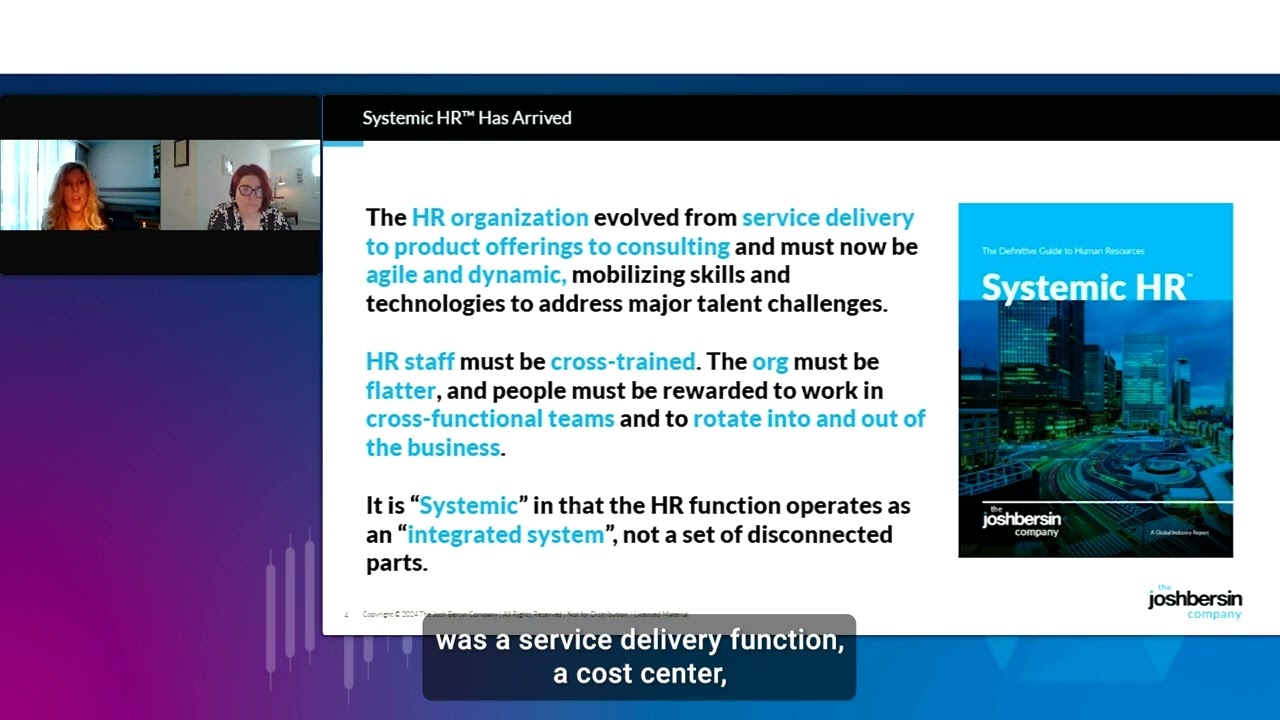
Related content: Kathi Enderes, Senior Vice President, Research and Global Industry Analyst at The Josh Bersin Company, talks about how shifting from the mindset of an operating model to an operating system can be key to future-proofing HR.
Everything is connected
When jobs go unfilled, the impact ripples throughout the organization. You must examine systems at every level, starting with accomplishing more work with fewer people.
That might mean bringing on contract workers and/or AI, taking a project-based approach, or experimenting with new leadership models.
They must also reconsider broader aspects that impact the attraction and retention of workers, including:
- Pay and benefits
- Employee experience and retention
- Job architecture
- Internal mobility
- Learning and development programs
- Leadership pipelines
- Diverse hiring and sourcing goals
“Every single problem that we’re facing today in HR is actually not a single-domain problem anymore,” Enderes said. “It’s really a multi-domain problem.”
She adds that in systemic HR, staff are cross-trained to understand all different areas of people-centered operations and work in cross-functional teams that rotate in and out of the business and HR to examine challenges through multiple lenses.
Enderes discussed the 4R Model framework, which refers to recruiting, retaining, reskilling, and redesigning. Too often, she said, HR teams focus on recruiting when they’re looking to fill jobs for any number of reasons.
But that’s not enough. “You have to think about retaining the people you already have and reskilling at the same time,” she said.
In addition, you should think about ways to redesign the jobs at hand to meet your organization’s goals with fewer employees, whether it’s using AI to support people to do their work faster or using a different employment model, like contract work or outsourcing. “All of these things help with closing the talent gap,” Enderes said.
The industry is rapidly changing
The Josh Bersin Company recently collaborated with LinkedIn to analyze what makes the best companies effective in HR functions. The survey included LinkedIn data from 7.5 million HR practitioner profiles.
Results illustrated a growing and evolving industry with more than 250 different roles—an increase of 25% in the last five years.
The fastest-rising roles revolve around accounting and administration, including:
- Accounting officer
- Accounting specialist
- Administrative assistance specialist
- Human resources executive
- Human resources technician
While the roles in the fastest decline are more strategic, including:
- Head of business management
- Human resources analyst
- Human resources business partner
- Recruiter
- Strategic adviser
Warren said it’s important to consider that even if certain roles are declining, those capabilities will still be needed, whether you’re talking about a recruiter, a business manager, or an analyst. She adds that there’s no longer a clear, linear career path in HR.
“It used to be [that] you started as a specialist, maybe you moved into talent acquisition or a business partner role, and then director, vice president, [or] chief human resources officer,” Warren said. “I don’t think it happens that way anymore. There are so many intersections between learning and development … and organizational development, and the roles are becoming more expansive, encouraging us to learn and grow.”
Organizations must stoke growth and development so HR team members can pursue opportunities at the company, explore their interests, and build fulfilling careers.
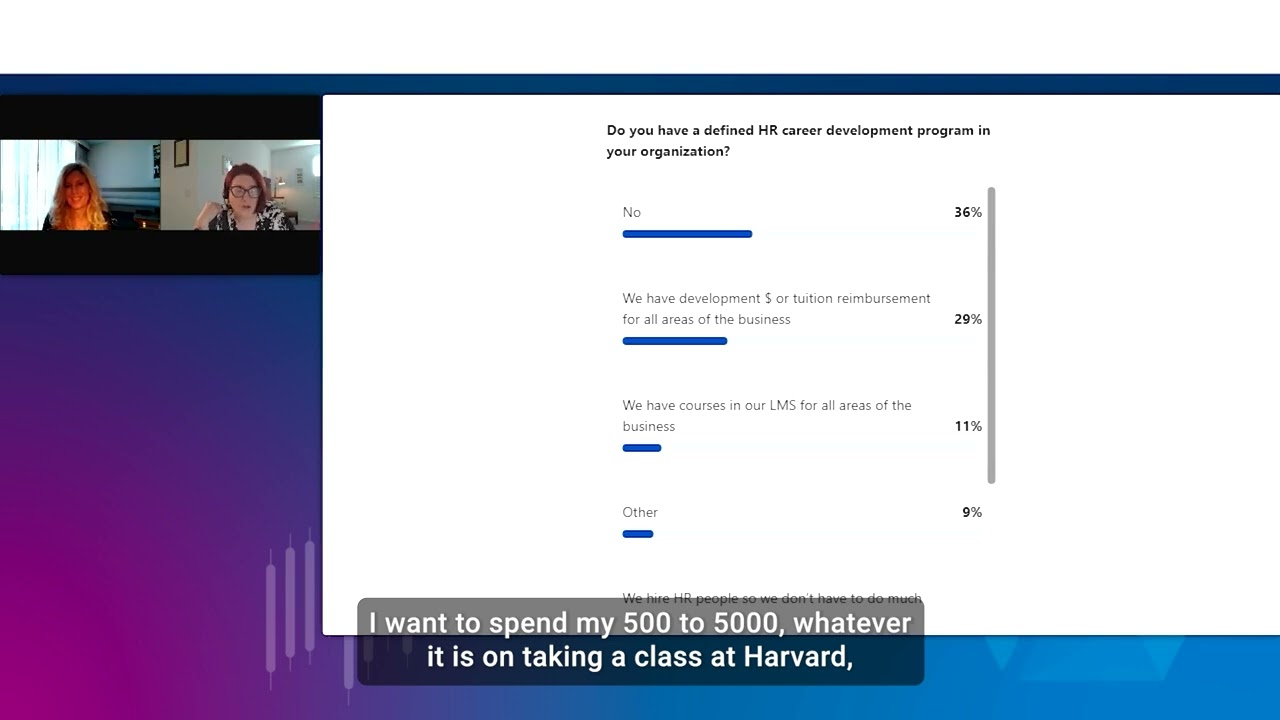
Related content: Rebecca Warren, Director, Talent-centered Transformation at Eightfold AI, shares why employees may find it difficult to get started with career development programs.
Career development doesn’t have to break the bank
Determining the best way to develop future HR leaders can be confusing. “It kind of feels like the Wild West, trying to decide what training and development areas to focus on,” Warren said.
However, employees don’t necessarily have to rely on external programs for those opportunities. Nurturing and developing HR team members can be embedded in the organization’s culture.
Enderes said it begins with an open conversation about career aspirations and how they want to grow, which then entails developing a plan to acquire those capabilities.
Mentorship and coaching can be impactful—and low-cost—as can informal meetings with colleagues from other departments, rotational assignments, in-depth courses, and external networking.
And, of course, feedback from a supervisor can be formative.
“When you ask people, ‘What has been the most life-changing in your career?’ it’s usually not a course they attended or even an Ivy League program,” Enderes said. “More likely, it’s ‘I had this great conversation with this senior person I really respected, who gave me some really hard feedback or helpful feedback.’”
HR capabilities drive overall growth
According to research from The Josh Bersin Company, there’s a direct correlation between the strength of employees’ HR capabilities and the strength of an organization.
“We see that those that have the highest capabilities are much more likely to be rapidly growing as an organization,” Enderes said. “It matters how many capabilities you have.”
The specific capabilities also matter. Those with the greatest impact on an enterprise’s growth include developing leaders and managers, change management and communication, and applying organizational design principles.
Yet, it’s still early days for this proactive HR approach.
Further research by The Josh Bersin Company found that:
- 7% of organizations have a formal professional development approach for HR.
- 8% have career paths that are defined for HR professionals.
- 8% of organizations rotate HR people between the different HR functions.
- 3% of organizations rotate HR people to functions outside of HR.
There’s a lot of room to grow here, and HR teams that really embrace the systemic model stand to gain when they build an agile workforce.

Strategic thinking and communication skills are critical
While AI might be trending in HR—and it is an essential tool—some skills can’t be left to technology.
In particular, you must help your organization manage change and communicate with empathy as you navigate the ups and downs of the evolving workplace.
Enderes said this comes down to understanding what your organization needs to accomplish and then designing the map to get there based on who is accountable for what work and understanding what actions drive tangible outcomes.
When done effectively, HR no longer looks like a cost center because you are driving change and generating revenue.
“If we tie everything we do back to the organization’s goals, that’s where we’re going to show our value,” Warren said.
Watch “Future-proofing HR: Upskilling, mentorship, and career growth for HR leaders” on demand now.