
If you’re in the jobs-employment-human resources world, you’ve probably heard of military skills translators. Sometimes under another name, these are tools where you can take a person’s military experience and try to turn it into something that’s useful to employers.
You’ll find these technologies on some corporate career sites, as well as now embedded into some job boards.
Well intentioned and a good start, they haven’t quite done the trick.
Corrie Waarum served in the U.S. Air Force, is an active volunteer helping veterans transition to civilian jobs, and recruits for Amazon in the North America Consumer Talent Acquisition department. “The tools provided to transitioning veterans in an effort to successfully translate military skills to civilian roles are lackluster at best,” Waarum tells me.
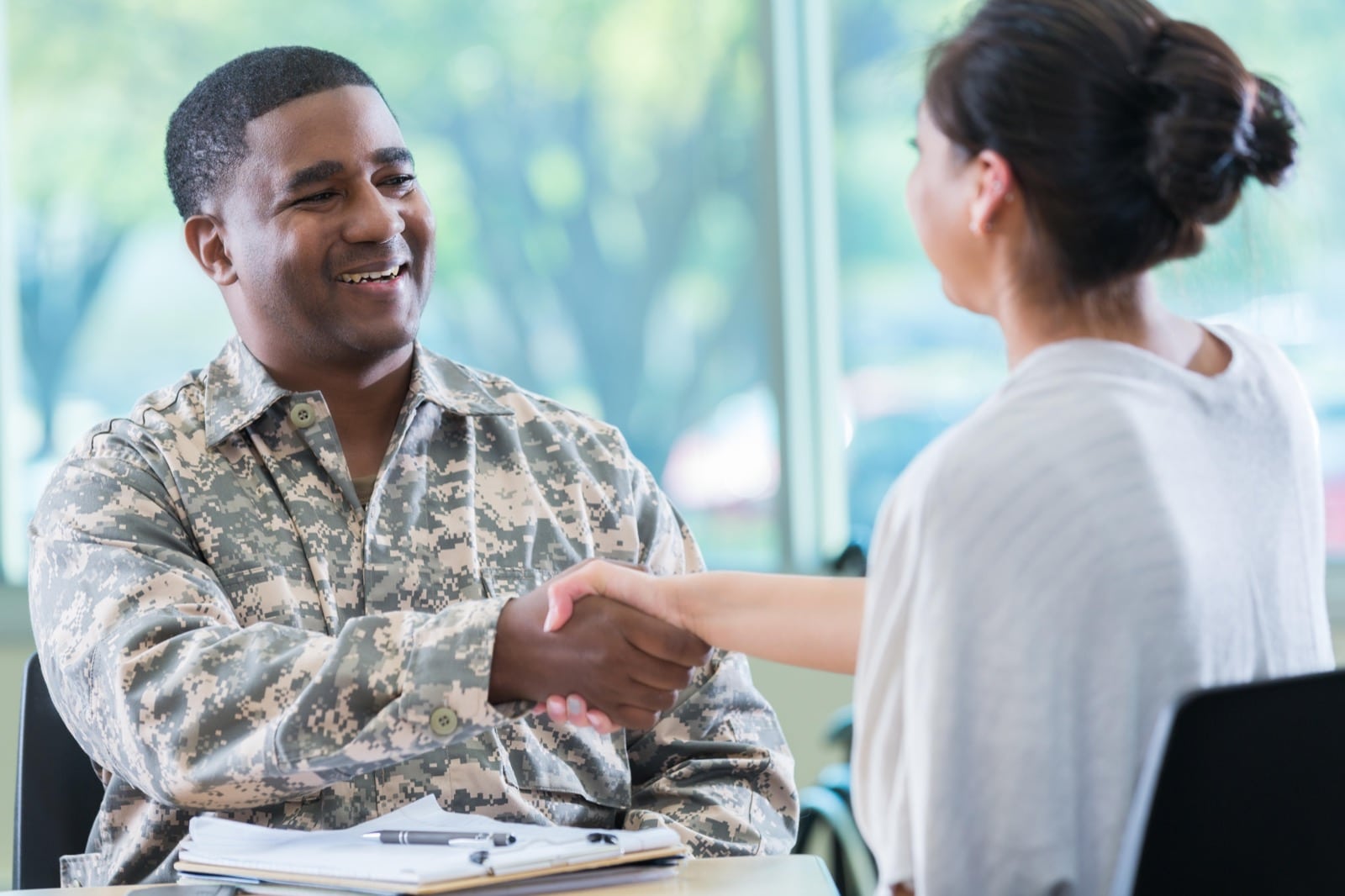
When service members depart from their time in the military, whether after four years or 30, Transition Assistance Programs match them with counselors and instructors to help plan their lives after the military. Don Moore, of Eightfold.ai, talked to a TAP program manager this month in California. “The transition specialist said military skills translation tends to paint a very one-dimensional picture of people. You’re a truck driver in the Army? You could be a truck driver for a private company.”
Moore is a U.S. Air Force veteran, a former program manager of military hiring at L-3 Communications, Gulfstream Aerospace, and General Dynamics, who says he’s an “unabashed champion for career-seeking veterans and spouses, and an evangelist to employers on what they are ‘missing.’” He’s working at Eightfold.ai on a better way, a way to overcome this “you’re a truck driver!” mentality.
Moore says, for example, that artificial intelligence could be used to look at the experience of someone who has been involved in fuels, during their time in the Air Force. While a directly correlating job may or may not exist in the civilian world, Moore says, Eightfold’s artificial intelligence can see how the person’s skills could be used, for example, working for a municipal hazmat team, or on cryogenic or other systems.
“It’s a basic example,” Moore says, “but it touches on just a part of what AI can do for veterans.”
Jeff Battinus is a talent-acquisition leader, working for a series of major healthcare companies. He’s also a division commander of the Interpreter Corps of the U.S. Coast Guard auxiliary. Through the years, he has found that efforts to translate military experience into corporate opportunities “are not robust enough.”
At Takeda, a multinational biopharmaceutical company, Battinus tells me he was looking to hire “metrologists,” which involves highly advanced calibration of instruments. Even though he was aware such a job existed in the U.S. Navy and Air Force, tools he used to find them were “completely worthless,” Battinus says.
A similar thing happened once, when Battinus was searching for a certain type of water technician. He knew these folks existed, that people were out there who’d worked on aircraft carriers and submarines in similar roles. But his sourcing efforts came up empty, so he ultimately had to just buy lists of people who had the right licenses.
And these are relatively basic matches that aren’t being made, matches between a job in the private sector and people in the military service who’ve done that job. AI could do much more advanced matching. Battinus gives the example of an infantry sergeant. “They’re constantly having to influence morale in their platoon,” he says. “Constantly selling all day long. A sergeant would make a great sales rep. They’d make amazing sales reps.”
Along those lines, Tannen Ellis-Graham, a Utah talent-acquisition director, said that she was looking for someone to hire at an aquarium. “We service fish and kids,” she tells me. “I was looking for an operations person who could do inventory. The inventory was actually the fish. Someone who could coordinate that. One of the first resumes I read was from someone from the military, who oversaw guns and bullets. Fish and kids, guns and bullets — they don’t match whatsoever. I felt bad, so I called him, and said ‘you can’t have bullets on your resume when you’re coming to a fish place.’ But once I dug deep, I realized he accounted for every single bullet. I said, ‘great, I’ve got to account for every single cricket! He didn’t describe his experience quite right, but AI would have helped him out.”
It can also account for soft skills, says Don Moore. “People have this stereotype of service members as robots following orders,” Moore says. “But AI can look at a military member’s experience and see what soft skills they have, like integrating into a team really effectively, or being diligent, conscientious, multi-tasking, or being strong at managing major projects very early in a career. A good recruiter can surface some of that, but the AI can surface so much more about that candidate.”
“Also,” Moore says, “AI can rack and stack and see what someone’s most qualified for.”
In other words, on a career site, AI could list jobs a sailor is a strong match for, or not a strong match for. It can even be used on a career site to show candidates who at a given company they could talk to about a job, or who can mentor them.
“Basically the AI can uncover paths for people they wouldn’t have even considered,” Moore says.
It can also surface “adjacent skills.” So, perhaps an Air Force pilot knows technology A but not technology B; the AI can show an employer that the software (technology B) the pilot does not know is readily learnable by someone who knows technology A.
Or, similarly, say the employer is searching for someone who is comfortable in a “fast-paced environment.” The AI can spot a soldier who has that comfort level, based on their experience, even if their resume doesn’t explicitly say anything about being fast-paced.
Phil Dana is the head of human resources at Dendreon, a biotechnology company. Dana’s a Naval Academy grad, and a long-time supporter of veterans. He gives the example of the human-resources field as just one profession ripe for entry by veterans. “I have always strongly championed more veterans to go into HR,” Dana tells me, “which is a field that would capitalize on their experiences with leadership and talent. But a civilian version of HR doesn’t translate. If you look at most of the senior HR leaders who are veterans, hardly any of them were ‘HR’ in the military.” Dana says he’d love to see AI uncover “transitioning members’ true strengths and pair them with career paths and opportunities that they would not have thought about.”
Waarum says that to date, “the best tool, I’ve found, is the trained eye of a military recruiter. Oftentimes, former veterans are able to more easily translate relevant skills in a way the business is able to consume.”
Moore says that what he wants to do at Eightfold is basically take Waarum’s point about trained eyes, and scale it. At large organizations, whether a big corporation or a government agency, the AI — having scoured so many thousands upon thousands of profiles of the careers and skills of military members and veterans — would automatically take the experience and skills of a service member (past or present) and know how those skills could be put to (new) work.
As mentioned at the outset, skills translators have tried to do this, but haven’t provided a full answer. Part of the problem, Moore says, and one he’s in the process of solving with Eightfold’s technology, is that people currently in the military “may not have the best resumes in the world. They come from a world where resumes are not needed until separation. It might not always be about the resume. It’s about the profile. It’s about the accomplishments. How to find meaning in that and show the incredible private- and public-sector value it has. We want to help the candidate showcase their skills and knowledge and everything else they’ve done, beyond the resume.”