

- Agentic AI goes beyond automation. It’s goal-driven, adaptive, and capable of acting without constant human input.
- Your HR teams can use agentic AI to streamline hiring, personalize employee development, and plan for future skills needs.
- The real value of agentic AI lies in its ability to think, adjust, and scale — unlike traditional AI tools that follow rigid scripts.
AI is evolving quickly, and so is its role in the workplace. One of the most significant shifts is the move from generative AI tools that require frequent prompts to agentic AI systems that can act more independently.
This leap is especially important in HR, where complexity, scale, and nuance are the norm.
But what is agentic AI exactly, and how can you separate real innovation from hype?
Let’s break it down.
What is agentic AI?
Agentic AI refers to AI systems that can make decisions, take initiative, and adapt to new information without constant human oversight or intervention to achieve specific goals.
Unlike traditional AI models that respond to direct queries or follow pre-scripted workflows, agentic AI acts more like a colleague than a tool. It doesn’t just execute tasks — it reasons through them, adjusts to changes, and works toward goals in dynamic environments.
A helpful way to understand agentic AI is to think of it as a collection of smaller specialized agents working in concert. These agents coordinate to monitor context, adapt to evolving input, reroute plans when needed, and even flag ethical issues or data inconsistencies.
For you in HR, this means AI that can do more than automate. It can strategize, course-correct, and improve outcomes over time.
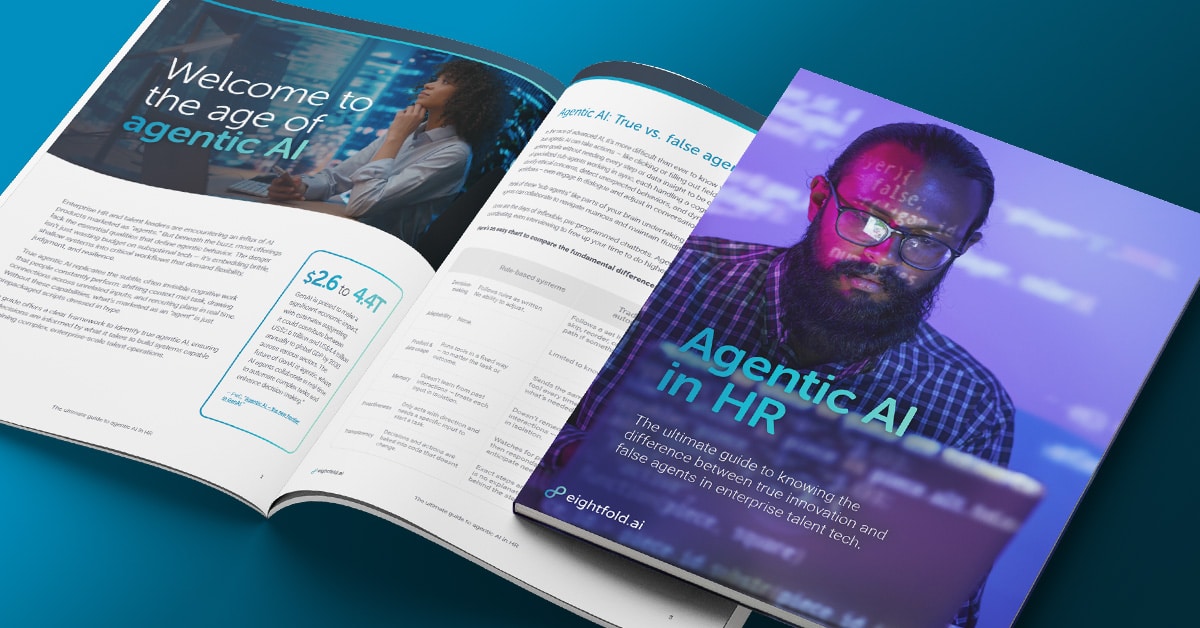
Related content: There’s a clear distinction between true agentic AI and false agents. Learn how to spot the difference in our Agentic AI in HR guide.
What isn’t agentic AI
With the rise in AI-driven HR products, many vendors have begun branding tools as “agentic” even when they’re not.
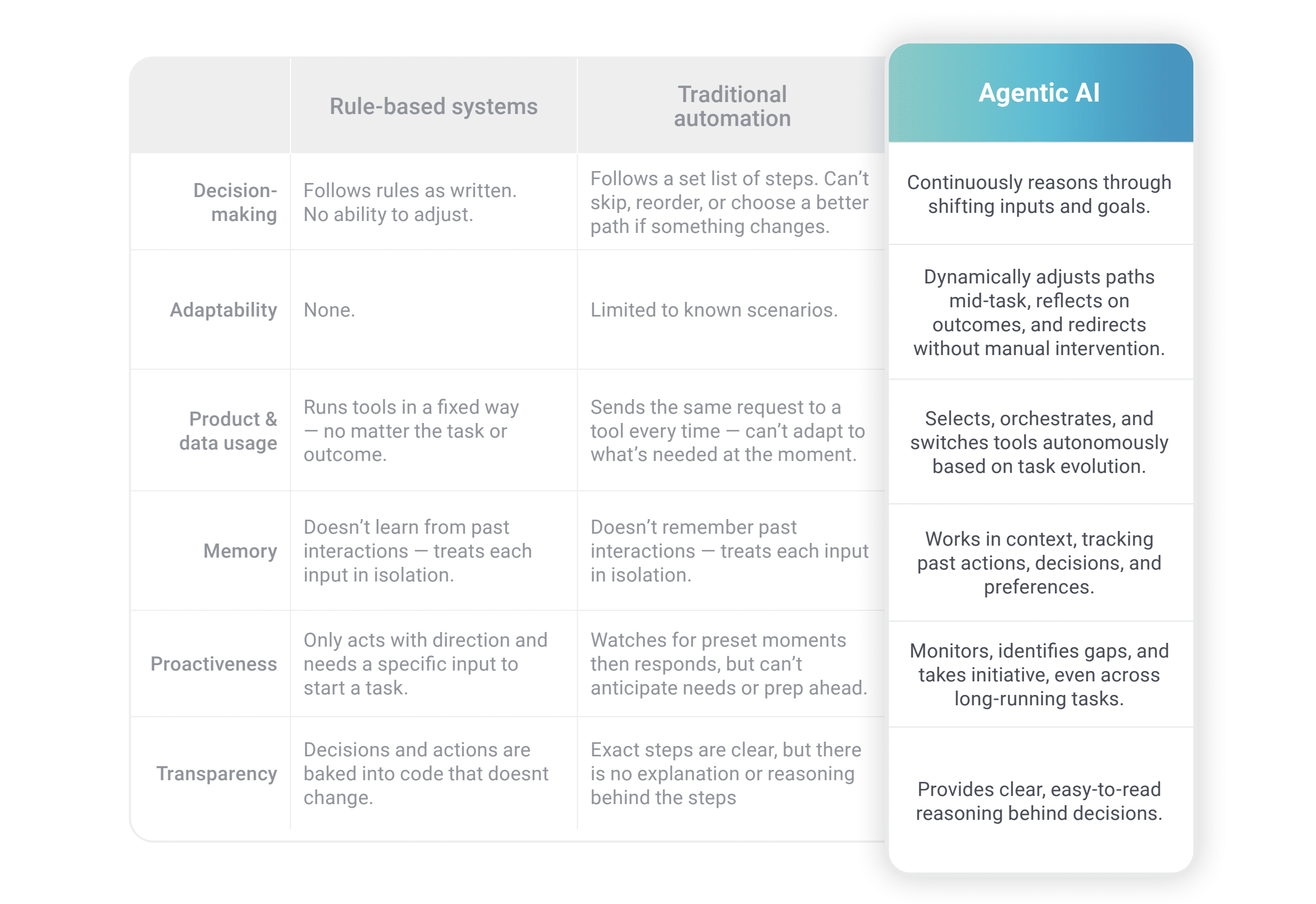
These so-called false agents can create the illusion of intelligence or autonomy, but under the hood, they’re often just sophisticated scripts for chatbots or rule-based workflows.
Here are some telltale signs you’re dealing with a false agent:
- No memory: The system treats every interaction as new, failing to remember preferences or past decisions.
- Brittle workflows: If a process breaks when an unexpected answer is given, the system lacks the flexibility of true agentic AI.
- Single-shot thinking: Tools that generate one-off outputs without iterative reasoning or refinement.
- No initiative: Systems that wait for direction rather than proactively monitoring for issues or taking next steps.
- No course correction: When something goes wrong, false agents don’t adjust. They stop or fail silently.
In contrast, real agentic AI systems reflect on outcomes, reroute when needed, and make transparent decisions. They behave more like adaptable teammates than static tools.
Understanding what signals a false agent could be the difference between getting it right or escalating costs and inefficiencies, mishandling sensitive data, and falling behind competitors.
Related content: Learn how agentic AI can fast-track hiring by automating multiple tasks simultaneously to kick off new role searches efficiently.
Practical uses of agentic AI in HR
Agentic AI is particularly well-suited for HR because the function deals with complex, often ambiguous, people-centered challenges.
Here are a few ways it can be used across your entire talent life cycle:
1. Talent acquisition
Agentic AI can streamline and improve hiring processes by:
- Sourcing candidates proactively based on evolving role definitions and workforce gaps.
- Engaging candidates autonomously, adapting messaging based on prior interactions.
- Conducting preliminary assessments and dynamically adjusting based on a candidate’s background or responses.
This frees recruiters to focus on strategic decisions rather than repetitive tasks like résumé screening or scheduling.
2. Internal mobility and workforce planning
Rather than relying on outdated job titles or static org charts, agentic AI can:
- Analyze employees’ evolving skills in real time.
- Suggest internal mobility opportunities based on growth patterns.
- Simulate workforce scenarios and recommend hiring or upskilling pathways.
This creates a more agile, skills-based organization.
3. Learning and development
Agentic AI can go beyond recommending courses. It can:
- Tailor learning journeys to individual career goals.
- Monitor progress and adjust recommendations as someone learns.
- Connect learning to emerging business needs and skills gaps.
It becomes a continuous development partner, not just a content distributor.
4. Employee experience and support
From onboarding to ongoing support, agentic AI can:
- Provide real-time, contextual answers to HR policy questions.
- Offer nudges to complete required actions (e.g., benefits enrollment).
- Adjust workflows based on feedback and behavior — not just triggers.
This leads to a more personalized and responsive employee experience.
Benefits of using agentic AI in HR
There are many payoffs for integrating agentic AI into HR operations.
1. Increased efficiency
You can move faster without compromising quality by offloading repetitive tasks and decision-heavy processes. Agentic AI handles the operational load, allowing your HR teams to focus on strategy and human connection.
2. More consistent, personalized experiences
Whether a candidate is applying for a job or an employee is looking for internal growth, agentic AI ensures timely, relevant, and personalized engagement at scale — something traditional tools struggle to deliver.
3. Better decisions, faster
Because agentic AI can reason through ambiguity and synthesize multiple data points, it supports better, real-time decision-making. Whether matching candidates to roles or identifying future skill gaps, its insights are based on evolving context, not rigid rules.
4. Scalability
As your organization grows, so does complexity. Agentic AI thrives in large, dynamic environments, and it can coordinate tasks, resolve exceptions, and spot patterns that your HR teams might miss.
5. Future-readiness
The future of work will demand agility. As roles change and new skills emerge, agentic systems will help you keep up with the pace. They don’t just automate critical actions — these will evolve with your business.
Why your HR team needs agentic AI now
Agentic AI marks a significant advancement in how technology can support all your work in HR. However, it’s crucial to cut through the hype surrounding it.
Not all AI agents are the same. You should look past eye-catching demonstrations and focus on systems that showcase adaptability, context-awareness, and genuine decision-making autonomy.
Begin with practical use cases and consider your long-term goals. When you consider what you need to accomplish, you agentic AI will help you streamline operations while enhancing the overall talent experience.
Learn more about how agentic AI fits into a skills-based workforce in our Agentic AI for HR guide.