
This blog post is excerpted from an in-depth feature on this topic which can be downloaded here at no charge.
“Where you go to school has a big impact on your career.”
It’s a decades-old saying that most of us have heard, and many talented individuals do attend top-tier universities. But in 2020, I nevertheless question why that statement still carries so much weight, especially when we account for the non-academic considerations that go into a student’s enrollment decision, the debate around accuracy of college entrance exams, and the focus on lifelong learning. I believe it is a recruiting capacity problem, dressed in the clothes of quality assessment.
Companies across the country recognize the importance of eliminating the bias from hiring, and have made great progress by changing their application and interview processes. However, we have not done enough to address the quality bias in university recruiting because, historically, companies needed to rely on universities to be the filter. That means the graduating class that we are recruiting today was filtered down based on a series of decisions four years ago.
But the budget constraints and necessary tradeoffs of the past do not need to bind us any longer. Talent-acquisition technologies such as Eightfold.ai’s Virtual Event Recruiting can address the capacity problem and enable companies to more effectively and efficiently engage quality talent wherever they are, including at universities that otherwise would not fit into the recruiting budget.
This broadened outreach will represent a positive change because there are many reasons why the “best and the brightest” may elect to attend lesser-known or lower-ranked universities.
The student’s choice
Every year, recruiters get ready to meet a new class of potential future employees. But the process that filtered down these young men and women started four years prior when these students had to decide where to apply and enroll. Non-academic considerations can ultimately be the deciding factors.
For example, location is an issue. Of the top 100 Universities, 41 percent are in the 11 Northern states. Students who would like to attend a top 20 school will likely have to stay in or relocate to the Northern region of the country. Of course, tuition is also an issue. Average annual tuition at universities ranked in the top 10 is $20,000 more than at universities ranked 51-60. That is an $80,000 difference over a 4-year enrollment period. Due to awareness about the pains associated with student debt, many high-potential students, like Erin Lowry, author of Broke Millennial, get accepted to higher-ranked universities but attend less-expensive schools because it is financially responsible for their situation.
The issue is that companies and universities have long enjoyed a mutually beneficial partnership. Schools act as a first-order filter and provide a talent pool for recruiting, and companies hire the graduates so that new classes of students will be inclined to enroll. Unfortunately, as we have seen, there are cracks in the system.
If high-potential future employees are either electing to go to lower-ranked schools or being weeded out by incongruous standardized tests, is there another way to evaluate and recruit candidates across universities?
Yes, and it starts with evaluating skills at scale.
Using Eightfold’s Talent Insights, we evaluated the prevalence of skills across recent graduates from the top 100 U.S. universities. We found that 70 percent of skills are nearly evenly distributed across the top and bottom 50 universities. They span functional, soft, and technical skills such as project management, social media, marketing, engineering, strategic planning, finance, and Java. Skills that have a larger standard deviation include functional skills such as research and data analysis, and technical skills such as MATLAB and Python, all of which are more prevalent for graduates of the Top 50 universities. Soft skills such as leadership, customer service, teamwork, and sales are more likely to be reported by graduates of the bottom 50 universities.
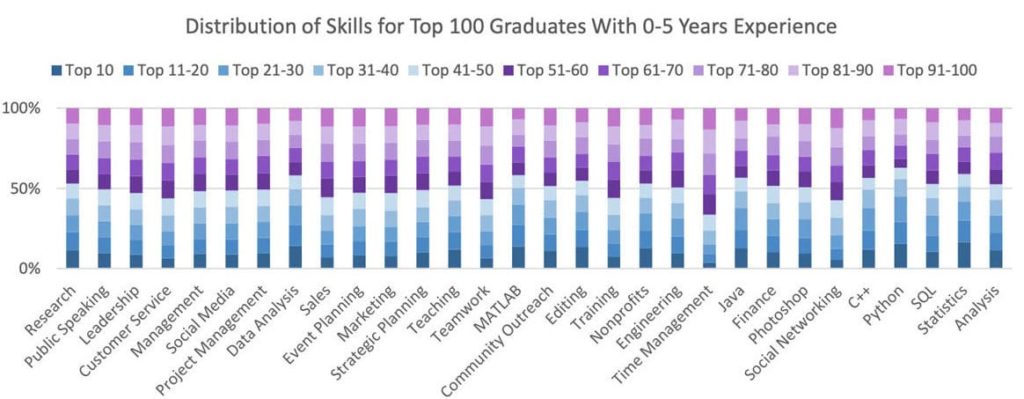
Therefore, graduates from all 100 universities have complementary skill sets that are important to have in a well-rounded workplace, and it could be mutually beneficial for companies to offer students more equal opportunity recruiting.
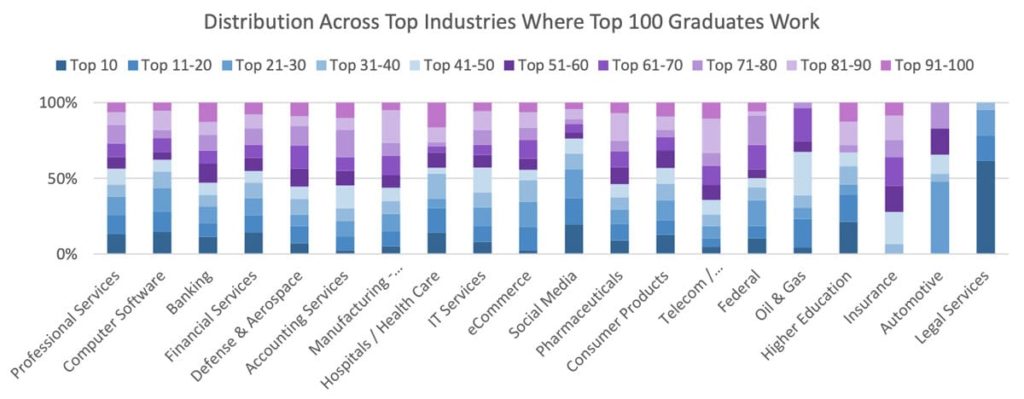
This could be especially relevant for the industries where we observed a disparity for graduates of the top and bottom 50 universities. Industries more common among graduates of the top 50 include Professional Services, Computer Software, Social Media, and (especially) Legal Services. Meanwhile, industries that skew toward graduates of the bottom 50 include Banking, Defense & Aerospace, Telecom, and (especially) Insurance.
Finding your talent
To a certain extent, it’s no surprise that talented individuals can be found in universities across the country. But there hasn’t been a feasible way for one company to visit at least 100 schools, and that’s why prioritizations had to be decided. The 2020 recruiting season, however, has seen change born out of necessity, as all recruiting went virtual due to Coronavirus restrictions. It’s possible that by the end of this season we will look back and realize this new behavior shouldn’t go back to “normal.”
Eightfold expedited the launch of its Virtual Event Recruiting product to align with recruiters needs today, but the solution was originally developed with a long-term goal to ameliorate the challenges of in-person recruiting.
Eightfold.ai’s Virtual Event Recruiting enables companies to:
- Recruit everywhere
- As this article demonstrated, there are a range of academic and non-academic reasons why top talent may be enrolled at universities where the company does not have the bandwidth or resources to visit. Virtual Event Recruiting is structured as a flat platform fee with no limit on the number of events.
- Personalize interactions at scale with quality applicants
- Once students register, recruiters can engage with them before, during, and after the event by sending customized messages to different types of applicants. Students can also be invited into smaller virtual events to get to know the company better and have more effective conversations.
- Put your best foot forward
- Distribute company assets to kick off the virtual event with an inspiring message from your CEO or short vignettes from employees. Invite notable people from the firm to participate in real time.
- Never scroll through resume books again.
- Students will be prompted to upload their resume before the event and Eightfold’s Talent Intelligence Platform identifies high-quality matches for open positions, enabling more purposeful and elevated conversation among recruiters and students.
- Stay in touch with your candidates
- Recruiters meet tons of great candidates, but what happens next matters most. Invite students who are high-quality matches to apply for open positions in real-time and add the remaining quality candidates to your talent pool for future hiring opportunities.
Let’s do away with the saying “where you go to school has a big impact on your career” and replace it with “your skills and potential have a big impact on your career.”
This blog post is excerpted from an in-depth feature on this topic which can be downloaded here at no charge.
Contact us, for more information or request a demo of Virtual Event Recruiting.