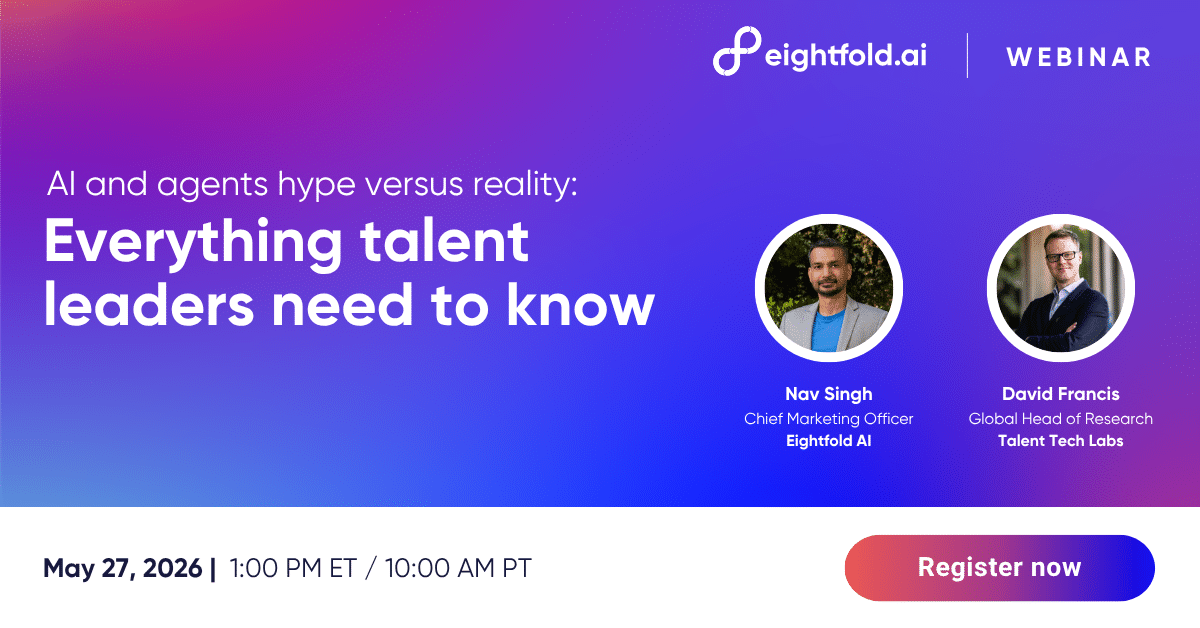


AI has moved from the CHRO’s watchlist to the CHRO’s job description. Boards want an AI workforce strategy. Employees want honesty about what changes. Candidates are already using AI, whether your hiring process is ready or not. And every talent leader is being asked the same question: what’s your plan?
Join Meghna Punhani, Chief People Officer of Eightfold AI, and Bonnie Dowler, Chief People Officer of The Groove, for a candid leader-to-leader conversation about navigating this moment. This isn’t a session led by technology evangelists; it’s a conversation between operators accountable for real workforces.
They’ll compare notes on where AI is genuinely changing talent acquisition and talent management, where the hype outruns the reality, and how they’re balancing speed of adoption with employee trust, fairness, and candidate experience. Expect an honest discussion of what they’ve gotten right, what they’d do differently, and the decisions every people leader will face in the next 12 months.
You’ll leave with a clearer view of how CHROs are separating durable change from noise, practical guardrails for bringing AI into hiring without eroding trust, and the questions to pressure-test your own talent strategy against.
The discussion examined how HR leaders can adopt AI responsibly while improving productivity, hiring, talent management, and employee trust.
Laura Connelly 0:09
So my name is Laura Connelly. I will be your moderator today, and we are very fortunate to have two seasoned leaders with us to host this discussion. We have Bonnie Dowler, who’s the Chief People Officer at the Groove, and Meghna Punhani, who is the Chief People Officer at Eightfold AI. Today’s conversation is meant to be conversational and practical. So before we dive in, we’d love to get a quick sense, Meghna and Bonnie, of the workforce that you’re responsible for—the size, the scope, the complexity—so we can ground the conversation in the realities you’re navigating. Meghna, I’ll start with you.
Meghna Punhani 0:45
Thank you, Laura. Thank you so much for having us on this podcast today. Very excited to be here. As an introduction, as Laura said, I am the Chief People Officer at Eightfold AI, and I would say my experience and perspective have actually been shaped a lot after spending almost two decades at Google—joining them at very early stages when they were a small company to them becoming a large company, and leading strategy, operations, and HR tech for them—and then moving on to a mid-sized company, Palo Alto Networks, and now in startups. I don’t consider myself a very traditional CHRO, so I learn from all of these conversations. But the unique thing about Eightfold that I want to mention is: first of all, I lead people teams, workforce, IT, and workplaces, so it’s a gamut of stuff. But it’s a very unique position as compared to other companies because, given that we are an AI-native HR technology company, I get to be in the seat of the customers and talk a lot to our customers. We drink our own champagne, and I’m customer zero internally, so we implement a lot of the products that we build externally for our customers as well. So I’m very honored to be sharing the perspective that we gain internally by implementing these AI products and how they are shaping HR for the future.
Laura Connelly 2:24
Bonnie, over to you.
Bonnie Dowler 2:33
Thank you. I am the Chief People Officer at the Groove. The Groove helps organizations get more out of their people and their technology, which today means using AI. I come from the company Collaborative Solutions, where most of the leaders at the Groove came from as well. I helped build the company from 17 people to over 2,600 people globally, and we decided we loved working together so much, and we had so much more we wanted to accomplish, that we founded the Groove. We are very excited to be an Eightfold partner, which means that we’re working with clients who are putting AI into action, which makes this topic today especially relevant for us. Very excited to be here with all of you today, and looking forward to a great discussion.
Laura Connelly 3:22
Perfect. So I think, like I said, the focus for today is to separate fact from fiction, signal from noise, and really make it practical. What are Meghna and Bonnie doing in their organizations? What’s worked? What hasn’t worked? But before we dive in, we want to do a quick audience activity to get a read of the room. AI can spark very different reactions depending on where you sit and what you’ve experienced. So the prompt for the group will create a word cloud for us. The question is: When you hear the words “artificial intelligence,” what is the first word that comes to mind? Don’t overthink it. Drop your first reaction into the word cloud. I have to say, I love word clouds. Efficiency, robot, partner.
Meghna Punhani 4:24
“Robot” is quite popular.
Laura Connelly 4:32
Time saver, unknown, errors. You know, it’s interesting, Meghna, Bonnie. I feel like there are—and we’ll touch on this as we go—two camps. There’s the scared, fraud, disruption, robot camp, in stark contrast to partner, intelligence, efficiency. So definitely two camps.
Bonnie Dowler 4:57
Lots of contrast.
Laura Connelly 4:58
Yeah. Okay, this is good. I think this is helpful to ground our conversation on where people are coming from as we go through this. So, where we’ll go next is touching on why this conversation and why now. What I’ll start with is a question on: What is the question you’re getting asked most from your teams right now, whether it’s by your board, your employees, or your own team? Meghna, let’s start with you. Oh, you’re on mute.
Meghna Punhani 5:41
That’s a bit of a theme today. All right, so first of all, I think it was fascinating to see the word cloud because obviously there are lots and lots of thoughts and sentiments out there: confusion, excitement. But at the same time, when you have conversations with various board members, employee groups, or leadership as we sit around the table, there are a few themes I see emerging. Most of them are around: How are we making our people more productive? How much are we enabling our workforce to be AI-enabled? Most importantly, I think it has now emerged to: Are people worried or scared? That was definitely a question we had in the past, but right now, of all the investments people are making, what value are we really getting out of all these AI tool deployments? Because we all know there are thousands and thousands of them out there. So these are some of the themes I see emerging across various groups. I do think people worry, but people have started to see value out of it as well, so I’m excited to dive into a lot of these conversations as we go forward. But yeah, Bonnie, I would love to hear the same from you as well. What are you hearing from the people you’re interacting with?
Bonnie Dowler 7:14
Yeah, definitely. I mean, I think the general theme is really: What is our AI strategy? Which is kind of a vague concept, right, because it evolves so quickly and you are always feeling behind. I think more importantly: What does this mean for our people? At the leadership level, it’s questions around productivity, efficiency, and whether we are being competitive. But from employees, candidates, and my own HR team, it’s much more personal: How is this going to change my job? Is this going to replace me or my work? In a lot of cases, it’s work that you enjoy doing—perhaps it could be automated through AI, but you want to hold on to it for whatever reason. And then the decision-making piece: Where is AI being embedded into decisions, and how is that going to affect me? I think that word cloud resonated quite a bit in that there is so much fear out there about AI, and on the other end, as HR leaders, we ask: Are we behind already? Yet we feel like we’re at the beginning. So there’s a lot there.
Laura Connelly 8:33
To that comment on “are you behind already?”: How is speed playing a role in the pressures you’re getting to deploy AI, again from either your board, executive team, employees, or candidates?
Bonnie Dowler 8:50
I can start. I think there is a lot of pressure from the strategy and business side to say: What are we doing? Let’s get there, let’s be competitive, and let’s have things we can speak to our customers about; let me have tools and different things. So that’s one aspect of it. But then I think the employees want to be able to trust it, so they want clear responses and a clear strategy that is understandable and meaningful to them. They want to understand not just how their job is changing, but how the company will change with AI at the focus. And then again, are people going to be treated fairly, who is overseeing it, and what processes do we have in place for that?
Meghna Punhani 9:50
Yeah, I mean, I would say something similar as well. When we look at the data, it does feel like—at least in tech workers, based on some surveys I’ve paid attention to and conversations I’ve been having—there’s a lot of anxiety, for sure, because the expectation is that you will move faster and there will be a lot of productivity. I see that the conversation is shifting a little bit: there’s obviously fear and anxiety, but at the same time, the fear is less about “Am I going to lose my job?” because tech workers have a little bit more understanding of what AI can or cannot do, or at least they’re developing their understanding. In the technology landscape, I’m noticing that folks are more worried about: “Am I personally providing the output that’s expected of me?” Earlier, I could take the time to deliver things, but now the response from everyone is: “Well, there are so many AI tools available, so why are we not able to use those to come out with a solution as quickly as possible?” Obviously, sometimes the quality suffers; sometimes, if you know how to use it very well, you can really produce good results. But in most of the conversations in my team, speed is obviously a requirement, but people wonder: “Am I really delivering the quality of output expected with all the AI tools available to me?” because expectations across teams are shifting drastically.
Laura Connelly 11:37
Yeah, it’s interesting. Like you mentioned, Meghna, the shift from “Will AI replace my job?” to “Am I delivering the value that I can with all the tools available to me?” Bonnie, do you feel like the conversation internally or externally has shifted as well in any way?
Bonnie Dowler 11:55
I think it’s definitely shifted. Putting the HR leader or recruiter lens on it—and I spend so much of my time talking with that talent pool—it’s really moved from exploratory, sitting on the sidelines, watching and saying, “Do I need to pay attention? Can I kick the can down the road a bit more? What are you doing over here?” to really taking the reins and saying, “No, it’s important that HR is a big piece of AI strategy and AI tools.” I think that is a piece very often forgotten as people work on developing or figuring out how fast to move. You really need to insert yourself with your IT organization or your CTO to partner so that you can have that voice of the employee, and then speak to your employees and say, “Actually, this is safe. This is how we put guardrails in place. There are humans behind all of this inserting themselves into each piece of this process, and we want to bring you along with us,” as opposed to forcing it on the employee workforce.
Laura Connelly 13:19
Definitely, and I think that’s probably a good segue into our next audience poll. Speaking of pressures coming from internally and externally, the question for the audience is: Where is the greatest pressure coming from regarding your AI workforce strategy? Is it business growth, productivity, and competitiveness? Is it your workforce itself? Is it the external market, or is it the enterprise? Select one of these four, and I’m very curious to see where our results will come out.
Meghna Punhani 14:06
Not surprising that growth, productivity, and competitiveness is the highest, because I think that’s what Bonnie and I have also been talking about—that’s where most of the conversation lies today.
Laura Connelly 14:23
Yeah, it’s even higher than I expected.
Meghna Punhani 14:25
Yeah, agree.
Laura Connelly 14:30
Interesting. Well, it makes sense, and I think it highlights that the audience is experiencing a lot of similarities across different organizations. All right, so that is a helpful segue into our next segment, which is going to be bringing this to life for the audience, starting with talent acquisition. Practical question: What is one thing that you’re actually doing differently in your organizations in hiring today versus 18 months ago? Meghna, maybe we can start with you.
Meghna Punhani 15:12
Yeah. Personally, I’m paying a lot more attention to what kind of skills we are looking for in people, so I’ll talk about two things. One is the skills that are important for the future, but we also have the advantage of being customer zero, applying a lot of our products internally too. We have the Eightfold AI Interviewer as a product that I love to talk about in terms of how we are implementing that internally and the benefits we are gaining. First, let me talk about skills. It’s really important to pay attention to who you are hiring, and skills play a large role because AI is revolutionizing every single industry out there, and with it, the kind of skills that people need to bring to the table to be successful. What areas are really important? I look at whether people have the curiosity to be in with the times, jump in, try different things, feel comfortable, learn and pick up things quickly, and take risks, because those are the people who will be really successful in the future—not just technologists, because now we have those tools in our hands. If I apply that closely to how I operate within the team, we’ve seen that happen drastically by AI-ifying the recruiting process for our team and using the Eightfold AI Interviewer not just as a pre-screening filter, but also through first-round interviews, whether for campus recruiting, high-volume hiring, or deep functional interviews. For example, we’re an AI company, and we fight for AI talent like any other tech AI company. This talent is really hard to find. We hire a lot of early-career people, and a couple of years ago, to hire these early-career AI-savvy folks, we would go to various universities. But how many can you humanly possibly go to across the world? We could scale to 3, 4, or 5 maximum. With the help of technology now, instead of going to 5 to 7 universities, we are able to go to 150+ universities across the globe, so the funnel for us to bring these people into the organization has gone really broad. The number of applicants has gone up: earlier, for 5 universities, you would only talk to 1,000 to 1,500 people, but all of a sudden, that has gone up to 15,000+ people for us. That’s an example of how you can now have access to a lot more people than in the past.
Meghna Punhani 18:50
What I also noticed was that the quality of the hire did not decrease, but the reach to pick the right set of people definitely went up. Internally, I want to save time for our hiring managers because they are highly paid engineers, so they don’t have to travel to these places or spend time on first-round screening, but only get involved when we know we’ve found the right folks for them to talk to. There was process change and tech implementation internally, but using technology to increase momentum, drive candidate and employee experience, and broaden our funnel has had a big impact internally and with many customers we talk to.
Bonnie Dowler 19:59
I have a different perspective—similar, but different—because having been at a medium-sized company before and then building a company from the ground up, we had the ability to start using AI tools from the beginning versus shifting. Looking at talent acquisition specifically, at my last company, by this point in time, we would have already had several recruiters, an interview scheduler, or a sourcer to try and bring resumes in. As Meghna said, AI tools now enable us to look at talent pools globally, get positions in front of candidates, and put screening tools in place—not to screen people out, but to focus on desired skill sets. Then we have giant passive candidate pools we can go to as new roles are created. When we open a role at my company, people ask, “Have we filled that role yet? It’s been four days.” The tools really help us move much more quickly. On the other side, regarding candidate experience and the fear around a robot controlling hiring or resume screening, there are humans involved in this process. It is not controlled by a robot, but it gives candidates better access to information about our companies—for instance, creating an AI video to push to candidates so they have an idea of who we are before they speak to a recruiter or hiring manager. The flow of information has increased, helping people make better choices about where they want to work, as opposed to starting a job and realizing it wasn’t what they expected after only talking to two people. The tools are exciting and help with speed, educating us on curiosity and skill sets, and educating candidates so they can make informed decisions.
Meghna Punhani 22:50
I love that. If I may add—seeing a few questions pop up—the human in the loop always needs to stay. While AI can speed up areas where the funnel expands, process changes are necessary to ensure recruiters, who have so much judgment, are inserted at the right time to drive the right results. It shouldn’t be solely dependent on AI, because fairness, transparency, and bias are areas humans handle better, as AI works off the data fed into it. It’s a combination of redesigning processes and work to identify where AI adds the most value and where humans add the most value.
Laura Connelly 24:24
Yeah, that’s a good callout. A lot of talk around expectations versus reality—like Bonnie mentioned, the req has been open for 20 minutes, why isn’t it filled?
Laura Connelly 24:36
Double-clicking on that, there’s a lot of hype around AI, and you all are operators leading the charge every day. Where do you think the hype around AI has gotten ahead of reality when it comes to HR and the workforce? Bonnie or Meghna, we can start with you.
Meghna Punhani 24:58
I wanted to call out the point I was making earlier: the conversation is shifting. Yes, there are thousands of AI tools at my disposal, and people are open to experimentation to test what works. But “How do you actually derive value from AI?” is becoming top-of-mind for everyone, because multiple tools cause fragmentation across a company. The hype focuses on having access to AI, but can we actually get value out of it? Taking a step back and redesigning processes helps. An exercise I’ve been going through with my team across recruiting and HR areas is thinking about: Which part of this process is better done by AI, and which part is better done by humans? Where can you bring in human judgment, asking the right questions, connecting dots across areas, bringing past experience, and building relationships with candidates or employees? AI will never be able to build those relationships. Taking a structured approach to redesign a process and inserting AI tools in the right places is where real value emerges, rather than implementing thousands of tools and hoping value follows.
Bonnie Dowler 27:05
I agree 100% with everything Meghna said. We’re all learning, and those who have started their AI journey have learned that the information is only as good as the data put into it. Starting at a foundational level, examining processes and foundational data is essential. Leadership and boards often look for bells and whistles seen in the media, but you must start with basic, strong processes, validate them, and locate where human connection needs to be so outcomes are strong. If a tool claims to do everything without human interaction, that’s hype. Tools that speed up a strong process with good data are where game-changing results happen.
Laura Connelly 28:34
There are some really good questions. Both Bonnie and Meghna talked about bias and ensuring humans are in the loop, though humans can also be biased. A question for Meghna: There’s fear around people optimizing keywords to get past AI resume screens. Could you comment on that, especially in the context of Eightfold AI Interviewer and how you deal with that?
Meghna Punhani 29:08
Oh yeah, absolutely. We take this really seriously. I wouldn’t want to implement anything where we don’t feel we can tackle that head-on. Responsible AI principles must remain at the forefront, building fairness into the system. AI reacts to the data fed into it, so controls within the system must monitor, test keywords, and spit out results to ensure biases don’t creep in. All Eightfold products use responsible AI and maintain certifications ahead of requirements. Another critical element is transparency. Humans struggle when they don’t know how decisions are made behind the scenes or what data is stored. The more open companies are about how systems are used, what data is gathered, where humans are in the loop, and how decisions were reached, the more trust is built. Products need that, but process redesign with proper checks and controls is equally important.
Laura Connelly 31:48
Well said. Many tools specifically do keyword matching, but the Eightfold AI Interviewer goes well beyond that to career trajectories and similar roles, avoiding simple keyword matching and mitigating bias. Now let’s shift to talent management. Where are you seeing AI make a meaningful difference across the employee lifecycle today? Bonnie, let me start with you.
Bonnie Dowler 32:32
Talent acquisition gets attention because it’s visible and high volume, but talent management is where cool things happen with AI. It changes how you understand your workforce across skills and increases internal mobility, because desired skills often exist internally without visibility. With talent management tools, you can look across your workforce to promote or shift people into different roles based on skill sets, upskill, and identify skill gaps to address with training. Resource management has been a game-changer for deploying talent across clients, aiding forecasting, compensation strategies, and succession planning. HR data was previously siloed in records or files without giving a clear picture of capability. AI unleashes that data to reveal what skills we have, what we’re missing, who we can develop or redeploy, putting focus back on internal employees instead of looking outside.
Meghna Punhani 34:51
Our mission at Eightfold is building the right career for everyone in the world, which is especially applicable with AI. The world must shift toward skills-based career focus rather than static proxies like title, job history, or resume. We look at what jobs someone has done, what they learned on the job, what skills they bring, and their potential. Instead of asking “Who has done this job?”, we ask “What underlying capabilities and potential does this human bring?” That’s visible in internal mobility. For example, an immigration specialist at Eightfold moved to marketing to become a social media manager because they were passionate and skilled at connecting with people. Our tool detected those transferable skills. A recruiter on my team also moved into business growth. I experienced this myself—I never thought I’d build a career in HR coming from technology and strategy, but my skill in connecting with people led to people strategy. Skills and potential are key areas where AI heavily impacts talent management.
Laura Connelly 38:04
Fascinating examples. Bonnie, what do you see as the difference between organizations making real progress with AI versus those struggling to gain traction?
Bonnie Dowler 38:28
Two main things. First, taking time to evaluate data and processes. Don’t be afraid to start from scratch if current processes aren’t working; AI will only accelerate broken processes. Take time to think it through rather than rushing forward due to leadership pressure for flashy features. Second, investing heavily in change management. Change management addresses the fear and uncertainty shown in the word cloud. Third, having HR be an active voice partnering with IT on tool usage, transparency, and human involvement. Slow down at the start to evaluate, and speed will follow.
Meghna Punhani 40:41
I agree 100% with Bonnie. It’s time for HR to claim its seat at the table, placing people at the center of this revolution while partnering with CTOs and CIOs. Additionally, the manager relationship is more important than ever. Day-to-day employee sentiment depends heavily on their relationship with their manager. We must invest in manager development so leaders can support teams navigating productivity expectations alongside fear of job loss. Someone asked how to manage a team of agents and humans together; basic management principles don’t change whether working with agents or humans—focusing on goals, outcomes, guardrails, and clear roles. Elevating leadership and manager roles is vital.
Laura Connelly 43:16
Regarding AI adoption: What was one decision you made in your organization that you would do again today, and what is one decision you would do differently?
Bonnie Dowler 43:52
Building a company from the ground up during the AI era gave us a clean slate for data and processes. We took a use-case-driven approach: starting with the work, identifying pain points where AI could help, and establishing guardrails. Early on, we set up an AI committee of curious and passionate employees to evaluate use cases and identify where human interaction was better suited. Avoiding a top-down mandate and bringing employees along on the journey was a decision I would 100% repeat. It’s an ongoing, daily refining of process and data that ensures we land in the right spot.
Meghna Punhani 45:53
You have to start before you feel completely ready. We didn’t wait for every open question to be answered regarding job impact or candidate experience; we led with curiosity, got our hands dirty, and tested tools directly. You realize the power of these tools once you use them. Ensure parallel processes protect candidates and customers, letting human judgment guide safety, but jump in. The AI you use today is the worst you will ever use because technology improves daily. Try it, iterate, and fix issues as technology evolves.
Laura Connelly 48:28
Our next polling question: What is your organization’s current approach to AI adoption? Retrofitting AI into existing processes, actively redesigning work and roles, still in early phases, or sitting back and waiting? (I fed these questions into AI prior to the webinar, and its predictions were wrong, highlighting that human experience differs from AI predictions.) Any takeaways, Meghna and Bonnie?
Meghna Punhani 49:42
It’s a big shift. AI-native or smaller companies have an advantage starting from scratch, while others are researching and planning. There’s never a perfect time or tool, so jump in responsibly, learn, and iterate.
Bonnie Dowler 50:54
The poll results should bring comfort because most organizations are still figuring it out. No one is truly behind; everyone is learning together because technology evolves daily. It’s a great time to embrace learning and share experiences.
Laura Connelly 52:15
Leading from the top is key. To close out, what is one key takeaway you’d like to leave with the audience?
Meghna Punhani 53:06
Clear ownership is essential. AI transformation stalls when ownership of business outcomes and process redesign isn’t clearly defined. Articulate who owns each process and empower them to redesign the work to expedite your AI journey.
Bonnie Dowler 54:29
AI will not replace people, but it will change how work gets done. HR has an opportunity to shape that experience. Bring employees into the conversation and keep human accountability where consequences matter most. Use AI to make HR faster, better, fairer, and more trusted.
Laura Connelly 55:19
Regarding bias, mistakes, and cultural fit: How do you address those concerns in your organizations?
Meghna Punhani 55:57
Establish checkpoints early in the process. Filter results through human oversight, rely on skills matching over keywords, and utilize responsible AI with built-in fairness checks and transparency.
Bonnie Dowler 58:10
Evaluate consequence and context. High-consequence decisions—hiring, compensation, promotion, employee relations—require human oversight to understand recommendations and hold ultimate accountability.
Laura Connelly 59:05
Thank you both for joining and sharing your insights. Passing it back to HCI.
HCI Moderator 59:25
Thank you to Bonnie, Meghna, and Laura, our sponsor Eightfold, and our viewers. Today’s webcast is approved for HRCI, SHRM, and HCI recertification credits. Check HCI.org for more information. Have a great afternoon!
By submitting this form, I consent to Eightfold processing my personal data in accordance with its Privacy Notice and agree to receive marketing emails from Eightfold about its products and events. I acknowledge that I can unsubscribe or update my preferences at any time.