
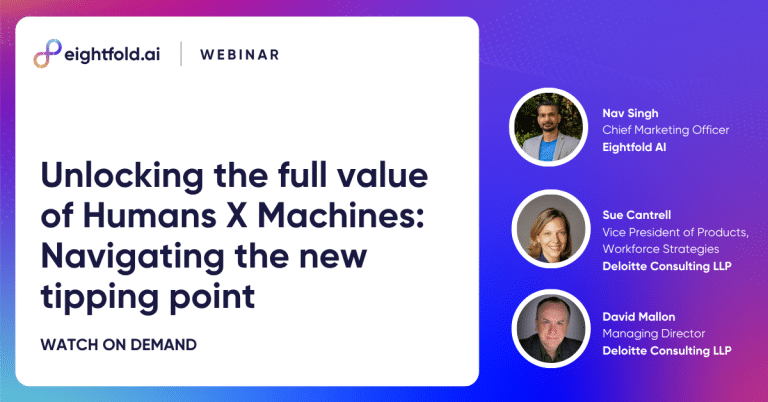

The 2026 Deloitte Global Human Capital Trends report identifies a critical tipping point: to remain competitive, organizations must move beyond simple automation toward a more intentional approach to realizing the multiplicative value of humans and machines working in concert. While 66% of leaders recognize that designing effective interactions between humans and machines is vital for success, only 6% are making significant progress in doing so. This “intentionality gap” is compounded by a rising “Fact or Fabrication” crisis—where 95% of executives now worry about the accuracy of candidate skills data as AI-generated profiles and “hiring slop” erode digital trust.
In this webinar, Deloitte and Eightfold will explore how to unlock the value of humans X machines by moving beyond technology implementation toward intentional work design. We will dive into how organizations can reclaim the human advantage by redefining decision-making authority and building a foundation of verified, data-driven insights. Join us to learn how to protect human agency while using AI as a force multiplier for organizational performance.
The webinar, led by Sue Cantrell, David Mallon, and Nav Singh, discussed Deloitte’s 2026 Global Human Capital Trends report, focusing on three trends: human-AI interaction, AI-driven misinformation, and AI’s role in decision-making. Key findings include 9000 survey respondents, 50 global experts, and 64% of organizations recognizing the importance of human-AI interaction. AI is used in 60% of business decisions, but only 50% regularly evaluate AI inputs. The discussion highlighted the need for intentional design, strong data governance, and human agency in AI decision-making to ensure trust and effectiveness.
Sue Cantrell 0:09
I will kick us off. I am Sue Cantrell. We’re thrilled to have you here today and to be joined by my dear friend and colleague, David Mallon, and Nav from Eightfold. And we are here to talk to you about a report that Deloitte does every year. We’re actually the longest-running longitudinal study of human capital issues, and this year’s report—it’s a Human Capital Trends report—is really called “From Tensions to Tipping Points: Choosing the Human Advantage.” And we’re going to be exploring three of our seven trends this year in this webinar, really around unlocking the full value of humans times machines. And before I go forward, let me just tell you a word about why we talk about navigating this new tipping point. We always like to build a story over time in our Deloitte Human Capital Trends report, and last year, we talked about tensions reshaping the worker and organization relationships. Tensions like, do we do automation with AI, or do we do augmentation? Are we striving for stability, or are we striving for agility? And the reality is, we’re managing polarities, not simple trade-offs. And today, we’re needing to stand at a tipping point where we choose to make choices now that have big consequences later. If you go to the previous slide, I’m going to talk a bit about the research that we do for this report. It is grounded in 9,000 survey respondents, including 1,761…
Sue Cantrell 1:52
…executives across 76 countries. We span out industries. We also interview a large number of organizations. We had over 50 global experts interviewed for this year’s report. So it really is grounded in what’s happening in organizations today. So if you go to the next slide, we talk about this human advantage, or what we call the human edge. And here’s what’s happening typically: we have navigated growth through the classic S-curves in business. It means we have a slow start, we have rapid acceleration, and then we plateau. And these S-curves are really getting compressed. The cycles are shrinking, and historically, we could jump to the next S-curve through technology. We could add new technology. But today, what we’re finding is that adding technology to jump to that next S-curve for growth may no longer be enough. And what we mean by that is competitive advantage no longer comes primarily from technology differentiation, because, after all, everybody can get almost the same technology, but it’s how you use the technology. It’s from cultivating what we call that human edge, because AI can amplify our human strengths, but it can’t replace them. And the advantage comes from pairing AI or machines with humans, with human intent and discernment. And that’s what we call at Deloitte the “humans times machines” difference. If you go to the next slide, I am going to just…
Sue Cantrell 3:37
…point out here that we have a large report. It’s almost like writing a book every year. We have seven trends plus an epilogue written to leaders and board members. Today, in this webinar, we’re going to cover the first three, which are really about that human advantage with the relationship between humans and AI. So we’re going to be covering “Getting human and machine relationships right,” “Fact or Fabrication: Is AI blurring the line when it comes to people and work?”, and “AI and the future of human decision-making.” Now we are going to have future joint webinars with Eightfold, with Nav, that are going to be covering some of the other trends. So check those out when they become available. I think one’s in the summer and one’s in the early fall. And I also encourage you to check out our Deloitte 2026 Global Human Capital Trends. And with that, I am going to let David talk to us about our first trend. Oh, or maybe a poll.
David Mallon 4:39
First, we have a poll first.
Sue Cantrell 4:43
Okay, so the question is: how would you describe your organization’s approach to AI and talent processes specifically? Would you say that you’re using AI for automation and efficiency primarily? Are you still evaluating AI? Have you redesigned work and workflows to take advantage of the unique opportunities with AI, or humans working iteratively with AI in the flow of work, often frequently back and forth, where there’s very little boundary or dividing line between AI and humans? And I realize that, you know, you could be doing all at once, but where would you say your primary approach is in using it in talent processes? Okay, well, undoubtedly most people are still evaluating where AI fits. No surprise there; it’s something that so many of us are tackling. Using AI for automation and efficiency… oh, wow, it’s really growing.
Sue Cantrell 5:50
That is one of the primary use cases for AI, and absolutely it can do that. We’re interested in where we can use it not only for automation and efficiency, but also to create different forms of business value. And wow, quite a few are using it in the flow of work, which is wonderful to see, especially with generative AI. It makes that a lot easier. And 0% have redesigned work around AI. Well, that’s actually something we’re going to talk about quite a bit today because we think that’s where some of the real value will lie.
David Mallon 6:31
Alright, now I will pick up and dig into the first of those trends. And one of the things that Sue teed up off the top there was this tension, this need to now think about not just the intersections of people and technology—humans, machines, human, AI, etc.—where we just put new technology into the organization, and then we try to figure out how the human and the technology work together kind of after the fact. And in fact, the poll just now kind of suddenly proved the point. Even though the numbers are moving for three of the answers, the one answer about redesigning work and workflows stayed at a zero. And that doesn’t surprise us. It’s definitely what we found in our research, definitely see in others. But it’s interesting: we spend a lot of time as organizations designing for how humans and humans work together. We spend a lot of time in organizations figuring out how technology works and how technologies work together, how they integrate. We aren’t spending nearly enough time on how do humans and machines work together, and that’s what this particular trend is all about. About two-thirds of our respondents identified this one as critical or urgent, but only 6% feel like they’re making any progress. So not surprising, given that 6% number, that today, you know, no one in this audience is saying that you’ve kind of already started down that path. We need to design for it if we’re going to unlock the potential of that “X” that Sue was talking about, that multiplicative effect of when people and AI and robots, etc., are working together, each kind of bringing the best of what they do, but doing more than just, you know, sort of doing work substitution and work that humans didn’t want to do, or augmentation helping the human go further, faster. Yeah, those are easy use cases, and those have been with us as long as humans have been walking around using tools. But this is different. And then to unlock that multiplicative value of what’s different here, we actually have to start to rethink the work and not just version the existing process. Not just to create, you know, a version two of an existing process that was probably designed that way because of how the humans work, but to really think differently about the outcomes. And that involves design at both the kind of big picture, macro level—so think things like the systems where much work happens, that includes culture, which is one of our trends, but it also includes things like org design and operating models. But in particular, and the part that’s new and different here, is it involves design at the micro level, so thinking about individual sets of work, workflows, etc., and all the decisions that we make about, you know, what is the human doing? What is the agent doing? How do they interact in which situations? Is one in control or the other? We’ll come back to that notion in a second. So some interesting sort of stats here. What we find, and several other studies have sort of confirmed similar things, is that most organizations—two-thirds, roughly, in our study—take what you might describe as sort of more of a tech-focused approach to how they’re bringing AI into the organization. Only 14% indicated some skill at shaping the interactions between people and machines, people and AI. 81% are increasing their investment in this, but only a quarter have actually sat down to think about rules of the road, guidelines, principles, patterns of interaction, etc. But what we found in our study was those that are beginning to do this are actually much, much more likely to exceed their expectations for the value they thought they were going to get from AI. And then maybe perhaps even more importantly, that isn’t just at the organizational level. It’s at the individual level too. The individuals are far more likely to feel like the work is meaningful, like this is actually generating value for them as well. And then, above all, it generates results. These organizations are much more likely to say that they regularly report strong financial results. So there’s a reason why this unlock matters.
Nav Singh 10:50
So David, this is where something came to mind in terms of a customer on the previous slide. So if you’re okay, I just wanted to—oh, please share—just a customer story where, you know, I think, as you said, David, like only 0% in that bucket which says have redesigned work today. We want to share those customer examples where people have redesigned this work so that it gives you information. It sparks some ideas in you to say, “Hey, I can do this. I can probably redesign the work and really get these benefits that we are highlighting here on the right-hand side,” right? So what comes to mind is Eaton, a large multinational company, an American-Irish company. They are a power management company. So they hire 15,000 people a year, and they said, you know, they were evaluating talent acquisition suites. Initially, you know, Eightfold was not in the picture. But then they looked at the AI capabilities, and they said that instead of just automating away some of the recruiter tasks, why don’t we redesign the work so that recruiter tasks are now based around skills rather than traditional jobs and hierarchies, because skills can be highlighted by using AI. So what they did was… their VP of Global Talent Acquisition was actually at our AI HR summit called Cultivate, and she said, whenever you’re using AI, don’t just think about bolting on AI to existing processes. Right? Exactly what you were saying, David. Think of, are your processes for hiring, recruitment, onboarding as simple as possible for the candidates, and then see how AI can be used there. So they redesigned how recruiters were focused on skills rather than traditional job hierarchies. And again, their VP of Global Talent Acquisition said—and this is really, really important because you can actually become a business contributor—she said it’s allowing us to compete in a market where Eaton really hadn’t competed in 100 years. It’s a 115-year-old company, and they said that this kind of talent that they were able to hire by using AI, by redesigning work, redesigning processes, allowed them to compete in markets where they hadn’t competed in 100 years. Imagine if you, as the HR professional, are able to have that kind of a profound impact on your business. And that is only possible if you redesign the work and the processes.
David Mallon 13:32
Thanks, Nav. I think that case example is really good. It’s a good example of what we’re often seeing, and you see this is not new for AI as a technology. We’ve seen it in past kinds of technologies as well, where we rush to implement, but we kind of build on… you think about cities, we build on the existing city infrastructure that we have, and not really think about, like, we could do much, much more if we were finding the right places to ask ourselves, “But how would we have done that outcome in the first place better now that we have that opportunity?” Before we leave this particular trend, one of the things that you are designing for—and we talk about in this chapter around interaction—is the fundamental relationships between the people and those technologies. Our research confirms what I think others have seen. In fact, there was a study this week from one of the big technology companies that said exactly the same thing: that few things predict value from AI more than does the user, the human involved, have a clear idea of their relationship to the AI. Some people use the words metacognition. Some people use theory of mind, but it’s basically: what is it to you? Is it your coach? Is it your direct report? Is it your assistant? Is it your boss? That mental model matters. The sort of worst thing you can do is approach AI, especially generative AI, as like a magic search button that’s going to just do things for you. That kind of tends to lead to maybe not some of those positive outcomes, not necessarily higher-quality outputs. But if you have that clear idea in your mind as to how you’re using AI, so much more value comes from the interaction. But it’s interesting, this is not a one-size-fits-all decision. You’re going to make different relationship decisions depending on different uses and contexts. And in some cases, yeah, you’re using AI as a thought partner, and it’s helping to kind of get your ideas clear. But in another case, it might be directing your work, or in another case, it might be working for you, right? So designing for this is really essential, and it doesn’t happen by accident. Organizations actually have to think about this, and then they have to think about how they both nudge and educate their workers to have that sort of best frame of mind, whatever the given context is.
Nav Singh 15:58
And David, even here, right on the previous slide, what comes to mind is another customer that I talked to: Bayer, a large German multinational life sciences company. And we want to give you these examples, right, in different verticals, so that you can see yourself, and you can see this has been done in multiple verticals, and that it’s certainly possible for you, but it just requires a different type of thinking. And that’s what we want to encourage in this webinar with these examples. So Bayer scaled their talent marketplace from 16,000 employees to 100,000 employees in eight months. So they said that the key design decision underneath was that skills have become the routing mechanism instead of hierarchy or the job title. So anyone with the right skills can apply for the job regardless of where they sit in the org chart. This really reduced their candidate screening time 90%. So their Head of Strategic Skills and Talent Flow said that they are leveraging talent intelligence to drive a critical business transformation. And that’s, again, what’s possible if you intentionally design how AI is going to be used. They looked at this kind of a chart in their minds and said, “We are going to be using AI as an assistant.” So that’s where they fell in. And they said, “We are going to intentionally redesign our working processes by making sure AI is in an assistive mode.” And maybe in some other areas, AI could be in one of the other possibilities here that you’re highlighting, David. But for them, for recruiting, AI was an assistive mode, and that gave them immense benefits.
David Mallon 17:53
There are a few other examples that we can share, which I think fit very much the same case that you’re describing. But I think embedded across all of them is this notion that this is not intuitive. You do actually have to think about it. You have to design for this. You have to be intentional about how you want the humans and the machines to collaborate. You need to think about those hard and soft wiring notions I was talking about before. You see these two examples here. I won’t go into them in super detail, but on the left-hand side, you have an example of an organization that took strides to be very intentional about cultural norms around AI and thinking about and kind of shaping what they wanted through things like training and leader engagement and an ambassador network. And on the right-hand side, you see an organization that brought a kind of coaching to their call center employees, which is sort of similar to the example you were talking about. And in a way, this wasn’t just about necessarily going further, faster, kind of creating efficiencies. It was actually also to make the work that the humans were doing itself better. So you see a good example of trying to design for both the human and business outcomes in the process. And with that, let’s switch to our second trend. Sue? Oh, we got a… sorry. We keep skipping the polls. We have a poll. Let’s do another poll. How often are you encountering synthetic candidate profiles in your talent acquisition process? And we’re asking this question intentionally because it speaks a lot to what will be the next trend. So yeah, this is pretty straightforward: frequently, occasionally, we’re kind of worried about it, we suspect it, we haven’t seen it yet, not yet on your radar. How often are you encountering, essentially, just sort of disinformation in your talent acquisition process? Synthetic, that it’s maybe not necessarily the most trustworthy information. Okay, so early on, it’s interesting because, you know, I would say so far, it seems like most of you have encountered this to some degree, and then the rest of you are a little worried about it. Which is sort of in keeping with, I think, the story that Sue’s about to tell. Let the data play out.
Sue Cantrell 20:36
Fascinating, because we had started studying this maybe a year ago, David, and the numbers were nowhere near these numbers when we started a year ago. Meaning, I think this is rapidly rising. I’m floored by these numbers, actually. It’s interesting.
David Mallon 20:53
It speaks to a little bit of how we do trends. It’s that at this time every year, we’re sort of starting to sample, kind of tease out weak signals, things that might be the trend. And we started digging into this one. And at first, we had a lot of folks sort of looking at us like, “That’s nothing,” yeah. And then a year on, this is the data. So why don’t you take it? I think let’s analyze the results and take it from here.
Sue Cantrell 21:18
Okay, so our next trend is called “Fact or Fabrication,” meaning AI is blurring the line when it comes to what is real, what is true about people and work, and synthetic candidates is just one aspect of what we’re seeing. So if you go to the next slide, I mean, broadly speaking, this statistic shocked me: over 50% of new web articles are generated primarily by AI, not by humans. And then, of course, we use generative AI to search the web and synthesize it. So it’s this layer of AI on top of AI on top of AI, right? But what’s really interesting here is that we’re seeing this issue of misinformation or disinformation creep into work and workers within organizations, in particular in talent acquisition processes. So I’m going to be really interested, Nav, in a minute to hear what you’re seeing on this front at Eightfold. So a couple of stats: 95% of executives are concerned with the accuracy of the data gathered on candidate skills. Nav, you’ve talked a lot about your customers’ transitions to skills in making decisions about hiring and matching people to work. Here’s some of the data: 1/3 of workers admit they regularly use AI to embellish their personal profiles, meaning their resumes, their social networking profiles. Many organizations are discovering that job interviews can now be, you know, done with deepfaked candidates, right? So a quarter of job seekers could be artificial by 2028—that’s according to Gartner research. And then 40% of organizations are actually posting jobs with no intention to hire. So we’ve got it on both sides. So we’re kind of seeing this “bot against bot” kind of situation in talent acquisition, where workers use AI to embellish their profiles to apply to jobs, and then employers use AI to screen them out. Before I let Nav comment, because I’m super interested in your perspective, Nav, on talent acquisition, I just wanted to make two more points on this, which is that beyond talent acquisition, we’re seeing it in other spaces too. So when it comes to assessing people’s work, it’s a bit of an issue when workers can do their work with AI. Sometimes we’ve even encountered organizations where workers are self-automating their jobs entirely. So 80% of leaders are concerned that workers are using AI to appear more productive than they really are. And then we’ve got an issue with risk management. So, you know, we’ve got deepfakes. There was one company that sent out an AI-generated fake CFO. It was done by one worker, and that was a huge risk issue, because most workers believed it was the real CFO. I’m going to pause here. Nav, what are you seeing, especially with talent acquisition? Any comments?
Nav Singh 24:25
Yeah, so, and I also saw an interesting comment from one of the listeners in the webinar. So one of the viewers, Carla, said they inadvertently hired an AI employee, and they realized it and they terminated them. So this is becoming much more real now. As you said, Sue and David, last year the numbers were not this high. And now we are also hearing from our customers that they’re actually thinking of some potential valid use cases of AI as well. For example, on their career websites, if there is a candidate who is searching for jobs, they deploy an AI agent to search for jobs and tell them which jobs are best suited for them, especially candidates who have the right skills and are in high demand. So they want to make sure that their career websites are created in such a way that they are amenable not just to humans, but also agents. So there are fraud use cases, and then there are some valid use cases that are going to become more and more prevalent in the future. So one customer that I want to talk about here is Forvia, which is a French global automotive supplier. They said that keyword-based screening was actually filtering out qualified candidates because they were not embellished. And on the other hand, you mentioned the embellished candidates—1/3 of the candidates say that they embellish—those kinds of resumes were actually getting in. And that’s where they again shifted to skills-based matching. So using AI algorithms, we have 1.6 million skills’ information. We have seen those skills being used in 1.6 billion career trajectories over time. So we know what “right” looks like and what’s an outlier. And if you have certain skills, you are expected to show certain things in your job and in your profile. If that’s not reflecting, if there is a disconnect, probably the resume is embellished, right? So that’s when they said, “We are evaluating a person’s career trajectory whether it matches the skills that they are claiming.” And that made weak profiles detectable, and it expanded their actual, real talent pool. So they said that the result was 3.5x more conversion on their career site, and 100,000-plus euros savings during this initiative. So it is possible for us to do this, but it has to be done very thoughtfully. AI has to be deployed in a thoughtful way, where you also need to figure out what skills are really required in your job to make someone successful.
Sue Cantrell 27:09
I love that example of being able to actually look at the outliers and find, you know, to kind of cross-check it based on their career trajectory. Yes, we’re going to have to get ahead of this for exactly that reason. So I love that story. Thanks for sharing it. If you move forward…
Sue Cantrell 27:29
…similar to what David was talking about on the earlier trend. For all of our trends, we just gauge kind of how important is this versus how much progress are you making towards it? And in this case, 61% recognize the importance of just having trustworthy workforce data. It surprises me that it’s not higher, because almost every decision that we make… we need to make it based on data that we know is real and that is trustworthy. Only 5% are feeling like they’re making great progress towards this. So if we go to the next slide, let’s talk about what we can do to make progress towards this. So we like to talk about we need to shift from cybersecurity to disinformation security. Not that cybersecurity is going away, we just need to expand our lens a little and think about disinformation as well. So there’s almost like a technical side of solutions you can look towards, and then there’s like a soft side. I’m going to start with the technical side. It’s the points on the right. One of the things we can do is implement AI lineage mapping. Basically, what this means is it helps us determine where the data has come from…
Sue Cantrell 28:48
…as it flows, which is really important to be able to trace where the data came from, to determine whether or not it’s trustworthy or valid or not.
Sue Cantrell 29:01
Making sure that you have governance set up to handle these issues, and accountability. Conducting AI risk simulations, especially in talent acquisition. So what happens when you have a deepfake candidate penetrate your organization? What do you do? Can you create like a risk simulation so that we’re equipped to be able to respond to that? And then being able to use new technologies like blockchain to do real-time, dynamic identity authentication. So blockchain can help verify people’s identities, for example. An example we like to talk about is SkillsFuture Singapore, and they issue tamper-proof digital certifications to verify the authenticity of workforce skills and qualifications. We also need to equip workers, hiring managers, talent acquisition professionals to understand what is real. We need to educate them, right. We need to help them develop judgment. That’s probably one of the most critical soft skills, or human capabilities, what Deloitte calls that we need in this world of AI. We need to be able to use our critical thinking cap to evaluate, to look underneath the covers. My dad just sent me a deepfake video of a well-known investment guru, and he sent it with all the best intentions a couple of weeks ago, and I immediately realized it was not real. Somebody had created it. And so we need to learn how to use that judgment, the reflexivity, the critical thinking skills. And then one of the most important things we can do, and I love these examples, is: let’s promote transparency in work outputs. Autodesk is an example we have where they created transparency cards. So you know, when you go to the grocery store, you pick up a food product and you read the nutritional label, it’s similar to that. They have labels on all the work products that help people understand how AI participated in creating that work product. Another company I just talked to in the life sciences industry is doing something similar now. So that just helps us become more aware of where the data is coming from. Nav, any last comments before we go to the poll on this one?
Nav Singh 31:29
Yes, I think a couple points that I think people could keep in mind as AI becomes more and more prevalent. So one is: talk to vendors about, have they implemented measures like ID.me verification, integration with CLEAR to make sure that the candidates are actually who they claim to be. This would have eliminated one of the problems that was highlighted by one of the viewers. Secondly, what we are also doing is that initially, it was an automated way of discovering using resumes, right? Like, do the claimed qualifications match their observable career arcs? Now we are doing that in a much more soft-skills fashion, where we have an AI Interviewer, and the AI Interviewer can interview candidates. And we know, based on the 10 years of skills data that we have and career arcs that we’ve seen in candidates, to be able to ask the right questions to identify whether the claimed skill is actually present or not. And this has really helped customers understand what is “right” and where the skills are actually present which will actually match the job, so they get the top candidates who are likely to be successful in their role.
Sue Cantrell 32:49
That’s really exciting. I mean, kudos to Eightfold for staying on top of this and helping customers develop solutions to combat misinformation. Alright, shall we go to the poll? Okay, this tees up our next trend, by the way, which is about AI and the future of human and machine decision-making. So our question is this: when hiring decisions made with the help of AI lead to poor outcomes, who is held accountable? Now, remember, it’s hiring decisions made by humans or AI, but AI plays a role in it. Who is held accountable? Is it the C-suite and leadership? Is it the tech team responsible for the AI system that was informing the hiring decisions? Is it the hiring manager who made the final call? Is it the talent acquisition team that designed the process, or is it a shared accountability framework?
Sue Cantrell 33:52
Yeah, no surprise there, shared accountability, yep, is by far the majority. Somebody needs to be held accountable. Sometimes organizations have not assigned accountability. Rarely is it the AI. So I see 0% for the tech team responsible for the AI system, because of that human judgment point: we can use AI to make decisions, but humans usually need to be held accountable.
Nav Singh 34:24
David, this also points to what you were mentioning earlier, because the shared accountability… that’s the end outcome. That’s why I think it’s really important for this to be a shared decision. In terms of, how do we redesign work? How do we redesign processes? It has to be a shared decision; multiple inputs have to go into that for us to get to the outcome that we want. Yeah.
David Mallon 34:48
It’s interesting, though, the one thing I will note about the tech team sort of being a zero here, is one of the most important things that’s often not considered is the data, the original data that was used to train the underlying model. And that is one of the most important determinants. So sort of figuring out where that data comes from, how it was used in the first place, is often overlooked. Let’s dive into our third and final trend, which is, yes, AI and the future of human decision-making. The thing is, leaders every day—for talent acquisition decisions, certainly, but then just throughout the organization—we have a torrent of decisions to make in a very, very noisy environment. And it’s not surprising that we quote another research study in the chapter that 85% of business leaders actually frequently regret their decisions because they come so fast and furious. 72% said in that same study they often get lost. It’s not that they don’t have data or they don’t have things to guide them, but they get lost in all of the data and the dashboards and such they have, and they find themselves not even wanting to make decisions at all. Well, the thing is… I went too fast. The thing is, today, AI is already involved, is already helping us to decide. In some cases, in the context of agents, it might even be making decisions for us. We are absolutely turning to AI as a solution here. But as we dug into this chapter, one of the things we found is we may be racing ahead of our capabilities here as an organization. In the chapter, we call it “running with scissors.” Roughly two-thirds—sorry here, 64% of our respondents—said this is a really important challenge. Only 5% said that they’re making progress against it. So they recognize that this is something they should be paying attention to. But one of the other things we found behind the scenes is we probably haven’t been giving enough attention to decision-making itself, kind of before we even introduced the complication that was AI. 60% of executives now say they regularly use AI to support decisions. Only 50% of organizations—and this is some bigger-picture research we’ve done on decision-making—so we found most organizations are not particularly mature at how they approach decision-making in the first place. It is a discipline. There are skills. You can be better at it. You can train people to do it. You can use frameworks to guide you. We’ll talk about that in a second. You can obviously use data to inform, but then you can teach people how to use that data in effective ways to actually make higher-quality decisions. Even the concept of decision quality is something that most leaders probably don’t know about. A quality decision is just the best decision you could have made with the data you had. It’s not, “Was it a good decision?” or “Did it achieve the outcomes you want?” Of course, you want to evaluate by outcomes, but that’s actually a bias unto itself. It’s called outcome bias, and it can actually make decision-making worse over time if you over-index and only ever evaluate decisions by outcomes versus evaluating decisions by the quality in which you made them. And that’s important, of course. Workers are worried about this. Executives are worried about this. I’ll round off the stats here with something that’s kind of frightening when you let it sink in: 60% say they’re already using AI to inform decisions. These are executives, right? 52%—so flip the number, basically half—don’t regularly evaluate the quality of the AI inputs they use. And that’s the executives in our study. And if you know anything about research and social desirability, for half of the executives in our study to admit they don’t regularly validate the quality of the AI inputs they’re given means the real number is probably quite a bit higher, because folks will probably tend to pick things that look good, right? So let’s talk about some examples. Nav, maybe I’ll just actually, in this case, start with you: what are you seeing with your clients?
Nav Singh 39:23
The one thing, David, that stuck with me is you were mentioning in one of the polling questions, right, that the underlying foundational models… it’s important to understand what they are trained on. And we have seen biases, because they are ultimately trained on what humans have done over the years, and there are some biases that are inherent in humans. I think that’s really critical for us to use models that have been tested for anti-bias, and that’s one of the things that we do. One customer that comes to mind here in terms of decision-making is STMicroelectronics. They’ve fully bought into the “AI informs and humans decide” principle. This is a leading global semiconductor manufacturer, and they built their talent acquisition transformation on just one principle. They said, “AI provides the structured intelligence before any human decision, and then the human retains full authority.” And so they said, once that requisition is approved, right, Eightfold instantly evaluates… uses AI, skill setting, match probability, diversity composition, and surfaces all of that information to the recruiter before even any candidate interaction. And recruiters then use their human judgment to make the final decision. So the result was 160-plus hours saved, and an 84% candidate NPS score. So this is really where their CHRO has said Eightfold has positioned them for the future of talent acquisition. And they were able to do that with a skills-based approach. And something that they designed their whole process around was this principle of “AI brings forward structured intelligence for humans to decide.” And that was very clear as a governing principle when they designed the process. And that’s very clear in who is accountable, because the humans are making that decision.
David Mallon 41:23
I love the example because it showcases, I think, what we talk about in the chapters: three things you can do to address this problem. One is just to treat decision-making as a discipline. So having those principles, those governing principles, having the frameworks, being thoughtful about where and how data and analytics and AI are being used. Which gets to the second one, which is really leaning into: how do we make the humans better decision-makers? How do we focus on how we evaluate the tool sets, the AI, the data models, to make sure that they’re actually doing what we want them to do? And then ultimately, this gets back to the first trend we talked about today, which is designing for how they come together. Designing for how the human and the AI tool sets, the analytics, etc., come together in the context of decision-making. As you mentioned there, the human is still ultimately presented with the choice, so they ultimately are responsible for that. Sometimes we use words like “in the loop,” “human in the loop.” We talk in the chapter about how that is a useful construct, but probably not necessarily sufficient for all the use cases that we need to think about. But it’s a good one. It’s a good start. It’s a good way to kind of think about, you know, where is the decision being made, who’s making it, etc. A key notion there—and it gets to both of the two case studies we have here, and I’ll focus specifically on the left-hand side, Liberty Mutual. They sound very similar to the case you mentioned. What’s important here is they were very, very clear from moment one that the tool sets, the data, the AI guidance that claims adjusters were being given was not just direction. It wasn’t something that they just had to take at face value; that the human element had to be involved. There was value in the adjusters bringing their own perspectives and experience. And they were very, very clear about when and how the human could choose to ignore the AI. And it sounds so simple, but it’s actually really, really important that we decide in advance how that happens, when we want that to happen. And then this gets to the tactical side of things: we should be tracking all of this. How do we capture the interactions? How do we log when decisions are made and how they’re made? So that, especially as the future we’re headed into… the scale of this is only going to get bigger and faster. Lots and lots of decisions, lots and lots of data, lots of agents doing a lot of things that are going to move at speeds that humans… it’s going to be hard for humans to always be in that loop. We’re going to need to track all of that so that we can unpack it, audit it, ultimately make it better, make it actually focused on what we want. Which also ties to the right-hand case study here: there’s some leadership development to be done here. This notion of decision-making, especially decision-making with AI, we think is going to be one of those foundations of leadership development into the future, because there are going to be few sets of skills that are more important to how leaders lead than being able to understand and use and work and make decisions alongside the AI tools that support them.
David Mallon 44:43
Before we leave this particular trend, just to give you a sense of kind of what you can build onto, in the chapter, we have this sort of summary of what typically is involved in decision frameworks. There are many different kinds of decisions. There are many different ways to categorize them. But just simply as organizations—and you probably won’t necessarily use all of these in any one particular framework, because they’re not going to fit all particular contexts—but just sitting down and actually thinking about different kinds of decisions. And therefore, with different kinds of decisions come different levels of input, different groups of input. Some of the most famous examples of this we talked about in the chapter are companies that have these sort of one-door, two-door decision-making frameworks, where they just try to know a degree of reversibility. If it’s a decision that can’t be easily reversed, more people have to be involved, more oversight. If it’s a decision that can be easily reversed, then you can go faster. You can try, you can experiment, because the cost of a mistake is not as high. These are just examples of good ways to get started. One of the things that we would add as a big fundamental idea to leave you with in this chapter is ultimately human agency is where accountability comes from. When we feel a sense of agency, when the human feels like they had something to do with the choice, they know why it was made a certain way, right? That’s where we begin to feel responsible. We feel responsible for those decisions. The moment that we lose that sense of agency, we don’t tend to feel very responsible. And so one of the biggest frameworks—framework, I guess, constructs—we need to consider is if you have a decision (and it sounds like in the case you mentioned, Nav, if you have a decision that needs to have a strong sense of accountability), that ultimately a human needs to, at some point, feel like they had agency in it, so that there is responsibility when something maybe doesn’t go quite right. Alright, I think, Sue, you can wrap us up with looking at some of the bigger picture implications of all of this. Thanks, David.
Sue Cantrell 46:56
Decisions that echo. So what’s interesting about this is the decisions we make around these trends today are going to have ripple effects, right? Obviously within our organizations, but they’re going to ripple across our people, our institutions, our families, our communities, civic trust, society. And so we need to be aware that when we make decisions around these critical issues affecting us today with respect to AI, we need to be able to make decisions in the short term, but also just be aware of the longer-term ramifications, especially C-suite leaders and boards. So we have a whole chapter kind of devoted to this. Before I go and talk about the key ripple effects for each of the trends we covered today, let’s go to a quick poll if we go to the next slide.
Sue Cantrell 47:56
So before we think about the longer-term picture, let’s zoom in on our shorter time horizon and ask you: which of these is most urgent for your organization to address now in the next 12 months? Realizing that all of these are probably important, but which one is the most important? Is it getting the human and AI interaction design right, that first trend that David talked about? Is it making sure that we’re fighting that misinformation and building trustworthy talent data? Or is it establishing clear decision rights and accountability—what David and Nav were talking about, designing the right decision-making and having humans ultimately be accountable? Which one is it? Which one is most important in terms of urgency? Uh-huh, decision-making is running at the top right now. Yeah, especially since AI is penetrating almost all of our decisions. Although they’re fairly evenly split when you look at them, and they’re actually very interdependent on one another. So that shouldn’t surprise us. If we get human and AI interaction design right, implicit in that is designing the right decisions within it. Well, decision-making… alright, let’s move forward to our last… we’re going to zoom out now and look at the longer-term ramifications of some of these trends. If you go to the next slide… so leaders and boards. The short-term question for leaders and boards on designing human and machine relationships is really the big question: how do we realize the return on our AI investments? Because the answer is making sure we design the right human and machine relationships. But think about the long-term consequences around the decisions we make around this. If we get intentional design right of human and machine interactions, then it can be a force multiplier. David talked about multiplying the outcomes of value, right, which includes business outcomes and human outcomes. It can deepen innovation. It can preserve the dignity of the human experience. It can make work more meaningful for humans rather than automating them away. But if we get it wrong, what is the risk? Well, the risk is there’s a loss of empathy, a loss of nuance, a loss of judgment. And those have big, big ripple effects on our society. “Fact or Fabrication”: Here’s the immediate question for boards and leaders, the short-term one: how do we protect our data and prevent intrusions into our systems? The longer-term consequences… you know, synthetic data, algorithmic manipulation, they can drive flawed strategy, alienate top talent. Nav, we talked about that. Like, what top talent would want to come to an organization if we know that the data isn’t right? And erode stakeholder confidence. On the flip side, strong data governance can drive transparency, accuracy, accountability. It can preserve our market reputation, our brand, market efficiency. When we talk about labor market efficiency, it takes some of the friction out of the system. And then AI and decision-making: The short-term question for boards and leaders is, how can organizations make quality decisions anchored in human agency—which is something David talked about—and trust? If we get this wrong and we have unchecked decision-making by machines, well, it amplifies already imperfect decision-making. We talked about the bias in the data—Nav did—that can get amplified at scale when we have AI helping us make decisions, and that threatens trust. But with deliberate governance, ethical oversight, where we really design those decision rights, AI can extend human capability. It can enable us to have faster, more consistent, and data-rich decisions without surrendering that human agency. And that comes back to our main theme of our report, which is the human advantage, the human edge. And we really believe that that’s where the competitive differentiation is going to be. Okay, so with that, we’re going to wrap it up. We don’t have another poll. We have four minutes left. Can we take a question or two before we wrap up?
David Mallon 52:49
Can I… there was a comment in the chat that I just wanted to make sure we get to. Someone commented on the “Fact or Fabrication” trend, that there are sort of double standards of what candidates can use AI for versus what organizations can use AI for. It’s a really good question. And in the chapter, we do talk about it a little bit from the point of view of the candidate, particularly in the context of things like ghost jobs, where you have organizations flooding the market with a lot of jobs that they may or may not have ever intended to hire for. That’s not helping either. Let’s put it this way: the disinformation is kind of working in both directions. So absolutely, it’s a fair point.
Nav Singh 53:29
Yeah, and David, I’m glad that you picked up on that. So I also wanted to share again… I had mentioned that our customers are actually… and this is something they’re hearing from Gartner as well… customers are talking to them about some valid use cases for AI. So candidates actually do have valid cases of using AI. And I totally agree it should not be a double standard. If organizations are allowed to use AI to evaluate candidates and their skills, candidates should have the agency to use AI for valid use cases. For example, somebody who’s really highly in demand would use AI to figure out which jobs they should apply to, which match their skills. And you could potentially have, in the future, a machine doing the first screening round. So we don’t know how this technology will evolve, but we are partnering with customers to address some of these challenges—that the “person” on the other end might be a machine in the first round, but it’s a valid use case, an actual valid candidate who wants to be hired, because some candidates say it’s a numbers game. So I love that.
Sue Cantrell 54:32
And you can represent yourself with an agent, as long as it’s authentic and real, right? And that can be a positive thing, and you’re already working to address that. That’s a great example of where the future might lie. Okay, shall we wrap this up?
HCI Moderator 54:50
Yes, absolutely. Thank you. Thank you so much to David, Sue, and Nav for spending the afternoon with us, sharing your insights, having just such a fantastic conversation. We truly appreciate you spending the afternoon with us today. And thanks to each of you in the audience as well for joining us. And we do see there were some questions that came through, so thank you for your engagement today. I know we didn’t get to a ton of Q&A today, but we will be sure to pass along all of your questions to the presenters after the conclusion of our event today. And just a reminder to HCI members, today’s webcast has been approved for HRCI and SHRM credit, as well as for HCI recertification credits. Your credits for attending this webcast will show up in your My HCI profile, under the transcript tab. And while you’re there, don’t forget to check out hci.org for even more insights, as well as information on certifications, virtual conferences, premier memberships, and more. And one more time, I’d like to thank each of our presenters again, our friends at Eightfold for helping make this event possible, and to each of you in the audience for joining us. I hope you all have a great rest of the day and a fantastic afternoon, and we can’t wait to see you on our next webinar. Thanks, everyone.
By submitting this form, I consent to Eightfold processing my personal data in accordance with its Privacy Notice and agree to receive marketing emails from Eightfold about its products and events. I acknowledge that I can unsubscribe or update my preferences at any time.