

- With AI and HR, we’re entering a world where traditional jobs, workplaces, and employee engagement are more dynamic and fluid.
- To truly unlock human potential, organizations will need to break out of old mindsets and make responsible decisions with AI implementations.
- Future opportunities for AI and HR from Deloitte’s 2024 Global Human Capital Trends report include balancing privacy with transparency, overcoming the imagination deficit, creating opportunities to experiment with AI, and even rethinking HR.
We all know that GenAI will forever change the way we work. And we’re just beginning to understand what we can accomplish with this technology. When AI is applied to the function of HR, the challenges are great, but the opportunities are even greater.
We’re entering a boundaryless world centered around talent, where traditional notions of jobs, workplaces, and employee engagement are more dynamic and fluid. We’ll need to shed some old thinking and make responsible decisions about how HR and AI will evolve to focus on unlocking human potential.
I recently had the opportunity to speak with Sue Cantrell, Vice President of Products, Workforce Strategies, and the U.S. Eminence Leader at Deloitte about the organization’s 2024 Global Human Capital Trends report. There are so many intriguing topics and trends within this report that are aligned with what we are working on at Eightfold and that are top of mind for HR leaders today.
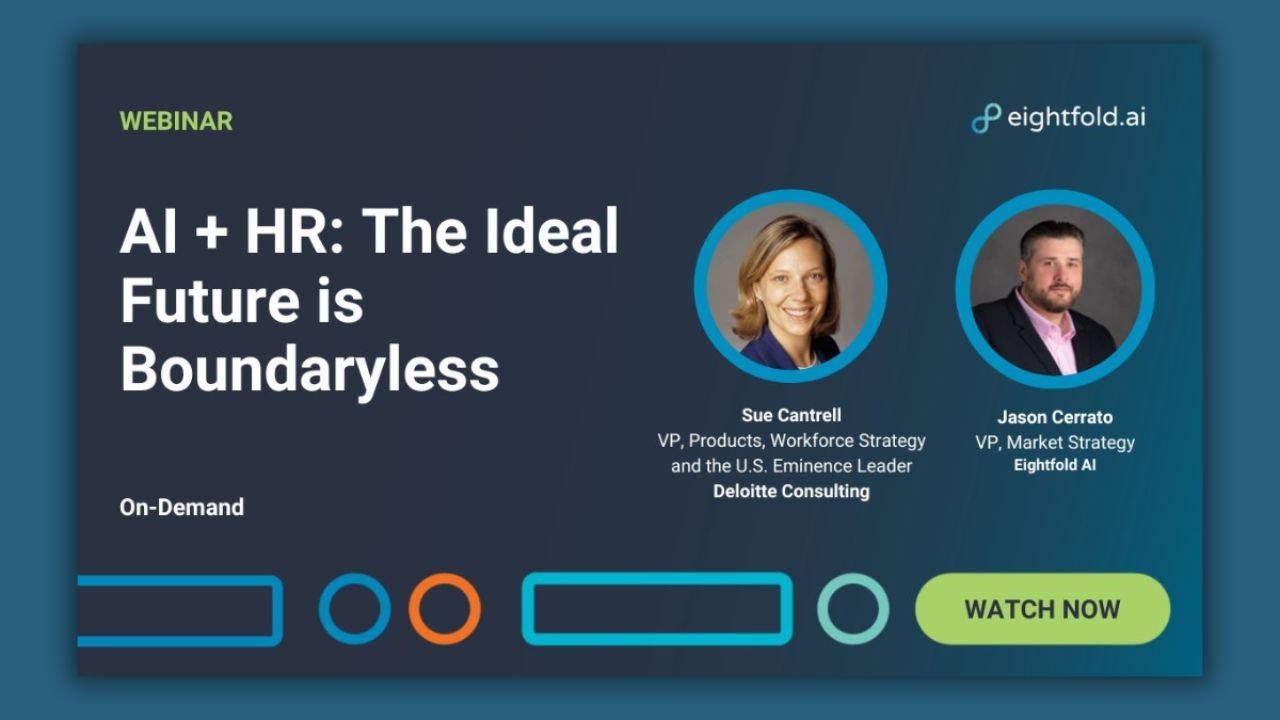
Related content: Watch our webinar with Deloitte “AI + HR: The Ideal Future is Boundaryless,” on demand now.
Everything is becoming transparent
More organizations are collecting information on how workers are working. And with GenAI, organizations can now analyze this vast amount of data to personalize the employee experience, build career development, and more. Leaders find this kind of transparency alluring because the assumption is that the more transparent the organization is, the greater the trust is with workers.
However, there is a flip side to all this transparency. What about privacy? This transparency paradox is one of the first trends Cantrell shared from the Deloitte report.
This has been a hot topic of discussion at many of the roundtables and conferences I’ve been attending. Part of the concern is what happens when people have so much information at their fingertips. With personalized career guidance, what happens when people can see where they can go in an organization, and they are doing all the tasks to get there, and it’s not happening for them? The technology doesn’t replace the human element of management discussions.
With the concept of the transparency paradox, it is balancing the capability of technology, workers, leadership, and the culture of the organization and working together. What happens when the organization has so much information? How could it potentially be turned into a negative? Leadership needs to have these conversations, make policies, and train managers where transparency can set the stage for organizational trust.
Related content: The future is centered around talent, not jobs. Read our new e-book on talent-centered design to learn why a future planned around skills — not jobs — is the way forward.
The need for imagination and curiosity
With the rise of GenAI, the demand for human capabilities like imagination, curiosity, and empathy becomes apparent. The next trend Cantrell shared from the report is the imagination deficit.
“AI is becoming increasingly better at replicating the functional and technical aspects of work,” Cantrell said. “Much of the differentiation going forward for organizations is going to come from what humans do or evolve to do. That’s putting this premium on imagination and curiosity. This also means we need to reimagine our work in the future due to new technical advances.”

Interestingly, 76% of workers surveyed by Deloitte said that it’s important for their organization to help them imagine how their job might change in the future as a result of new technologies like GenAI, but only 43% of organizations are helping workers reimagine how their jobs may change.
One of the debates that’s been going on for the last few years with the impact of AI is what jobs will be replaced and what jobs will be created. Many of the jobs that will be created will be jobs that didn’t exist before. The skills these jobs will require may sit in between functions which may be a combination of operations, finance, legal, engineering, or other functions.
With a skills-based approach and talent intelligence, this ability to understand how skills overlap or how skills are adjacent will be critical to filling the jobs of the future. It will be important to develop and nurture people with these skills to bring out the imagination and human capabilities that will be needed.
Let workers play and experiment

To address the imagination deficit, Cantrell said that organizations should facilitate play and experimentation among workers. Establishing digital playgrounds would allow for safe exploration of new technologies like GenAI.
This approach fosters the development of human capabilities and familiarizes workers with emerging tools in a low-risk environment. With the increasing integration of AI in the workplace, digital playgrounds can help bridge the gap between technological advancements and workforce readiness.
“A digital playground isn’t a virtual platform per se. It’s a mindset and an approach where technologies, like AI, are democratized so workers can use them with intention,” Cantrell said. “When the organization does this, it creates a safe space for workers to build confidence, learn new skills, and hone their human capabilities.”
Rather than making AI a top-down mandate, enabling workers to feel like active participants in the evolution of their roles can be a way to earn their buy-in. And giving them an opportunity to explore and experiment in digital playgrounds also supports continuous learning and the development of new skills.
Rethinking HR with no boundaries
Traditionally, the HR function was often specialized and siloed from other operations across the organization. A lot of progress has been made over the past few years around integrating within the HR function with the business. Cantrell explained how AI has driven this trend of boundaryless HR.
“With generative AI, HR has to work closely with business leaders and workers to redesign work and roles,” she said. “For example, on the responsible use of workforce data, risks with ethics, ESG, corporate responsibility, DEI, finance, operations, marketing, and public affairs. The boundaries between those disciplines are breaking down because rather than owning the discipline of people, HR co-creates that discipline and cultivates it across all roles in the organization.”

The report shows that 72% of respondents agreed that HR’s shift from an operations function to a discipline operating across functions to orchestrate work is very important or of critical importance.
HR has moved beyond placing people in jobs to supporting overall business strategies by matching skills to the work at hand. When skills become the foundational element of any talent plan, it creates a dynamic understanding of what people can do and what they can learn. This approach creates a more agile, flexible workforce that is primed to take on any challenge.
With technology accelerating and the growing competitive crisis for workers, examining talent through a deeper skills-based lens will create a talent-centered organization designed to perform. This holistic view, powered by the insights that an AI-native talent intelligence platform delivers, will benefit your HR teams, your organization, and your workforce — and prepare everyone for what’s ahead.
Ready for a future built around your talent? Be sure to join our next webinar discussing this topic with Deloitte’s Sue Cantrell and Eightfold’s Jason Cerrato on June 26: How to create a thriving environment for people — and your business.
Jason Cerrato is former Vice President, Talent-centered Transformation at Eightfold AI. Before joining Eightfold, he was an HCM industry analyst with Gartner and held talent leadership positions at United Technologies for over a decade. Cerrato is the co-host of The New Talent Code podcast — new episodes are streaming now.