

- AI can help organizations unlock people’s potential by identifying the essential skills needed to align talent with rapidly changing business priorities.
- To determine how AI fits into your processes, start by identifying pain points and then use AI to solve them.
- When demonstrating the impact of AI internally, data that attests to faster hiring and measurable improvements speaks louder than a marketing blitz.
AI is enabling HR leaders to work smarter, better, and faster. But to build trust across the organization it must be deployed in the right way, at the right time.
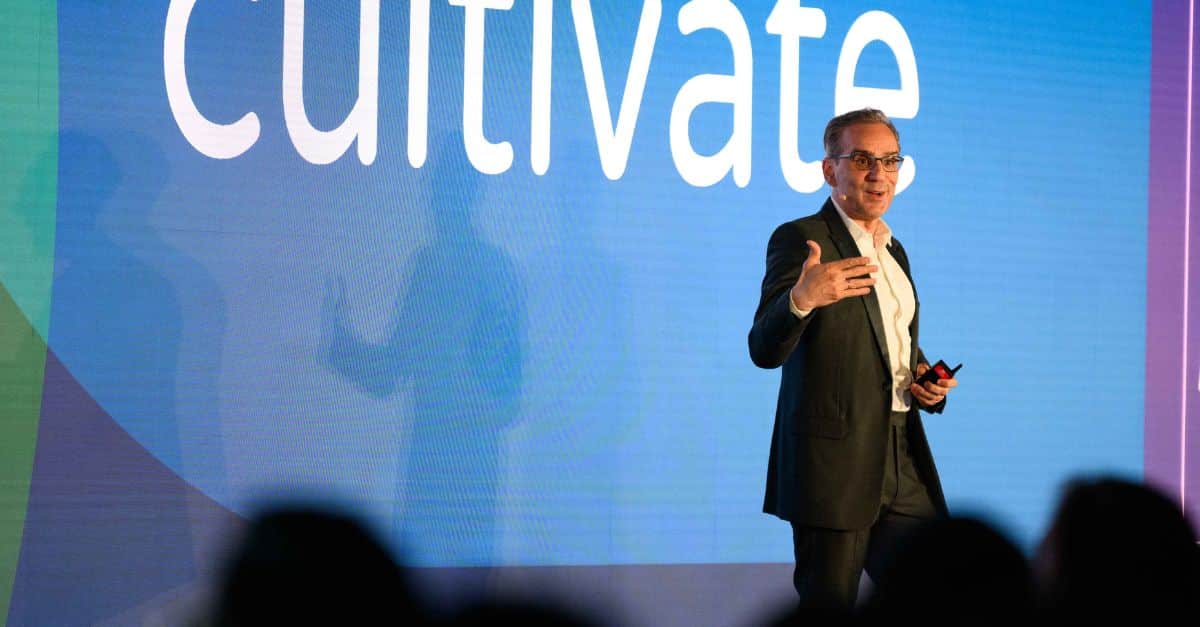
That topic took center stage during a recent Cultivate EU ’25 keynote led by Rimple Patel, Eightfold Chief Customer Officer who spoke with Bianca Choudhary, VP, Global Talent Acquisition at biopharmaceutical company AstraZeneca, and Noel Brown, Global Head of Enterprise Talent at global financial leader HSBC, about the way their organizations are integrating AI in talent acquisition.
During the conversation, both experts emphasized the need to approach adoption responsibly to build resilient workforces and shared lessons they’ve learned in their organizational transformations.
Above all, they encouraged the audience to get started on their AI journey as soon as possible.
“The future is here, and we have to embrace that now and get going,” Brown said.
Bianca Choudhary talks about AstraZeneca’s approach to HR strategies in the age of AI.
As priorities evolve, AI can be a boon
Business leaders everywhere are immersed in conversations about how to use AI to accomplish strategic goals. Choudhary said that is opening doors to discuss how AI can shape the talent landscape, too..
“Our business is under a lot of pressure,” she said. “We need to deliver medicines to patients faster. So what is the part that we play in finding the best people to be able to help our business do that?”
At AstraZeneca, her team is asking what skills are in demand, now and in the near future, like curiosity, judgement, agility, and digital literacy. They’re working to develop those skills and abilities internally, so that the workforce will thrive even as technology takes over more tasks and business priorities evolve.
“What got us here today is not going to get us to where we need to be in the next two or three years,” Choudhary said.
By using AI to unlock more value, businesses can do more, agreed Brown. That’s one way his team is striving to keep a legacy business like HSBC ahead in its industry.
“Our workforce is our biggest operating expense,” he said. “And we’re probably leveraging 10% of their skills and not the 90% we could be.”
Working with an AI platform has enabled HSBC to determine which tasks can be automated so that workers can dial into the moments that matter and perform more purposeful, meaningful work.
Noel Brown talks about how HSBC approached navigating their AI transformation.
Show don’t tell when it comes to impact
It’s easy to talk a big game when deploying AI across an organization, but that’s not what will win over hearts and minds.
In preparation to go live with our platform, Choudhary said her AstraZeneca team purposefully decided against launching a big-bang communications campaign.
“We thought that was going to distract from what we really want to deliver, which is something much more meaningful, intuitive, and an elevated experience,” she said.
Instead, she says the TA team will manage and support the business through the changes. And then, in six or nine months, they’ll examine the data and share the results with the organization.
“We will look at the hires that we’ve made, the moves that we’ve made, and we will play that back to the business and say these are the people that you may not have otherwise hired,” Choudhary said. “This is where they are now.”
HSBC took a similar approach. Because the bank is risk-averse by nature, it was important to extensively test the technology under the watchful eye of an AI risk committee.
“We don’t make decisions leveraging AI, but we want to use AI to free up capacity to have more qualitative discussions or review our video interviews,” Brown said.
They started off by evaluating AI in limited use cases. Based on anecdotal feedback over the course of a year, they learned that the platform enables the company to hire faster and from more varied pools of applicants.
Bolstered by those insights, Brown said they’ll now launch in more markets and scale with intention.
Choudhary shares her early insights and learnings from using AI in HR.
Know what’s holding you back and let AI move you forward
Organizations make the most of AI when they incorporate it into a number of processes. However, to understand where it fits, they may need to do some soul-searching.
Choudhary said her team’s early steps involved identifying pain points and problem statements.
“We asked, ‘What’s weighing us down? What are the business problems we’re trying to solve for? Where are we not getting it right today? What’s holding us back?’ ” she said.
Then, they analyzed how much time different tasks take — like sourcing, screening, and interviewing — for recruiters. Armed with that information, they built a roadmap that put AI to work where it could make the most impact, like writing job ads.
“We trained the AI on all of our employer brand messaging, our corporate messaging, we fed it lots of information that was specific to location or skill set or talent segment,” Choudhary said. “Now, a job ad can be written in seconds versus 30 or 40 minutes.”
Build trustworthy processes across the board
HSBC and AstraZeneca receive an enormous influx of job applications every year, numbering in the millions. For these enterprises, it’s important to ensure that the application process is smooth, even if the person isn’t hired.
“Many applicants are customers, and we have to be in front of that to make sure that even if they’re not successful, they have a good process,” Brown said.
You build trust by making people feel good about the process, added Choudhary.
“Whether they’re interacting with a human or an agent, from the first interaction that they have with us all the way through to the end, those have to be elevated, experiential moments,” she said.
The same goes for the onboarding process. That’s where HR has another significant opportunity to build trust in AI, while keeping a human in the loop. Employees learn early that technology can and will be effective at the right place and time, all across the organization.

Embracing change, empowering people, enabling performance
There’s no question that work, workers, and workforces are changing, and happening fast. While many organizations are now focusing on what AI can do, it’s just as important to reimagine the work that people can do and plan accordingly. As technology advances and business objectives change, a resilient workforce will be able to adapt along the way.
The AI era is speeding ahead. Some have compared this transition to the automobile age, when carriages became obsolete. Others point to the light bulb moment, when we went from candlelight to electric illumination.
Whatever the analogy, the revolution is here. AI is helping organizations everywhere bring new talent in, move existing talent into the right place, and drive business performance.
Watch the full session from Cultivate Europe ’25, available now on demand.