

- Breaking free of “old proxies” when it comes to ways of working will free organizations to become truly boundaryless — that begins with refocusing on your people, not productivity.
- The majority, 90%, of the workforce acknowledges AI has or will become essential to their jobs. Start small by identifying repetitive daily tasks that could be aided by AI.
- Be ready to adapt to changing regulations around AI. Create a council or committee to oversee and guide adoption to save headaches later on.
The world of work is becoming boundaryless, and there’s one organization that has their finger on the pulse of this evolution: Deloitte.
Deloitte’s annual 2024 Global Human Capital Trends report is filled with insights into how work is evolving and what it will take for organizations — and the people running them — to thrive in this new boundaryless world of work.
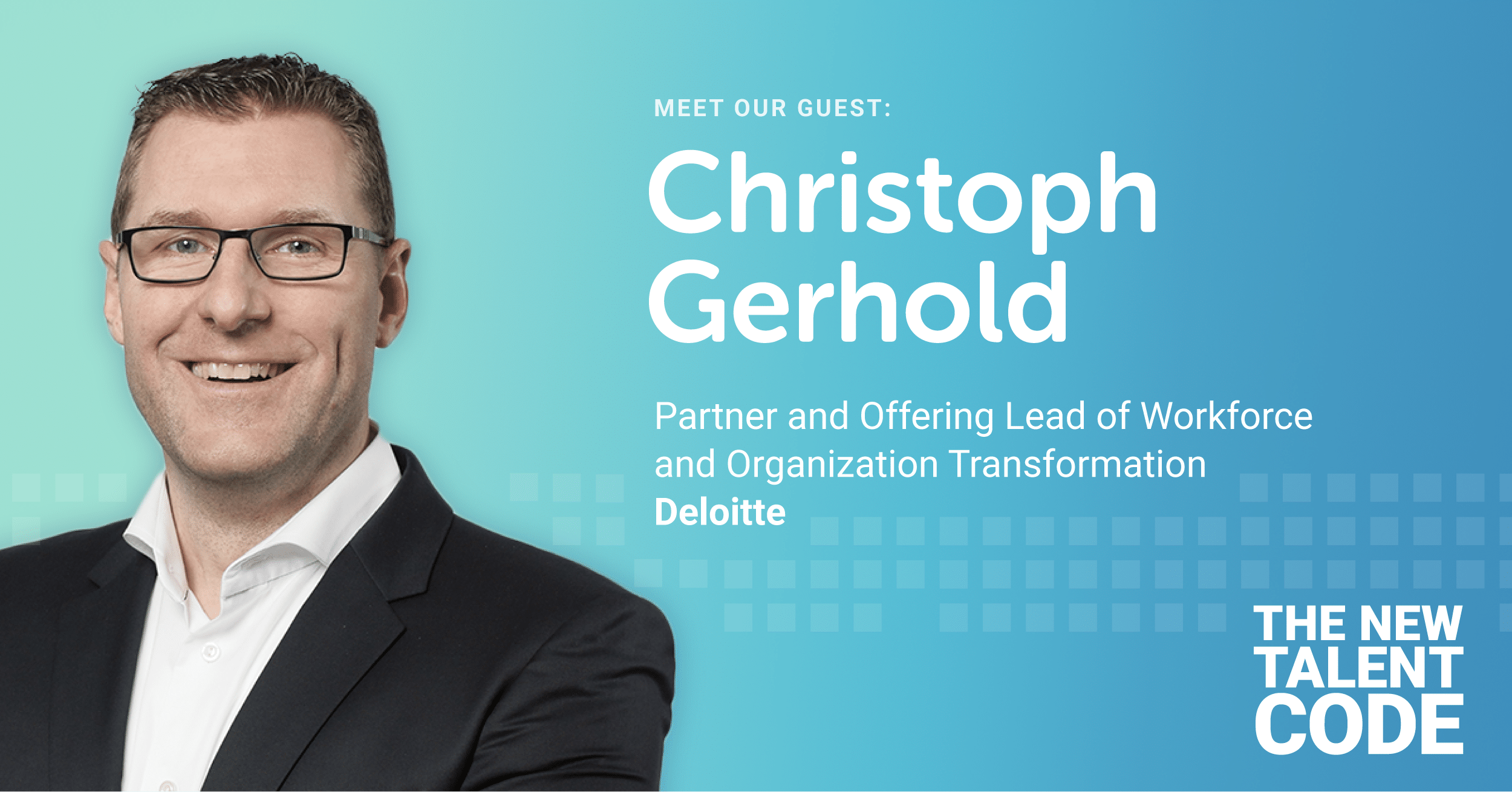
Christoph Gerhold, Partner and Offering Lead of Workforce and Organizational Transformation at Deloitte, joins Ligia Zamora and Jason Cerrato on this episode of The New Talent Code to share his thoughts on what this means, how organizations can use AI to thrive in this new world, and the regulations around AI needed to ensure success for everyone.
Related content: Christoph Gerhold, Partner and Offering Lead of Workforce and Organization Transformation at Deloitte Consulting, joins The New Talent Code to talk about workforce transformation in this new boundaryless world.
Focus on potential over credentials
There is constant change happening in every aspect of life: how we maintain friendships and family relationships, the worldwide geopolitical climate, how economies ebb and flow.
Work is no different, and organizations that are adapting well are moving away from old concepts and processes to respond. Leaders are also asking what they need to attract top talent while lowering turnover rates — all while looking at traditional, gig, and contract workers.
There are many moving parts to consider.
“Measuring people and their work based on — we call it old proxies in our research — on things like increased productivity, numbers of calls, number of units you’re producing is not working out anymore,” Gerhold said. “Reflecting on social skills — I think that’s the real asset that people bring to the table, like being curious, being passionate, being empathetic, being innovative, being creative. I think that’s the real value that people can bring to the table.”
To do that, HR teams must understand the business they work for and the challenges it faces.
“These challenges are often human challenges, like finding the right people, then training and developing them,” Gerhold said. “That’s what HR, in many cases, is not able to provide at the very moment … because they don’t have time for it.”
Related content: Is your workforce designed to make the most of your talent? Read our paper on why talent-centered design is the way forward in this boundaryless world of work.
Integrating AI into daily work
Gerhold said that one easy way to start with AI is to look for ways that AI can ease the burden of administrative or repetitive tasks. It’s also essential to develop a clear framework for workers to understand how to best work with AI in their roles.
Change is not always easy, and [AI] is not like a self-driven thing,” Gerhold said. “At the very beginning, everyone is skeptical about change and dependent on what you provide as a framework. HR, on one hand, needs to use technology to get more time for these important topics. They also need to make sure that they understand the concerns and challenges of their employees and have some solutions for that.”
Gerhold acknowledges that AI can be a large investment for any organization, but workers can start small and identify simple use cases to begin familiarizing themselves with how AI works. He also encourages organizations to offer digital playgrounds where employees can experiment.
“We recommend this to give our people psychological safety and the room to try things out,” he said. “They can say, ‘I can do this, and I would not harm any of our clients. I could try this out, and if it works, I can introduce it to my client and say this is the way we could also do it for you.’”
Deloitte surveyed more than 14,000 workers, reporting that 90% of workers agreed that they needed to understand or adopt AI tools in their work. Also notable: right now, only 10% of organizations are actively investing in AI.
“I think fear holds them back,” Gerhold said. “I think they don’t really see the use case or area of application for it, or that they somehow treat it like another trend. Everyone needs to deal with AI.”

Related content: Dig into more findings from Deloitte’s 2024 Global Human Capital Trends report in this Q&A from Cultivate ‘24.
The role of digital ethics
Another reason for hesitation: it is taking time for regulations to catch up to AI.
In Europe, the EU AI Act went into effect in early 2024. In the United States, cities, like New York City, and states, like California and Colorado, have already passed legislation around AI, but there are no federal regulations yet.
Gerhold says this is where organizations need to recognize AI is changing and evolving constantly, and they need to be ready to do the same alongside it.
Any easy starting point? Assembling an AI ethics council or committee to help guide your organization. He recommends building a group that includes people with backgrounds in law, psychology, and data science to start.
“You really need to take into consideration all aspects [of AI],” he said about who to place on an AI committee. “They are working together, not isolated, with our people that are making sure we ensure [there is] digital enablement from the beginning.”
Looking ahead on report trends
While Deloitte focused on this new boundaryless world of work with this year’s report, Gerhold says we’re only at the beginning of this conversation. to see more around this topic over the next year more discussions into human sustainability and workplace microcultures.“The question is, how do we make sure that microcultures are able to work in their way of working, which is the basis for really achieving great things and for making the difference without contradicting the company’s culture,”he said.
Above all, he encourages organizations and HR leaders to embrace the idea of becoming boundaryless.
“Break boundaries. In so many companies, we are in strict silos, and we do have all these boundaries. I think that’s exactly what we should try to overcome with AI because it goes far beyond what we can think of today. It closes with the imagination deficit, which we need to overcome. It’s really on us what we make out of it.”
Listen to the full episode of The New Talent Code with Deloitte’s Christoph Gerhold on our website or wherever you listen to podcasts.