

For decades, business growth has followed a predictable pattern: double your output, double your head count. This linear model made sense in the Industrial Age and even through much of the Information Age.
But that era is over.
Today, organizations are hitting a fundamental ceiling — one that no amount of additional head count or better software can break through.
The ceiling? Human scale.
In 2026, as we stand at the threshold of the Intelligence Age, the traditional approach to scaling isn’t just outdated — it’s putting your organization at a significant competitive disadvantage.
That’s why we’ve just published a new ebook, The Infinite Workforce. In it, we explore why the traditional model of scaling is over and what comes next: a fundamental shift from managing finite capacity to orchestrating infinite intelligence.
The velocity gap is widening
Here’s what is keeping the C-suite up at night: the velocity gap.
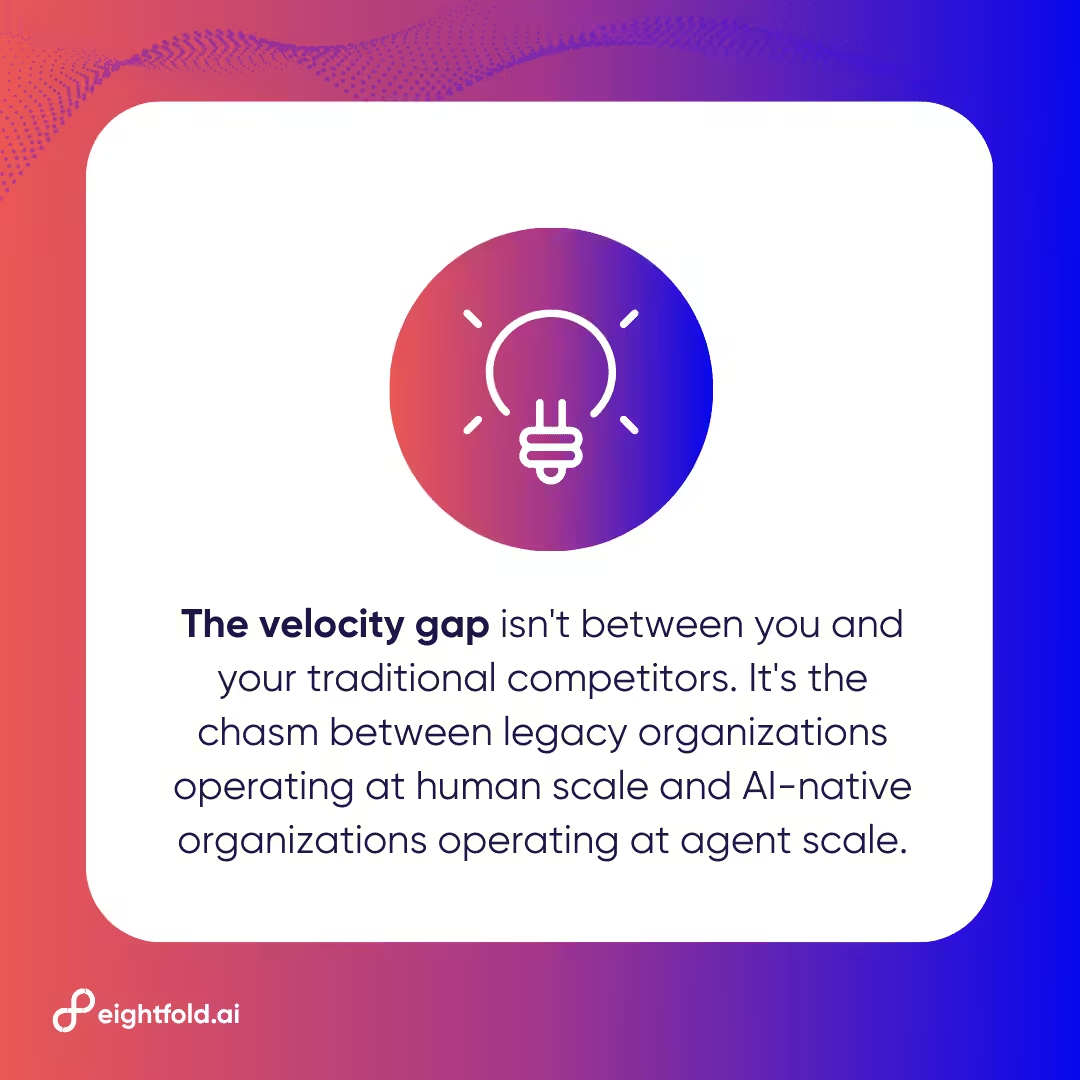
This isn’t the gap between you and your traditional competitors. It’s the chasm between legacy organizations operating at human scale and AI-native organizations operating at agent scale.
While 88% of organizations report using AI in at least one business function, only about 6% qualify as AI high performers — those attributing EBIT impact of 5% or more to AI use. The difference isn’t marginal. High performers have fundamentally redesigned how work gets done, while the remaining 94% are simply layering AI on top of legacy processes.
Think about what this means for talent acquisition specifically. If your competitors are using agentic AI to compress hiring cycles by 70% to 90%, your traditional linear talent models will leave your organization structurally disadvantaged within years, not decades.
This is what we call time compression. Where previous industrial cycles measured progress in decades, we’re now compressing a century of advancement into a single decade. Drug discovery that took years now happens in days. Material science breakthroughs that required 20-year cycles now take months. And as a talent leader, complex hiring coordination that traditionally took six weeks can now happen in an afternoon.
McKinsey research suggests that generative AI has the potential to add between $2.6 trillion and $4.4 trillion annually to the global economy. Critically, HR is pinpointed as a primary beneficiary, with 20% of this value locked within talent acquisition and recruiting specifically.
The question isn’t whether this transformation will happen. It’s whether you’ll lead it or be left behind by it.
Two traps keeping you stuck
In our ebook, we identify two architectural traps preventing most organizations from breaking through the human-scale ceiling.
The legacy trap: Your current systems of record were built for the Industrial and Information Ages — designed to track head count, manage benefits, and ensure compliance. These platforms treat candidates as static database records. They can tell you who works at your company, but they can’t show you what potential your workers have.
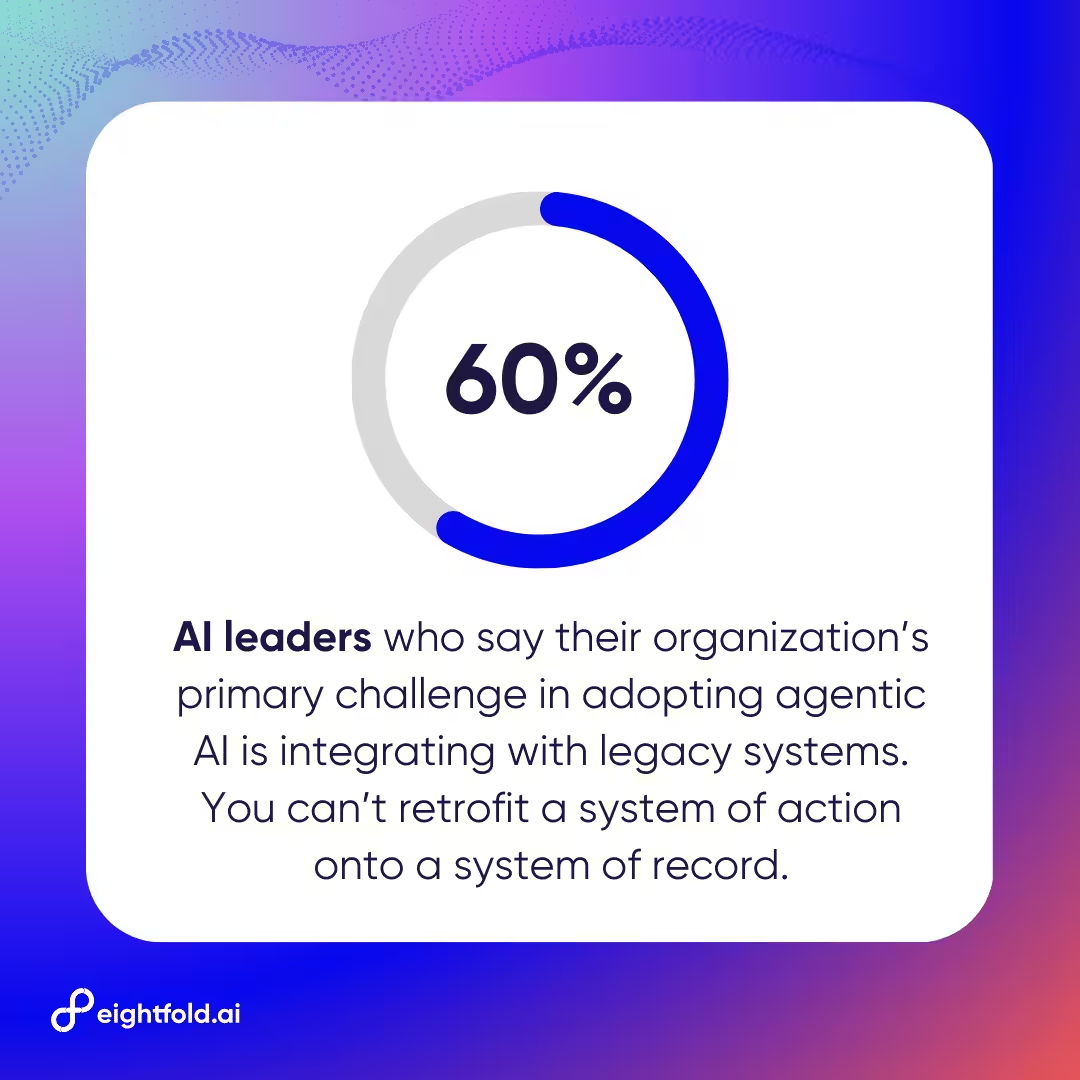
And here’s the critical point: you cannot retrofit a system of action onto a system of record. According to Deloitte, nearly 60% of AI leaders say their organization’s primary challenge in adopting agentic AI is integrating with legacy systems.
The generalist trap: On the other extreme are general-purpose LLMs like ChatGPT, Claude, and Gemini. While remarkable for creative writing or research, these models are architecturally unsafe for enterprise talent decisions. They excel at language but lack what we call “spatial intelligence for work” — they don’t understand career physics, skill overlap nuances, or hiring compliance risks. These platforms are built for fluency, not accuracy. For talent decisions, you cannot afford mistakes.
You’re caught in a bind. Legacy systems keep you trapped in the past. Generalist systems are guessing at your future without grounding in work reality.
What the Infinite Workforce actually means
The Infinite Workforce is not about replacing your recruiters with robots. It’s about fundamentally rearchitecting how work gets done.
Here’s the shift: In legacy models, you were the sole executor of every task. Your capacity was directly limited by your team’s calendar, bandwidth, and working hours.
The Infinite Workforce is a hybrid model where people orchestrate digital agents to operate beyond traditional capacity constraints.
This creates three fundamental changes in how you operate:
- Agents handle execution at scale: Digital workers manage high-volume, data-intensive work. Unlike AI assistants that simply suggest edits or answer questions, these agents execute complete workflows — from complex talent sourcing to conducting structured interviews with thousands of candidates simultaneously.
- Talent leaders orchestrate from above: Instead of working in the weeds of administrative tasks, your recruiters work above the operational layer. They become architects and orchestrators — setting strategic direction, making judgment calls, and applying uniquely human capabilities like persuasion, ethical reasoning, and creative problem-solving.
- Capacity becomes infinite: Your team’s output is no longer constrained by head count. When digital workers can interview one candidate or one million candidates with the same level of precision and compliance, you’ve moved from scarcity to abundance.
McKinsey research shows that currently demonstrated technologies could, in theory, automate activities accounting for 57% of U.S. work hours today. In HR specifically, this means freeing your recruiters from rote administrative tasks to focus on strategic objectives that only humans can accomplish.
Real-world proof: This is happening now
This isn’t theoretical. We’re seeing the transformation happen in real time with early adopters of our AI Interviewer.
Organizations using AI Interviewer are seeing:
- 33% reduction in time to fill
- Hiring cycles compressed to as few as 1.3 days, versus weeks with traditional methods
- 80% of manual recruiter work automated
- 92.5% interview completion rate
- 93% candidate NPS score
One of our customers reduced their time to offer by nine days, achieved $2.4 million in cost savings, and increased their talent network by 300%. Another compressed time to interview by up to 90%, moving from 42-day hiring cycles to under a week.
These aren’t productivity improvements. These are fundamental shifts in operating models.
The strategic imperative: Act now
The World Economic Forum predicts that by 2030, about 92 million jobs will be displaced — with 170 million new ones being created. If you adopt AI agents in hiring earlier to find, grow, and support human potential, you’ll have a clear advantage in finding that talent in the years ahead.
Here’s what this means for the next 12-18 months:
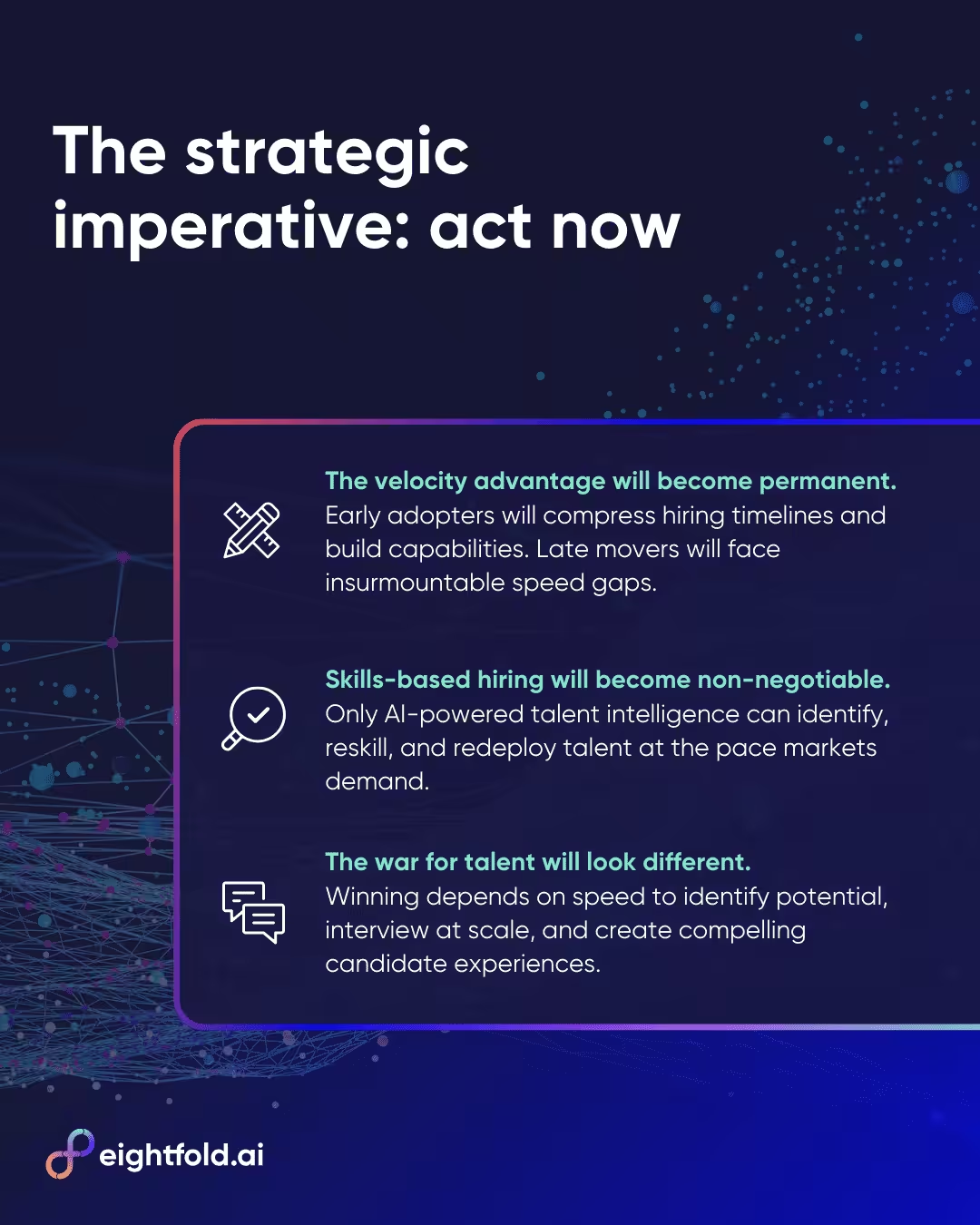
The velocity advantage will become permanent. Organizations that deploy agentic AI now will compress hiring timelines and build muscle memory around orchestrating digital workers. Those that wait will face an increasingly insurmountable gap in speed-to-talent.
Skills-based hiring will become non-negotiable. The WEF projects that 39% of workers’ core skills will change by 2030. Only organizations with AI-powered talent intelligence can respond at this pace — identifying, reskilling, and redeploying talent at market speed rather than manual HR process speed.
The war for talent will intensify — but look different. It won’t be about who has the biggest recruiting team. It will be about who can move fastest to identify potential, conduct fair and compliant interviews at scale, and create compelling experiences that win candidates over.
Your next step
In The Infinite Workforce, we provide the full architectural blueprint for making this transition — from understanding what’s broken in your current systems to implementing your first agentic AI proof of concept in 30 days.
The organizations winning in the AI era aren’t waiting for perfect conditions. They’re running proof of concepts now and scaling what works.
Our advice to you is simple: Start.
Choose one high-volume recruiting process where manual work creates your biggest bottleneck. Deploy AI Interviewer for one role, one team, or one location. Run it alongside your current process to compare results. Within 30 days, you’ll have concrete data showing how much faster you can hire, how many more candidates you can interview, and how much time your recruiters gain back for strategic work.
The era of scaling head count is over. The era of the Infinite Workforce has begun.
The only question is whether you’ll be among the 6% of high performers who redesign how work gets done — or among the 94% still layering AI on top of processes built for a different age.
Download The Infinite Workforce ebook to learn how to escape the legacy trap and build the workforce your future demands.