

Your talent strategy is about to fundamentally change. After surveying 700+ organizations across three continents, we uncovered a striking pattern: the organizations achieving breakthrough results with AI aren’t just implementing new technology — these places are reimagining how work gets done at the most fundamental level.
The data from our latest report, “The new role of the CHRO,” reveals a stark performance gap. AI leaders are seeing 88% higher staff productivity, 84% higher profitability, and 84% higher retention compared to organizations just starting the AI journey.
What separates these industry leaders from everyone else? These organizations have leadership moving beyond experimentation to full-scale transformation — and they’re doing it faster than you think.
As we look ahead to 2026, we asked our thought leaders to share their predictions on how AI will further impact talent practices in the coming year.

AI will become a true collaborator
“When agentic AI understands skills at a granular level and remembers every interaction, it stops becoming a tool and starts becoming a collaborator,” said Ashutosh Garg, Eightfold CEO and Co-founder. “When AI understands a person’s strengths and intent, it can remove friction, automate the busywork, and elevate what humans do best. It enables work that aligns with both the organization’s needs and the individual’s purpose. The organizations that embrace this shift will unlock unprecedented human potential.”
The shift from AI as a tool to AI as a collaborator represents a fundamental transformation in how work happens.
Our research shows that 64% of organizations in earlier stages of the AI journey cite lack of AI skills and knowledge as the biggest barrier to innovation.
Here’s what’s changing: by 2026, agentic AI will fully understand people — skills, context, and aspirations — using memory and personalization to help everyone focus on work that matters.
Organizations that have already embraced this shift are seeing dramatic results. The businesses using AI-native talent intelligence report double-digit increases across all recruiting metrics, with improvements in time to market, time to present, and time to offer.
When AI truly understands each person’s unique capabilities, it doesn’t just fill positions — it creates opportunities for people to contribute at the highest level.
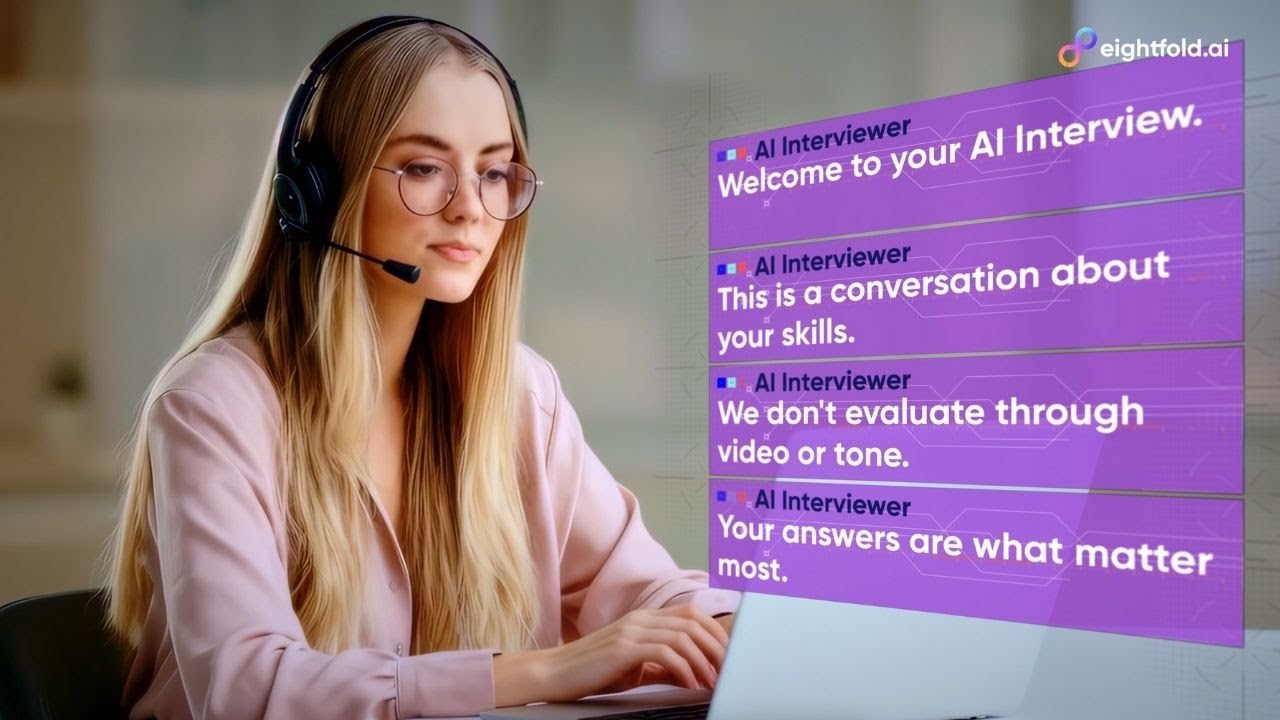
See how AI Interviewer can transform hiring from a waiting game into an instant opportunity.
Agentic AI will move from pilots to production
“Talent decisions today hinge on interviewer quality and human bandwidth,” said Varun Kacholia, Eightfold CTO and Co-founder. “With agentic interviewers, every candidate receives the same rigor, structure, and fairness — improving quality of hire while freeing humans to focus on decisions, not logistics. The companies that adopt this early will out hire everyone else.”
By 2026, agentic AI will shift from pilot explorations to full production systems — running interviews, screening talent, and driving workflows end-to-end. AI interviewers will break into the mainstream: multimodal, unbiased, and able to evaluate talent at a level of signal consistency humans cannot scale.
Consider the implications. Most organizations remain stuck in the “messy middle” of AI implementation, with 67% of organizations only at the starting or midway point in leadership alignment.
But the organizations that push through? These are already achieving 4.2x higher innovation rates and 4.4x greater revenue growth compared to those just beginning the journey.
The breakthrough comes when organizations realize that agentic AI isn’t about replacing human judgment — it’s about enhancing human capacity.
When every candidate can receive the same level of rigorous, structured evaluation regardless of which recruiter happens to review their application, you’re not just improving efficiency. You’re fundamentally improving fairness and quality of hire.
Recruiting workflows will be reconfigured
“As agents continue to get cheaper, faster and better at certain tasks, it gives us the ability to reimagine how long standing processes should be redesigned,” said Sachit Kamat, Eightfold Chief Product Officer. “The ability to interview every single qualified candidate is something that is possible with AI Interviewer, for example.”
Agentic AI will dramatically reconfigure recruiting workflows as recruiting leaders realize the benefits of operating at agent scale. We won’t simply use agents to automate what humans do today.
This is where the real transformation happens. Organizations at the leading edge have made significant progress in creating long-term HR plans aligned with AI transformation strategy — 76% of leaders compared to 0% of beginners. They understand that when agents can handle high-volume tasks with increasing speed and declining cost, the entire process needs to be rethought from the ground up.
The most successful organizations are already seeing this play out:
- Eaton reported a 300% increase in its talent network size and double-digit increases in candidate velocity.
- Vodafone reduced cost to hire and time to hire by 50% while increasing learning hours per employee by 67%.
These aren’t marginal improvements — these are the results of fundamentally redesigning processes around what AI makes possible.
AI interviewing will become table stakes
“A recruiter phone screen costs $30-$50 per candidate,” said Amber Grewal, Eightfold Chief Growth Officer in her LinkedIn column, 10 predictions for HR and HR tech in 2026. “An AI interviewer conducts 2,000+ screens daily at a fraction of that cost, 24/7, in any language. But the real value is data — every AI interview generates verified skills intelligence that makes future matching smarter. Organizations deploying AI interviewing at scale in 2026 build a 12 to 18-month head start on competitive advantage.”
By the end of 2026, AI-powered interviewing will shift from competitive advantage to baseline expectation, especially in high-volume hiring. The economics are compelling, but these tell only part of the story.
True transformation happens when AI interviewing becomes part of a larger talent intelligence ecosystem. AI Interviewer sits at the center of this transformation, creating a workflow where every conversation strengthens the talent intelligence platform. Interviews don’t just evaluate one candidate — each one enhances the system’s understanding of skills, improves matching algorithms, and makes every subsequent hiring decision more informed.
Organizations already operating at this scale are seeing the compounding benefits. Our survey found that 90% of leaders recognize that AI transformation requires strong CHRO-CIO partnerships, with the most successful implementations integrating AI interviewing into broader talent strategies rather than treating it as a standalone tool.
The result: fundamentally stronger hiring decisions informed by verified skills data rather than résumé keywords and interviewer intuition.
The organizations that deploy AI interviewing at scale in 2026 won’t just save money on screens. These will build an intelligence advantage that competitors will struggle to match in the next year, an eternity in today’s war for talent.
AI will shift from tool to trusted partner
“As AI takes on a more collaborative role, its impact will depend entirely on the humans guiding it — their creativity, empathy, and willingness to be transparent about how it’s used,” said Rebecca Warren, Eightfold Senior Director, Talent-centered Transformation. “Leaders who openly communicate their AI practices and invite dialogue will earn deeper trust and faster adoption. In a world where change isn’t slowing down, success will favor those who learn quickly, adapt often, and build solutions with AI rather than around it.”
In 2026, AI in HR will shift from being one tool among many in the tech stack to becoming a trusted partner that helps leaders cut through complexity and make faster, more informed people decisions.
Our research reveals a critical insight: successful AI transformation requires a strong partnership between the CHRO and CIO.
While only 1% of organizations in early AI stages recognize this need, 90% of AI leaders understand that this partnership is essential. This dramatic gap explains much of the performance difference between leaders and laggards.
The human element remains paramount. Organizations with mature AI programs are much less likely to face staff resistance (20% vs. 61% for beginners) and organizational silos (16% vs. 52%). These workplaces achieved this by being transparent about AI use, inviting dialogue, and ensuring that humans guide the technology rather than being displaced by it.
AI agents will become valued team members
“AI agents will be onboard with the same care given to new employees — introducing context, goals, and culture so it understands the organization’s purpose,” said Teresa Wykes, Eightfold Senior Director, Talent-centered Transformation. “Encourage collaboration by defining roles where human creativity and AI efficiency complement each other. Regularly review outputs, offer feedback, and refine parameters. Over time, this partnership fosters trust, adaptability, and shared growth between humans and intelligent systems.”
By 2026, organizations will treat AI agents not just as tools, but as valued team members requiring onboarding, context, and ongoing development.
This represents a fundamental shift in how organizations approach AI implementation. Among leading organizations, 81% believe that the boundary between digital and human workers will blur in the future, and 86% believe the CHRO will take on more responsibility to manage both human and digital workers.
The practical implications are already becoming clear. Organizations are developing plans to manage AI agents like human workers: assigning tasks, providing context, and measuring performance.
More than half of leading organizations (52%) have made significant progress in developing these management frameworks, while only 1% of beginning organizations have done so. The future is about creating an environment where human ingenuity and AI efficiency complement each other, with clear roles and collaborative processes that build on the strengths of both.
The path forward
These predictions aren’t just forecasts — consider this a roadmap for 2026. The organizations that will thrive will be those that recognize AI transformation isn’t primarily a tech challenge — it’s about skills, change management, and breaking down silos.
The performance gap is already staggering and will only widen in 2026. Organizations need to move decisively from experimentation to implementation, from pilots to production, and from AI as a tool to AI as a collaborative partner.
The question isn’t whether these changes will happen — these are already underway. The question is how quickly your organization can harness AI to unlock and scale human potential.
Don’t just read about agentic AI — experience it. See how AI Interviewer is reshaping talent acquisition today.