

- Traditional frameworks can’t keep up with the demands of AI. Leaders must replace outdated models with the real-time learning and flexibility AI offers.
- The future of work is about augmenting people’s skills, so forward-thinking leaders are investing in reskilling and growth for their teams.
- HR is an engine for change. In the AI era, HR must lead with empathy, build adaptive cultures, and guide responsible, people-centered innovation.
The age of AI is here and along with it, the need for change. Change is no longer a phase to be managed — it’s a condition to be mastered.
That’s the central message in a compelling new report from worktech design and consulting firm QuantumWork Advisory (QWA), “Avoid the extinction event: AI demands a new change playbook,” co-authored by Mark Condon, Managing Partner and Founder of QWA, and Siân Lloyd, Principal Consultant, Change and Adoption.
Across every industry and job category, AI is rewriting the rules of work., As a direct result of this ever-shifting landscape, talent expectations are changing just as fast.
The organizations that survive won’t be the ones that resist change. These will be the ones that evolve with it, continuously and compassionately.
If you’re in HR, talent, or a leadership role, here are five actions you need to take now to prepare your organization for one of the biggest workforce transformations in history. Get ready to help your employees not just survive but succeed.
Related content: Learn more about building a solid business case for talent intelligence in this blog post.
1. Embrace continuous change as a core capability
Traditional change-management frameworks were built for episodic shifts with clear beginnings and endings. AI doesn’t evolve in neat phases. It accelerates, self-improves, and reshapes work in real time.
Static roadmaps can’t keep pace. You need to shift from one-off transformation projects to building in a way that is always evolving.
What this looks like:
- Replace annual planning with adaptive cycles that respond to emerging trends.
- Measure learning velocity and response time, not just milestones.
- Normalize experimentation as part of the workflow — not a disruption to it.
“The old model was freeze, change, refreeze — the new reality is flow,” Condon said. “Organizations that still believe in stable states between transformations are preparing for a world that no longer exists.”
2. Reframe automation as a catalyst for skill growth
AI will automate tasks, but that doesn’t mean it’s eliminating the need for people in most roles. The future of work is people working with machines, not people versus machines.
The real opportunity lies in using AI to augment human potential and unlock new capabilities.
“Automation isn’t the endgame: every task we delegate to AI unlocks skills and capabilities we didn’t know existed,” Condon said.
You must make the shift from workforce replacement to workforce reinvention. This starts with understanding the current skills landscape and identifying where upskilling is the smarter investment.
Steps to take now:
- Run skills assessments that look for opportunities to augment roles — not eliminate them.
- Create real-time learning paths tied to evolving work requirements.
- Frame reskilling as growth, not remediation.
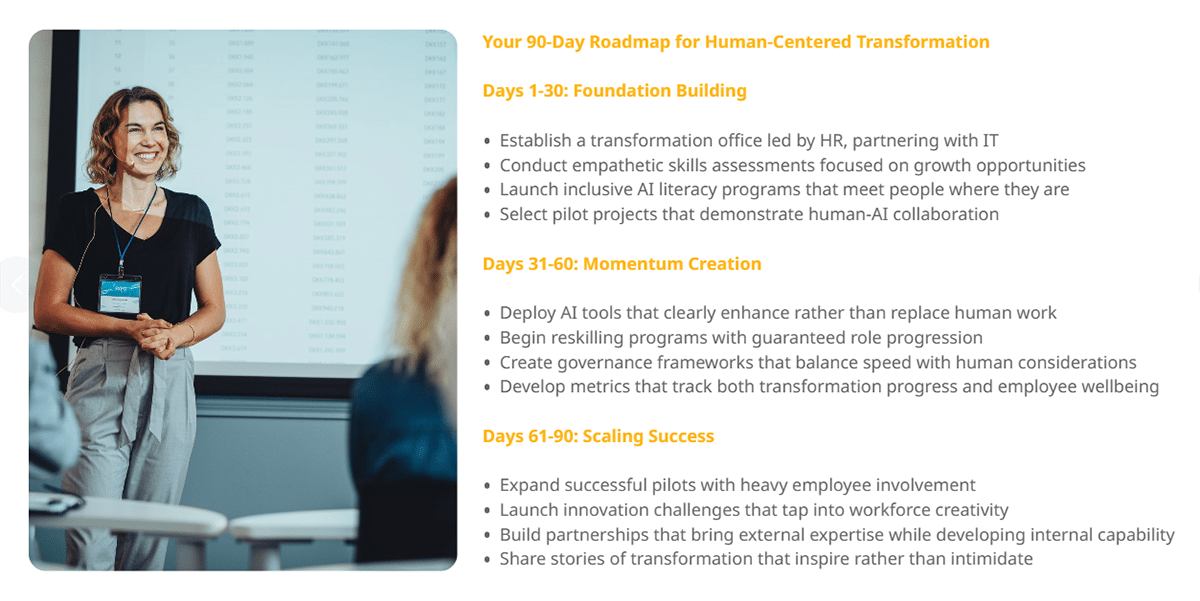
3. Make HR the architect of human-AI collaboration
AI is too important to be left solely to IT. The human impact of these tools, from job design to trust in decision-making, demands leadership from HR.
In this new era, you must step into a strategic role to shape how your organization adapts, how your culture evolves, and how your talent learns to thrive alongside AI.
This shift requires:
- Embedding change capability across the business, not siloing it in transformation teams.
- Designing ethical guardrails that prioritize people, transparency, and inclusion.
- Building feedback loops that let employees influence how AI shapes their roles.
“The moment is now,” Condon said. “HR must transform from policy enforcer to possibility creator and from cost center to value architect.”
4. Lead with empathy, learn in public
The most successful leaders in this transformation wave won’t be the ones with the flashiest AI tools. They’ll be the ones creating safety, clarity, and shared purpose in uncertain times.
When employees don’t know where they fit in a rapidly evolving organization, fear can quickly take hold. That’s why emotional intelligence, vulnerability, and transparency are no longer soft skills — these are essential survival skills.
“In times of technological disruption, the leaders who admit uncertainty and invite collaboration create more trust than those who pretend to have all the answers,” Condon said.
How to lead:
- Admit when you don’t have all the answers and invite collaboration.
- Anchor communication in purpose: why are we evolving, and what’s in it for your people?
- Celebrate learning attempts, not just wins.
5. Move fast and responsibly
The pace of AI adoption is staggering, but moving quickly doesn’t mean abandoning ethics or empathy. In fact, moving responsibly is the only sustainable way to move fast.
QWA calls this responsible speed — balancing urgency with inclusion, momentum with meaning.
What responsible speed looks like:
- Open communication about where AI is being deployed and why.
- Involving frontline employees in redesigning AI-enhanced roles.
- Providing career support and reskilling pathways for displaced workers.
“Responsible speed means matching technological urgency with human readiness,” Condon said. “While AI innovation moves at lightning pace, sustainable transformation happens when organizations accelerate thoughtfully — removing limiting beliefs while keeping people at the center.”
The real risk is inaction
The most dangerous move organizations can make right now isn’t adopting the wrong AI tool — it’s waiting too long to adapt people, processes, and culture to the accelerating change.
This isn’t about scrambling to stay ahead. It’s about building a capability for ongoing reinvention. With the right mindset — and a people-centered approach — change can become something your workforce looks forward to, not fear.
“The greatest risk in the AI era isn’t adopting the wrong technology,” Condon said. “It’s hesitating to reimagine what’s possible.”
Read the full report, Avoid the extinction event: AI demands a new change playbook, from QuantumWork Advisory.