

Making internal mobility the norm could be the secret to retention. It’s all about harnessing the wealth of knowledge, skills, and talent already within your organization and strategically placing individuals into emerging roles.
Indeed, people don’t want to stay with the same company forever. The average employee tenure in 2020 was 4.1 years. Modern career paths rarely stay on a linear trajectory.
At the same time, people don’t jump ship for the sake of jumping ship. On the contrary, employees are hungry to learn, grow, and be exposed to new opportunities — whether in a project or a new role. Nowadays, that no longer means someone has to change who signs their paycheck.
Internal mobility. Talent redeployment. Succession planning. Project-based employment. These concepts are not brand new, but there are new ways of thinking about a blended strategy for filling roles — and skill gaps. This reality fueled an online discussion with Eightfold AI’s Senior Director of Product Marketing, Jason Cerrato, and Head of Talent Strategy and Transformation, Andrea Shiah.
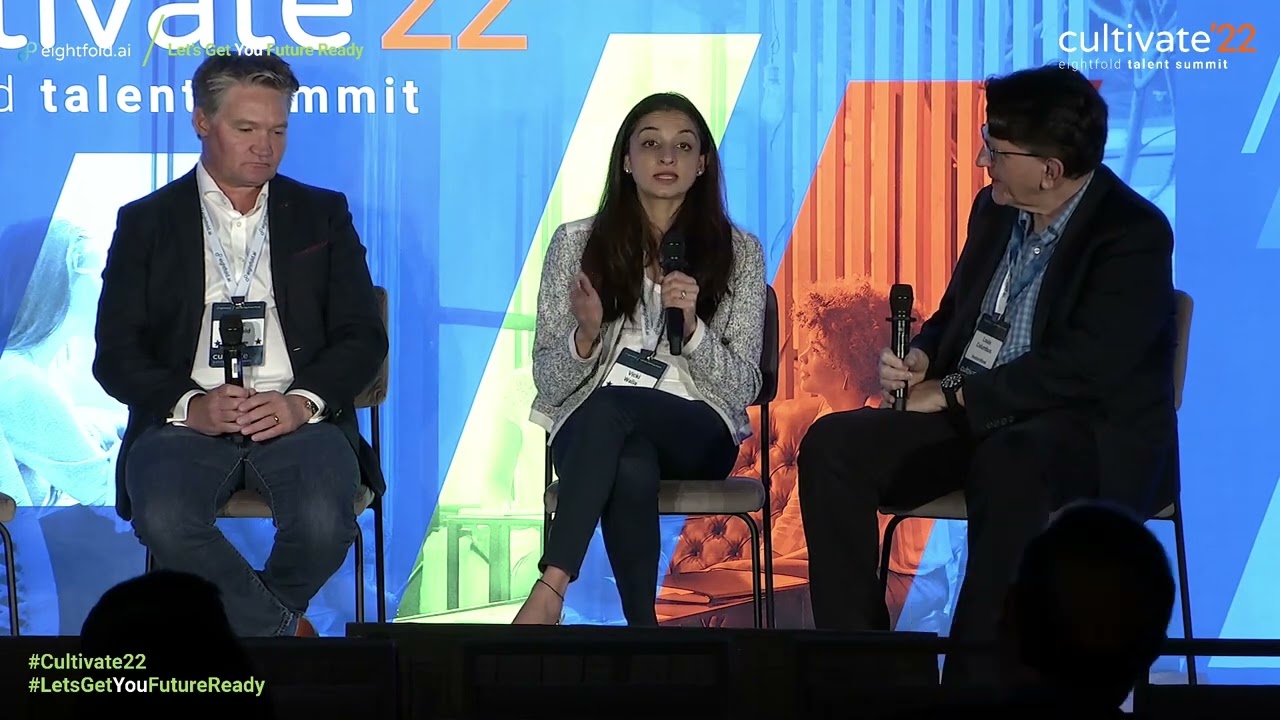
For more practical advice on internal mobility, check out this conversation between senior talent leaders at Vodafone and Prudential.
Read on to learn why putting internal mobility and talent redeployment into practice is the key to retaining top reformers and closing critical skill gaps.
For tough-to-fill jobs, deconstruct them
Job requirements are arbitrary. As a result, many hiring managers have the “perfect” candidate in mind: someone with the ideal combination of skills and experiences. But, in reality, that person may not exist. Or that combination of skills and experiences is hard to come by, leaving a role vacant for months.
Cerrato suggested that organizations reframe how work gets done rather than hire one individual full-time. For example, what are those 20-30 skills required to carry out those responsibilities? Can several people carry out these responsibilities on a project basis?
By deconstructing roles — and understanding what is needed to accomplish that work — organizations can instead reach across multiple departments.
Inviting several people with various skill sets to tackle the work on a project basis is the core of a talent marketplace. It enables the organization to fill a gap in how the job gets done.
Simultaneously, employees value having the power to seek out their own growth opportunities. In fact, over 50 percent of nearly 1,000 full-time employees in Eightfold’s 2022 talent survey strongly value project-based work, mentor programs, and internal job boards. And two-thirds of respondents want visibility into their current skills and future capabilities.

Breaking down a role to the skill level and inviting a group to contribute to a project opens up new opportunities for employees to learn new skills, gain visibility across teams, and ultimately stay engaged with the company.
Tracking and deploying with an intelligent talent marketplace
During the height of the pandemic, many companies crowdsourced skills through an internal talent marketplace to pivot employees into roles growing in demand. This showed us that it is possible to move people strategically — and do this at scale.
For other organizations, this project-based approach to work has stuck not as a mechanism for survival but as a framework for creating a learning culture. Even the world’s largest employer, the U.S. Department of Defense, leverages this concept to identify undiscoverable expertise for the Department for mission-critical projects (more about that in the podcast below).
Organizations can use a talent intelligence platform to track all the skills developed and learned across projects, including within employee resource groups, hackathons, and other marketing events. The goal is to increase visibility for employees, track skills and experiences, and store them on an accessible employee profile.
Reframe internal mobility as part of the recruiter purview
This shift in how work can get done requires hiring managers and recruiters to have a flexible mindset. Most recruiters focus solely on bringing in external candidates to fill open roles.
How do leaders also shift the perspective of recruiters to not only include employees in part of the search for an available position but to consider them first?
If a recruiter fills an open position with an internal candidate, they may see that as a problem: now another position is open. However, with the mindset that responsibilities are more liquid than ever, why is it not possible that someone on that team can shift their responsibilities to cover any gaps?
How do we get started? Change management can’t come from HR, said Shiah. Instead, leaders can champion gig work at the most senior levels by rotating people around. This behavior gives the green light to other business units.

Work today needs to be dynamic — otherwise, careers become stagnant, people become bored, and people leave. It shouldn’t be more accessible for employees to find a job outside their organization than inside. Let’s change that.
To learn more about how to redesign jobs by understanding skills, watch this webinar titled “Reskilling, Upskilling, and Building a Culture of Continuous Learning.”