

Satya Nadella put it plainly: “All of us are going to be managers of infinite minds.”
It’s a deceptively simple statement. But unpack it, and it reframes everything we think we know about how organizations acquire, develop, and deploy talent.
For HR leaders, the implications are both exhilarating and unsettling. Exhilarating because the constraint of human bandwidth — the finite number of recruiters, interviewers, and talent professionals your organization can employ — is about to become obsolete. Unsettling because the systems, processes, and technologies most HR organizations rely on today were never designed for this world.
We are living through what historians will call the Intelligence Revolution: a convergence of agentic AI, superintelligent systems, and autonomous execution that is compressing the work of entire enterprises.
Drug discovery that once took years now takes days. Material science breakthroughs that once took decades now take months. The question for talent leaders is not whether this wave will reach HR — it already has.
The question is whether your infrastructure is built to ride it.

Five revolutions, one breaking point
To understand why the ATS era is ending, it helps to understand what era we are entering.
Historians of technology typically mark four great industrial revolutions: mechanization, mass production, electronics and automation, and the pervasive connectivity of the digital age. Each revolution did not merely improve upon the previous one — it fundamentally changed the rules of value creation.
The Intelligence Revolution is the fifth. And it is categorically different from its predecessors.
Where earlier revolutions automated physical labor and then routine cognitive tasks, this one introduces agency. AI systems that don’t just process information but take action. Systems that don’t just record outcomes but learn from them. Systems capable of operating at infinite scale, with infinite consistency, around the clock.
Consider what is already happening outside HR. Lovable, an AI-powered app-building platform, reached $100 million in annual recurring revenue in eight months — with fewer than 50 employees. Radical AI is simulating billions of materials in minutes, removing bottlenecks that have constrained scientific progress for generations.
These are not incremental improvements. They are business model transformations enabled by a new class of technology.
The talent function cannot be the last corner of the enterprise to feel this shift. And yet, for most organizations, it is.
What the ATS was actually built for
The applicant tracking system emerged in a world where the primary challenge of recruiting was administrative: collecting applications, managing workflows, maintaining compliance records, and preventing candidate data from falling through the cracks. It was, at its core, a system of record.
That was a legitimate and valuable problem to solve. For decades, it was the right tool for the job. But the job has fundamentally changed.
Today’s talent leaders are not struggling to track applications. They are struggling to:
- Move fast enough in a hypercompetitive talent market.
- Assess potential at scale, not just credentials at a glance.
- Compress hiring timelines without sacrificing quality.
- Understand not just where candidates have been, but where they could go.
None of these are record-keeping problems. They are action problems. And a system of record, however well-configured, cannot solve them.
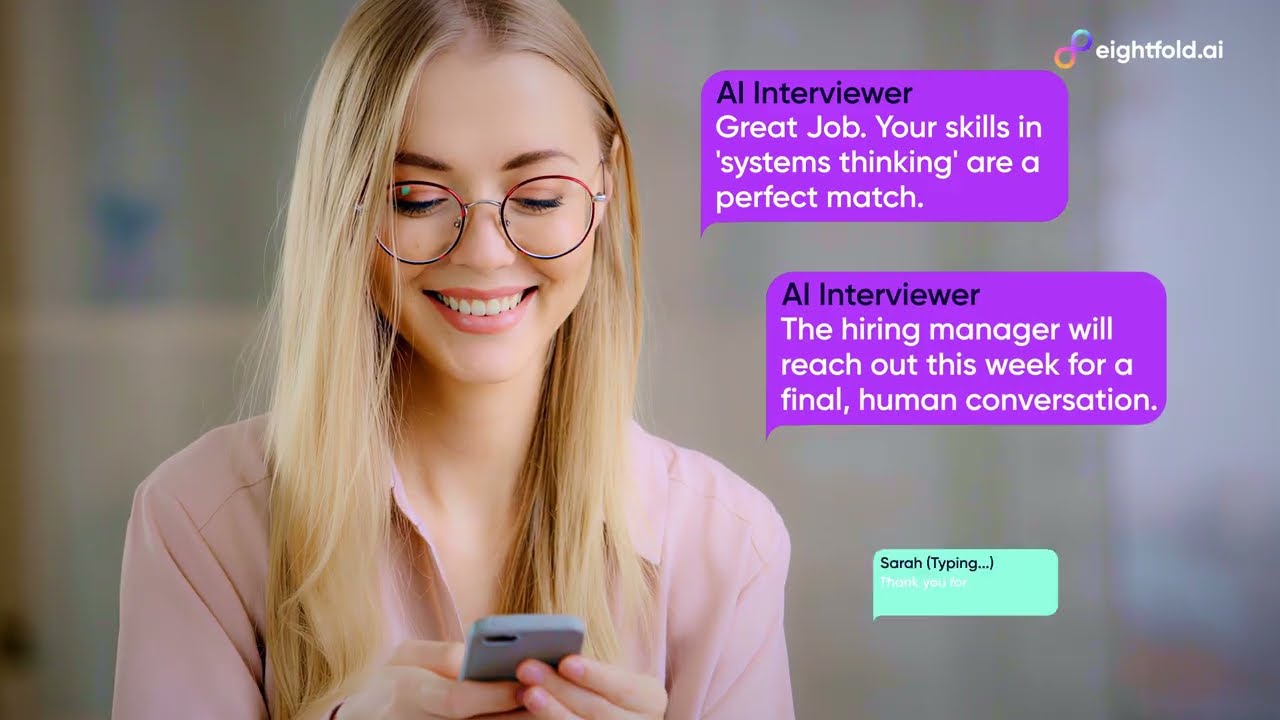
Learn how AI Interviewer solves action problems for recruiters.
The Infinite Workforce requires a different operating system
The Intelligence Revolution is giving rise to what forward-thinking organizations are calling the Infinite Workforce: a hybrid of human talent and AI agents, where humans provide strategy, judgment, nuance, and creative problem-solving, while agents handle autonomous, high-volume, data-intensive execution with infinite consistency.
In the Infinite Workforce model, humans are not replaced — they are elevated. They become orchestrators of AI agents that can conduct millions of interviews simultaneously, screen the full breadth of a global talent pool, and surface candidates based not just on what they have done, but on what they are capable of becoming.
This is the promise of Talent Superintelligence: AI that sees potential, predicts trajectory, and guides growth in ways that no human recruiter, working alone, ever could.
But here is the critical point for CHROs and talent leaders: the Infinite Workforce requires a fundamentally different infrastructure. You cannot bolt an agentic AI onto an ATS and call it a transformation.
The underlying operating system must be rebuilt for a world where AI agents are first-class participants in the talent process, not afterthoughts layered on top of legacy workflows.
The upgrade trap
There is a seductive logic to incremental improvement. Why rebuild when you can upgrade? Why reimagine when you can optimize?
The answer lies in the nature of the Intelligence Revolution itself.
When Lovable built a $100M business with 50 people, they did not do it by hiring faster recruiters. They did it by rethinking what a software business could look like when agentic AI handles execution at scale.
The organizations that will win the talent wars of the next decade will be those that make the same leap in their HR function: not asking how to make their existing processes faster, but asking what becomes possible when the constraints of human bandwidth are removed entirely.
HR leaders who treat AI as a feature upgrade — adding a chatbot here, a screening tool there — will find themselves running a more efficient version of a process that is no longer fit for purpose.
The organizations that will define the next decade of talent acquisition are those willing to ask the harder question: are we building for the world that is coming, or optimizing for the world that is leaving?
Related content: See how Quality Automotive Services plans to use AI Interviewer to create a talent system of action.
What a talent system of action looks like
The successor to the ATS is not a better ATS. It is an Agentic Talent Operating System: a platform built from the ground up to power the Infinite Workforce. Three characteristics define it.
It accumulates wisdom, not just data.
The most powerful talent systems of the next decade will be those that learn from every hiring decision, every promotion, every outcome — continuously refining their understanding of what potential looks like within a specific organization, industry, and market context.
This is the difference between a system that stores records and one that accumulates institutional wisdom. It sees potential, not just credentials.
The Talent Superintelligence layer doesn’t just match keywords on a résumé. It understands the skills adjacent to those listed, forecasts where a candidate could go rather than just where they have been, and surfaces talent that traditional screening would miss entirely.
This is how organizations expand their talent pools at scale — not by casting a wider net, but by seeing more clearly. It acts, not just records.
Our AI Interviewer is the clearest expression of what agentic talent technology looks like in practice. Operating 24/7, globally, it conducts interviews with exacting rigor and infinite consistency — compressing hiring timelines from months to days, eliminating candidate ghosting, and delivering quality assessments at a scale no human team could match.
Candidates get a responsive, respected experience. Organizations get the best talent, faster.
The year everything changes
For forward-thinking CHROs, 2026 is not just another year of incremental HR technology investment. It is the year the gap between organizations that have reimagined their talent infrastructure and those that have not will become impossible to ignore.
The Intelligence Revolution is not coming for your ATS. It has already arrived. The question is whether your talent strategy is built to harness it — or whether you are still trying to solve a 2015 problem with 2015 tools in a 2026 world.
Satya Nadella is right. We are all going to be managers of infinite minds. The only question is: will your talent infrastructure be ready when that moment arrives?
Ready to hire faster without sacrificing quality? Meet AI Interviewer.