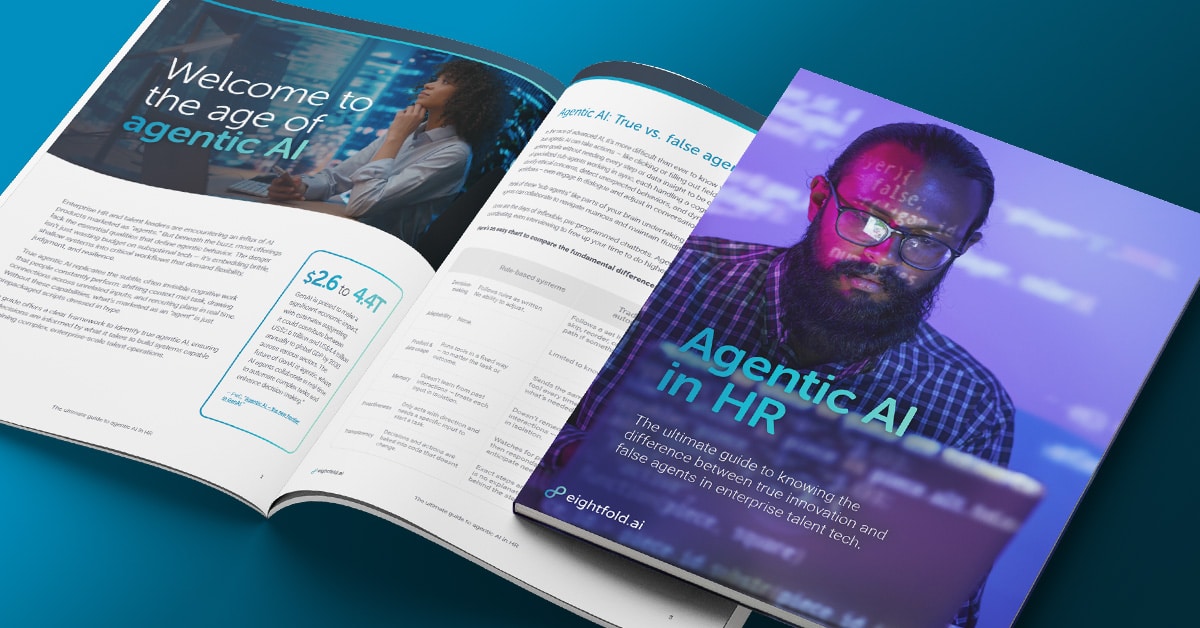


- Recruiters and candidates are frustrated with their ATS experiences, but change is coming quickly to these platforms, thanks to AI, which will alter the experience for the better.
- Modern ATS platforms don’t just provide recommendations. These can autonomously handle tasks like scheduling and candidate engagement, freeing recruiters to focus on building and maintaining relationships with talent.
- When used responsibly and ethically, AI can help make today’s modern recruiting processes feel more human by allowing recruiters more time to talk with candidates, improving the interview experience, and providing high-quality hires for the organization.
Applicant tracking systems (ATS) have long been the bread and butter of your recruiting technology.
But let’s be honest — your system probably isn’t one you love using.
If you’re constantly grumbling about clunky workflows, hearing candidates complain about black-hole experiences, and dealing with a set of disparate tools tacked on to your ATS, then yes, your ATS experience is incredibly frustrating.
So why are you still talking about your ATS in 2025? Because it’s finally changing — and fast.
Recently, Madeline Laurano, Founder of Aptitude Research, joined Conor Volpe, Director of Product Marketing at Eightfold, to unpack the current state of the ATS, where it’s headed in the era of agentic AI, and what you should expect from your system going forward.
Here are five takeaways from their conversation.
Madeline Laurano, Founder of Aptitude Research, talks about why organizations still need an ATS.
1. ATS dissatisfaction is real, but investment isn’t slowing down.
Your ATS has probably been part of your recruiting tech stack for decades. Yet according to Aptitude Research’s latest report, “Beyond Tracking: The Evolution of the ATS is an Intelligent and Agentic Era,” only 28% of organizations report being satisfied with their current system. Even more striking, one in four plan to replace their ATS this year.
That’s a surprisingly high replacement rate for a technology you might consider mature and reliable.
“Companies feel very frustrated with the ATS,” Laurano said. “Recruiters are incredibly frustrated with the ATS. Candidates are starting to recognize ATS brands and complain about them when they apply. It’s not going away, but the dissatisfaction is very real.”
Even if you’re frustrated, you’re probably not cutting ATS spend. In fact, Laurano says 90% of organizations are either maintaining or increasing ATS budgets. One issue might sound familiar: you expect your ATS to “do everything,” but still rely on a dozen add-ons to fill the gaps.
No matter your frustrations, dissatisfaction alone hasn’t been enough to shake the ATS from its position as the cornerstone of your recruiting tech stack.
2. You’re entering the agentic AI era.
For years, you’ve only seen incremental ATS improvements — a cleaner interface here, a mobile feature there. But now, you’re entering a transformative shift: the move to intelligent, agentic ATS platforms.
“This, to me, is the most significant evolution we’ve seen in the ATS market,” Laurano said. “It changes both how we deliver outcomes and the experience itself.”
You’re already using AI in sourcing and screening. The next wave you’ll encounter is agentic AI — systems that can recommend actions, schedule interviews, engage candidates, and even perform initial screenings for you.
For recruiters, this shift means fewer hours chasing down calendars and more time building relationships with candidates.
“AI isn’t replacing the human side of recruiting — it’s enabling it,” Laurano said.
Laurano shares how AI can genuinely improve the candidate experience in the recruitment process.
3. Candidate experience may finally improve.
If you could fix one thing about your ATS, candidate experience would probably top your list. Your candidates are tired of ghosting, generic rejection emails, and dehumanizing processes.
You could use AI to change that. Laurano shared one striking example: an organization that measured not just time to fill (40 days) but also time to respond (90 days). Candidates were waiting months to hear back — often long after the job was filled.
“That’s not human at all,” Laurano said. “But AI can scale and provide that human element — communication, transparency, fairness — in a way recruiters simply can’t manage on their own.”
Your candidates want a fair chance at a position they’re applying for — and to hear back in a timely manner whether they’re a potential fit or not. With agentic AI, you can give every applicant at least some interaction and feedback from the start, making your recruiting process feel more human, not less.
4. The ‘best of breed vs. HCM’ debate is shifting.
For years, you’ve faced a binary choice: a standalone ATS or a recruiting module within your human capital management (HCM) platform. Now, your choice is more nuanced.
“It’s completely changed,” Laurano said. “Today’s next wave of ATS providers aren’t just startups building point solutions. They’re intelligent platforms that can deliver more than a traditional ATS, while still fitting into the broader talent stack.”
This matters because gaps in your ATS — scheduling, analytics, candidate engagement — probably force you to buy multiple add-ons, driving up costs and creating integration headaches.
If newer ATS models can cover more ground natively, you can ask harder questions of your vendors. It’s time to expect more from your ATS.
5. Success requires new measures — and new questions for vendors.
You’ve probably measured your ATS ROI in familiar terms — faster time to fill, lower cost per hire, and reduced administrative work. Those metrics still matter, but you’ll need to broaden your view.
“Think in three buckets: efficiency, experience, and effectiveness,” Laurano said. “Efficiency is still important. Experience is harder to measure, but critical. And effectiveness means things like quality of hire and long-term impact.”
Evaluating your ATS in the AI era means asking tougher questions of your vendors — around ethical AI frameworks, explainability, humans-in-the-loop controls, and third-party audits.
If your vendor can’t answer these questions transparently, it’s a red flag.

Looking ahead: Get the ATS you deserve
Your ATS isn’t going away — it’s evolving. That evolution could finally resolve your biggest frustrations — but only if you raise your expectations.
Instead of asking, “Which ATS can I live with?” the question becomes, “Which ATS will deliver efficiency, effectiveness, and a fair candidate experience — powered responsibly by AI?”
The next step is clear: take a hard look at your current system, identify the gaps that matter most, and challenge your vendors to show how they’ll close them with agentic AI.
“We don’t need a traditional ATS anymore,” Laurano said. “We can start to think very differently about what the system can do.”
Your ATS may be the bread and butter of recruiting — but in 2025, it’s time for you to demand more than stale toast.
Watch “The ATS Reimagined: New research on what’s working, what’s not, and what’s next,” available now on demand.