

Artificial intelligence (AI) offers opportunities to connect with candidates like never before.
The US had 6.9 million open jobs at the end of 2018, according to the Bureau of Labor Statistics. Finding the right people to fill these positions has traditionally been a time-consuming process, but tools like artificial intelligence, machine learning and natural language processing (NLP) are making it easier.
While AI is expected to handle an increasing share of the HR workload in the coming year, “AI isn’t meant to replace humans in the hiring process,” says Greg Simpson, senior vice president and career transition practice leader at Lee Hecht Harrison. “Companies still rely on personal one-on-one conversations and a human’s ability to think critically and understand context when making a hiring decision.”
AI’s role is to take on time-consuming tasks at each stage of the hiring process. The technology makes it easier for recruiters and hiring managers to connect with more qualified and enthusiastic candidates.
Finding better candidates
To hire the right person, recruiters have to begin by finding and attracting the best applicants. Here, artificial intelligence can improve both the efficiency and the effectiveness of the search.
“By automating processes such as candidate sourcing, AI can double recruiters’ efforts by scouring the internet for promising candidates while the recruiter focuses on other tasks,” says Cara Heilmann, CEO of career coaching firm Ready Reset Go.
Creating better job postings
Job postings play an advertising and marketing role for companies. Their goal is to engage candidates, piquing their interest sufficiently that the candidate applies for the role described.
Programmatic advertising also helps attract the right applicants. Case in point: We offer a personalized career site so our clients can put the right job ads in front of the right people at the right time. This has the added benefit of unclogging the bottleneck recruiters face when they’re overwhelmed with irrelevant inbound applications — but they have to spend time managing them anyway.
With personalized sites, candidates can get routed to the job opportunities that are better fits for their skills and experiences. As a result, our clients see 80 percent faster times to interview.
Reaching out
Not all AI tools are limited to scouring a company’s own applicant tracking system. Some can comb the internet for likely candidates on sites like LinkedIn. The ability to look outside an applicant pool for candidates is essential because, most likely, the best person for the role isn’t even looking for a new job.
These passive candidates, however, are overwhelmingly open to conversations about new opportunities, says writer and strategist Kirsten Agnello-Dean. LinkedIn’s own data reveals that 90 percent of its users are willing to have conversations with recruiters and hiring managers about new companies or positions, even when they aren’t actively looking for a new job. AI can improve hiring managers’ chances of talking to interested talent without unduly distracting managers from other duties.

Screening candidates
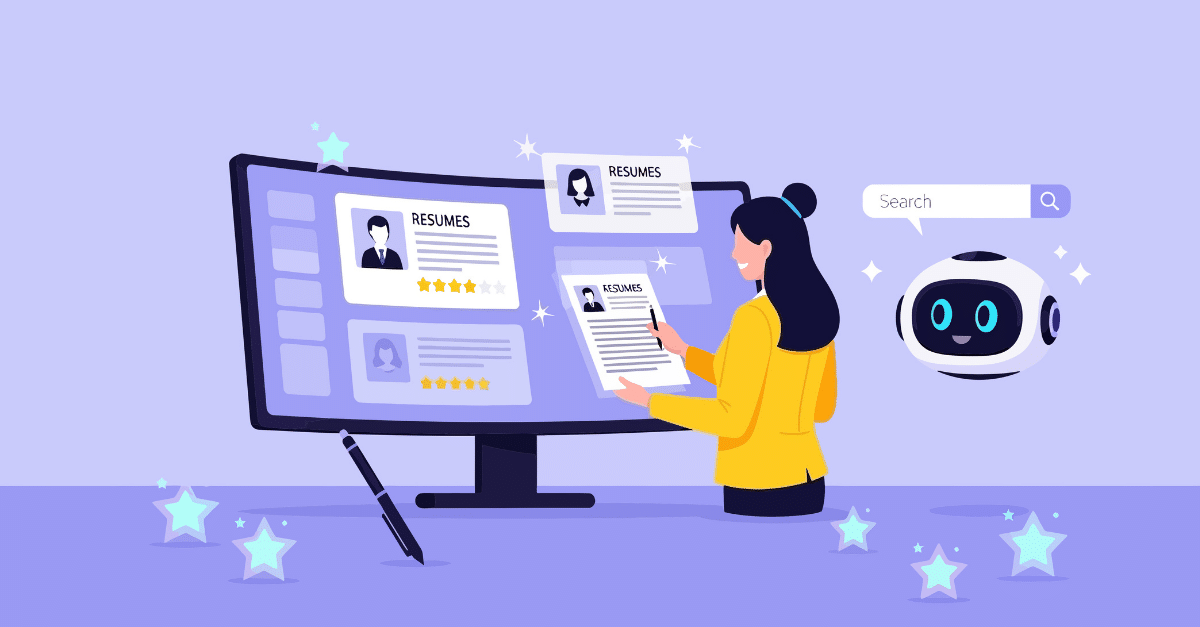
Reviewing resumes by hand consumes a great deal of a recruiter’s time, which is why early applicant-tracking systems included tools for screening resumes based on matching keywords. AI is taking these screening tools to the next level.
“Bots will be able to scan and identify the top resumes in a batch of applicants,” says Leanne Wong, leadership development and performance coach at MC Partners. The use of natural language processing will allow AI-enabled systems to read resumes more effectively, since NLP helps the system identify synonyms and variations in phrasing that earlier resume-scanning systems couldn’t spot.
Candidates also like AI for its perceived objectivity. About 56 percent of candidates who have experienced job discrimination say that they trust artificial intelligence to reduce bias in the hiring process and give them a fairer shot at the work they feel confident to perform, Conner Forrest at TechRepublic reports.
Candidates appreciate knowing that the hiring managers on the receiving end of an application will only be considering the candidates’ skills — not their ages, genders, ethnicities or other personal characteristics that might bias a hiring decision. In fact, masked screening tends to invite more female candidates to apply. We’ve seen upticks of nearly 20 percent in women applicants when the screening process is masked.
An added benefits: Companies that use AI to screen candidates gain an additional reputation boost among job-seekers.
Screening interviews and skills assessments
AI-based tools can also help recruiters and hiring managers conduct screening interviews. Video platforms equipped with artificial intelligence algorithms can also evaluate not only what candidates say, but also how they carry themselves, says Dr. Terri Horton, founder of TLT Consulting. For instance, AI can help recruiters and hiring managers get a better read of a candidate by evaluating vocal tone, pace and syntax, and facial and body language.
AI-enabled tools can both save time and reduce subjectivity in candidate screening. Research in using artificial intelligence to meet this goal in education is already taking place. For instance, a 2018 study in the European Journal of Education, authored by Michael O’Leary and colleagues, describes AI-enabled software that can evaluate students’ constructed essay answers for clarity and comprehension. Equipped with natural language processing, these systems could easily be adapted to better evaluate candidates’ written or spoken answers.
Interviewing and job offers
Keeping candidates engaged throughout the hiring process can be challenging. Artificial intelligence can improve engagement by improving communication in several ways, Hannah Morgan at US News & World Report writes.
First, AI-enhanced communications can ensure that companies stay more proactively engaged with candidates. Automated emails, for example, can keep candidates informed of the hiring process, and AI can personalize each email for the candidate’s needs.
Second, AI chatbots and similar tools can help ensure that candidates get the information they need when they need it, even if recruiters or hiring managers aren’t in the office. Chatbots, for example, can answer questions from candidates or provide basic information about the company, all on the candidate’s schedule.
AI can soften the blow of worst-case scenarios, too. Traditionally, when a candidate abandoned the hiring process, recruiters had to start from scratch in courting a new candidate. With the use of AI platforms, however, applicant data is already stored and sorted, making it easier to return to the list of candidates without having to build a new pool.

Onboarding and Training
AI’s ability to improve candidate-recruiter relationships extends beyond applications and screening. By taking on high-volume, low-value tasks, AI gives recruiters and hiring managers more time to spend with candidates.
The technology can help reduce turnover, as well. Currently, about 65 percent of new hires search for another job within the first three months after their start date, Karsten Strauss at Forbes reports. That so many professionals step into a new job only to face immediate dissatisfaction indicates that recruiters and hiring managers aren’t making the best possible match between the person and the role.
Here, Strauss says, using data correctly is essential. Companies that leverage AI to analyze data and apply key results can improve not only their hiring process, but also the onboarding and training that may convince a new hire of their own ability to thrive on the job.
For example, training software that incorporates AI can adapt to new hires’ needs by predicting which questions they’ll ask first and then providing the answers. These tools can also learn how to provide better answers to frequently asked questions over time, says Lin Grensing-Pophal at L&D Daily Advisor. Similar tools can be used to improve training by adapting to user inputs, drilling new hires harder on weak concepts until their grasp of all the necessary information is up to par.
At each step of the hiring process, artificial intelligence can tackle high-volume, low-value tasks, giving recruiters more time to focus on the human element of finding and keeping top talent.
Images by: Dmitrity Shirosonov/©123RF.com, ammentorp/©123RF.com, piksel/©123RF.com