

Candidate expectations have shifted, and the technology underneath them has too.
Recorded, one-way video interviews are increasingly seen by candidates as a step back rather than forward. A one-way recording asks candidates to perform for a webcam and wait. A real conversation responds as they speak.
The bar has moved from “can a candidate be assessed asynchronously” to “can a candidate have a real, responsive conversation, anytime, in their own language.”
For more than a decade, one-way video defined what an AI-native interview looked like: a candidate records answers to a fixed set of questions, and a recruiter reviews the playback later. HireVue built its category on that model, and it was a real improvement over phone screens at scale, but the one-way format is increasingly a dated fit for what candidates now expect.
That’s the gap Eightfold AI Interviewer is built to close.
See how AI Interviewer works.
From recorded playback to a fluid conversation
The core difference is simple to state and significant in practice: Legacy systems, like HireVue, pair a one-way video recording with a separately validated assessment to score skills. A recruiter reviews the result after the recording is complete.
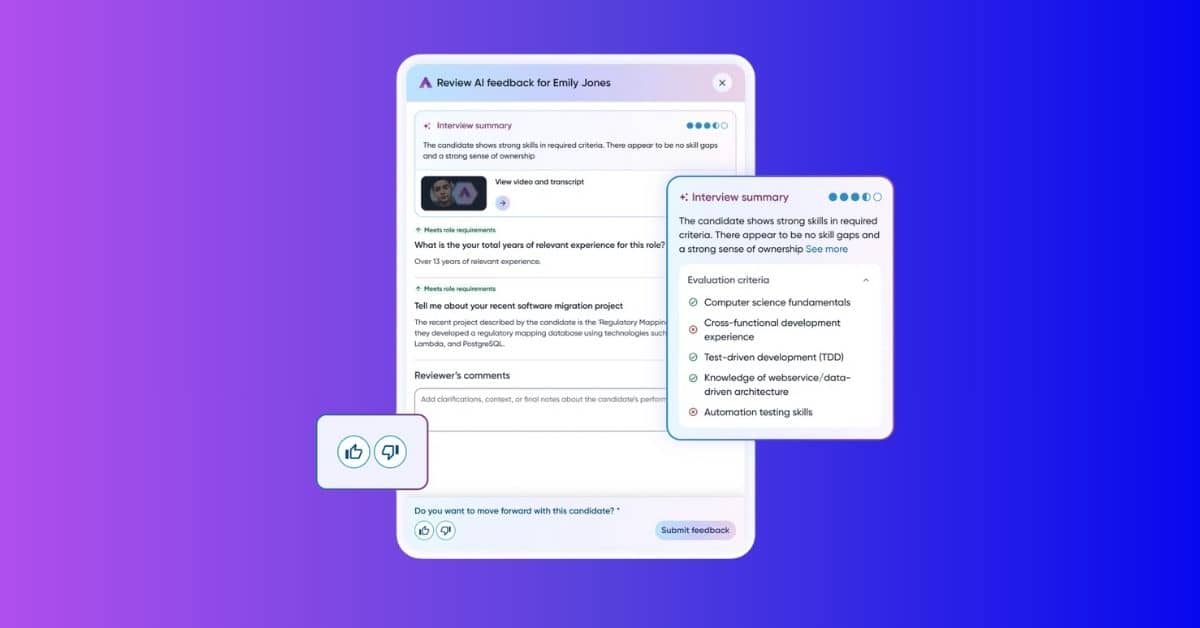
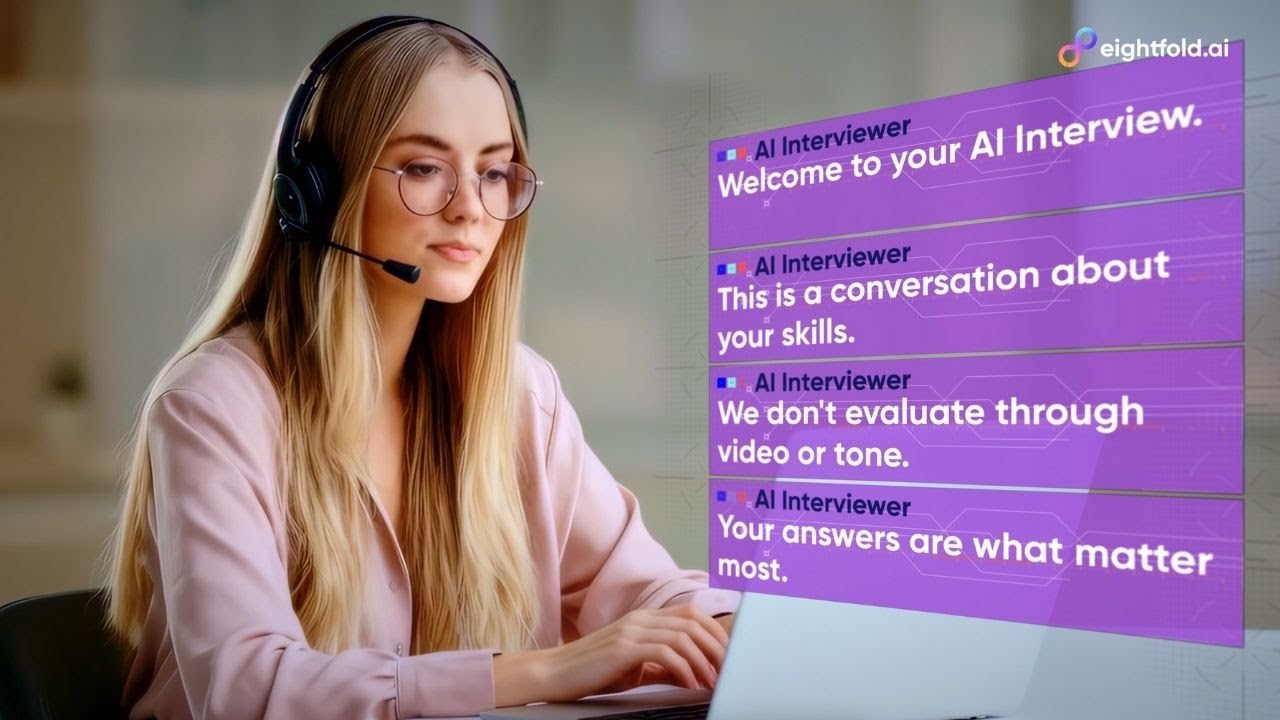
AI Interviewer conducts a more realistic interview, in real time.
When a candidate responds to a question in part or not with the expected level of detail, the agent asks a dynamic follow-up designed to elicit a full response instead of moving to the next fixed prompt. It can move between technical, functional knowledge, and reasoning questions inside one fluid conversation, and it runs on the same underlying intelligence that powers matching and internal mobility across the rest of the platform.
Why this matters more depending on the role
High-volume and hourly hiring: Candidates can interview the moment they apply, 24/7, in 22+ languages, with CEFR-based language proficiency built into the interview. One-way video, by contrast, depends on candidates remembering to come back and complete a recording, which caps completion rates.
Early career and campus hiring: Students juggling exams and multiple offers can interview on their own schedule instead of waiting for a recruiter or a campus event slot. The adaptive conversation also gives entry-level candidates room to respond more fully against the role’s evaluation criteria, even when a résumé is thin on experience.
Technical hiring: Coding, reasoning, and functional knowledge one adaptive conversation rather than as a separate test run apart from the interview.

The Oracle Recruiting Cloud advantage
For organizations already running Oracle Recruiting Cloud, there’s now a more direct path to modernizing the interview stack.
AI Interviewer is embedded inside Oracle Recruiting Cloud workflows rather than sitting alongside them as a separate add-on, and it can be procured through the Oracle Cloud Marketplace using existing Oracle Universal Credits — which means teams can get started without opening a new budget line.
The impact on speed has been significant for early enterprise deployments. Hiring cycles that typically run around 42 days have compressed to as few as five days — a difference that matters most for roles where time-to-fill directly affects revenue or service levels.
Addressing the new HireVue voice AI
HireVue recently introduced its own voice AI interviewing capability, following its acquisition of Hireguide in March 2026.
HireVue positions its new voice interviewer to qualify candidates earlier in the funnel, before the first recruiter call.AI Interviewer has been in market as a full, multimodal interviewer integrated with matching and assessment across the hiring life cycle.
Teams evaluating solutions should ask how integrated and proven the underlying agent actually is, not just whether the feature exists.
Where Eightfold pushes ahead
Validated, static assessments still have a place in hiring — these are a reasonable foundation for measuring specific skills. What Eightfold adds is the layer those assessments can’t provide on their own: a live, adaptive conversation tied to a continuously learning engine built on more than 1 billion career profiles. The combination gives talent teams a fuller picture of a candidate than either a static test or a recorded video can deliver alone.
Language support tells a similar story. Breadth of language coverage matters less than depth of engagement. A genuinely adaptive, two-way conversation surfaces far more about a candidate’s fit and communication skills than a one-way recorded monologue, regardless of how many languages that monologue is available in.
Governance is where the distinction is most concrete. Among other certifications, Eightfold holds ISO 42001 certification for AI management systems. Customers can integrate interviews with identity verification through our partners, CLEAR, opt to capture interview signals that help determine if interview cheating is occurring, including tab-switching detection. These controls are built for the scale and scrutiny enterprise hiring now requires.
What the numbers show
- Average time to interview of approximately a day, contributing to a 33% reduction in overall time to fill
- Approximately 80% less manual review work for recruiters
- A 93% candidate NPS
- Eightfold match scores that correlate with higher promotability and lower attrition
The bottom line
Recorded video interviews solved a real problem at a different point in hiring’s evolution. But candidates now expect something closer to a real conversation, and talent teams need a system that delivers this.
That’s the shift underway, and it’s why enterprise teams running legacy systems today are taking a closer look at what a real-time, conversational interviewer can do instead.
If you’re evaluating your current talent acquisition stack, talk to our team about how a switch to AI Interviewer could impact your hiring volume and timeline.
See the AI Interviewer in action — request a demo today.