

For most of modern business history, workforce planning has followed a simple and stubborn equation: more output requires more people. You needed to hire your way to growth, staff your way to scale, and accept that human bandwidth was the hard ceiling on what your organization could accomplish.
That equation is breaking down — and for CPOs and CFOs, the implications are significant. We are entering an era of workforce abundance, where the constraint is no longer how many people you can hire but how quickly you can re-architect your organization to harness a new class of capacity.
Agentic AI — systems that don’t just assist but autonomously act, execute multi-step workflows, and make constrained decisions at scale — is rewriting the math of what’s possible.
Understanding what that shift actually means, operationally and financially, requires stepping back from the tools and looking at the architecture.
The human-scale ceiling is a structural problem, not a resource problem
Legacy workforce planning models were built around a linear assumption: capacity scales with head count. To process more résumés, hire more recruiters. To onboard faster, staff more coordinators. To interview more candidates, add more calendar slots.
Every operational ceiling had the same solution: more humans doing more tasks.
The problem isn’t that this approach was wrong for its time. The problem is that it treats human bandwidth as the only available resource.
In a world where agentic AI can autonomously execute end-to-end workflows — conducting interviews, screening candidates, mapping skills, identifying gaps — that assumption no longer holds.
This is what researchers and practitioners are calling the human-scale ceiling: the hard limit on organizational capacity that exists not because of budget or talent, but because every single task requires a human to execute it.
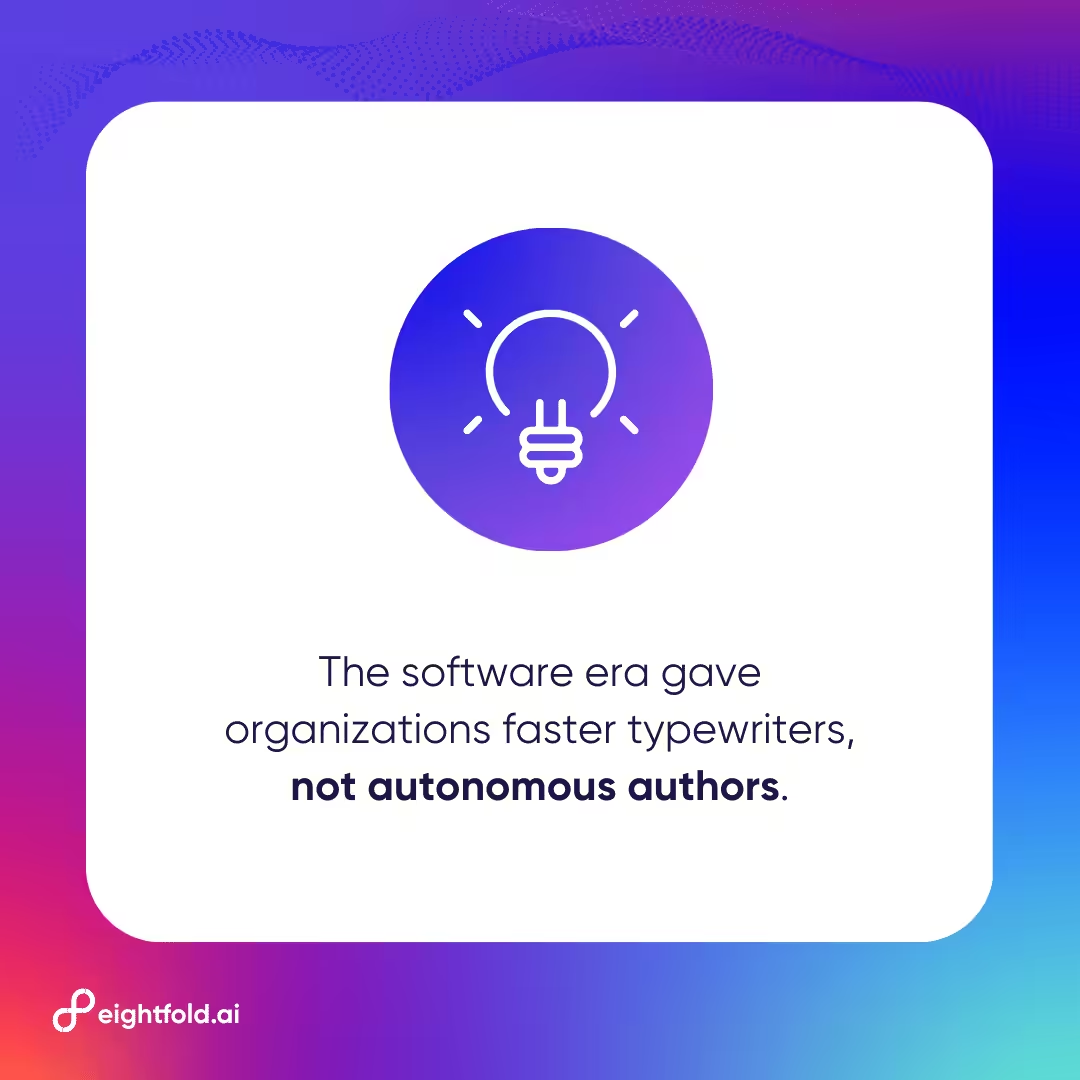
Software investments haven’t solved this — they’ve accelerated tasks without eliminating them. As one framing puts it, the software era gave organizations faster typewriters, not autonomous authors.
For CPOs, this shows up as recruiter burnout, slow time-to-fill, and talent pipelines that can’t keep pace with business demand. For CFOs, it shows up as a cost structure that scales linearly with growth and a growing gap between what AI-native competitors can do and what legacy-model organizations can afford.
Agentic AI doesn’t optimize the ceiling — it removes it
The shift from AI-as-assistant to agentic AI is a meaningful architectural change, not a marketing distinction. Agentic systems can set sub-goals, chain decisions together, and execute complete workflows — not just surface recommendations for humans to act on.
In talent acquisition specifically, this means the difference between a tool that helps a recruiter schedule faster and a digital worker that conducts the interview autonomously.
The productivity numbers emerging from early adopters are striking. Organizations deploying agentic talent solutions are reporting up to five times productivity gains in talent acquisition — not by working harder, but by shifting recruiters from execution to orchestration.
The manual work, such as screening, scheduling, initial interviewing, is absorbed by digital workers. Human work, like judgment, persuasion, and strategy, is elevated.
Hiring timelines are compressing just as dramatically. Where traditional recruiting cycles run six weeks or more from application to offer, agentic systems are reducing that to days — in documented cases, as few as five.
Our AI Interviewer, for instance, has compressed hiring cycles from 42 days to under a week, with 80% of manual recruiter work automated and a 92.5% interview completion rate maintained.
For organizations competing for scarce technical talent or scaling rapidly, that velocity gap is not a marginal improvement. It is a structural competitive advantage.
The new workforce math: From head count to manufactured intelligence
The concept of the Infinite Workforce reframes how organizations should think about capacity planning. Rather than asking “how many people do we need to hire to meet this goal?” the question becomes “how do we architect the right combination of human judgment and digital execution?”
In this model, digital agents handle high-volume execution: sourcing candidates, conducting screening interviews, assessing skills, mapping career trajectories. Human talent leaders operate above that layer — setting strategy, making high-stakes decisions, building relationships with candidates, advising on workforce design.
The ratio of output to head count changes fundamentally. A recruiting team of 10, properly supported by agentic AI, can operate at the capacity of a team of 50 without the associated cost structure.
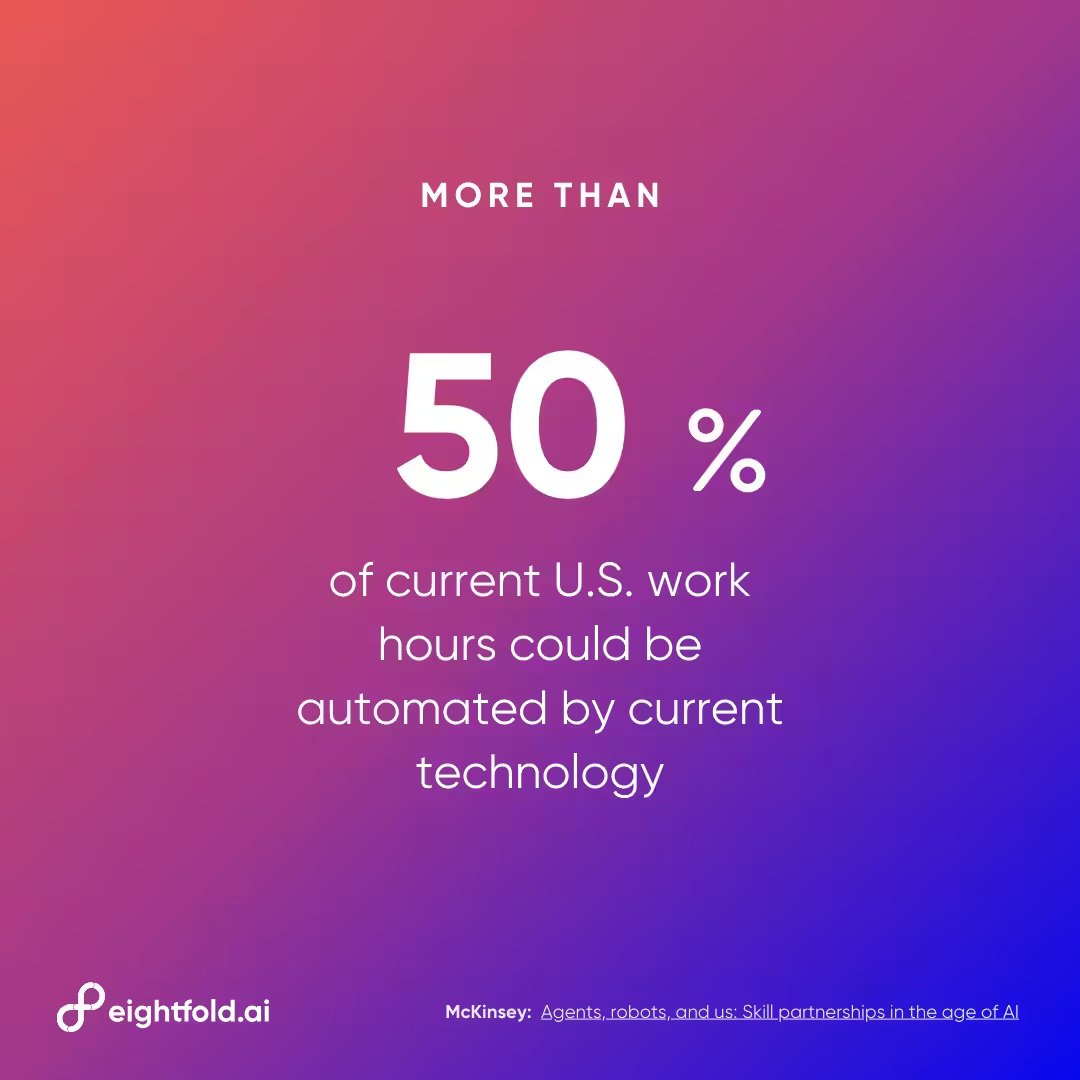
McKinsey research suggests that currently demonstrated technologies could automate activities accounting for more than half of U.S. work hours. PwC analysis of nearly a billion job postings found that AI-exposed industries are already achieving nearly three times the revenue growth per employee compared to their less AI-integrated counterparts.
The financial case for re-architecture is not speculative — it is emerging in real earnings data.
For CFOs, this reframes the workforce as a variable that can scale non-linearly with investment. For CPOs, it reframes the talent function from a cost center constrained by head count to a strategic capability that manufactures intelligence on demand.
The architectural trap most organizations are already in
The barrier to capturing this advantage isn’t awareness — it’s architecture. Most enterprise organizations fall into one of two traps when they try to modernize.
The first is the legacy trap. Traditional HR systems, built for administration, compliance, and record-keeping, were designed for the industrial age. They treat people as static records. They can tell you who works here; they cannot tell you what a given person is capable of becoming.
More importantly, they are architecturally incapable of supporting agentic execution. You cannot retrofit a system of action onto a system of record. Adding an AI feature to a legacy platform doesn’t create a digital worker. It creates a faster filing cabinet.
The second is the generalist trap. General-purpose LLMs are powerful tools for many tasks, but they are architecturally misaligned with high-stakes talent decisions. They lack what practitioners call spatial intelligence for the world of work — the deep understanding of how careers develop, how skills transfer across roles, and what compliance guardrails govern hiring decisions.
Using a general-purpose chatbot to make workforce decisions is not just imprecise; in regulated environments, it introduces real legal exposure.
The organizations moving beyond both traps are building on purpose-built agentic platforms — systems designed from the ground up to act, not just recommend; to reason about talent potential across billions of real-world career trajectories, not just internal data; and to operate with the compliance and auditability that enterprise deployment demands.
Our Agentic Talent Operating System is one example of this architecture in practice, combining a global talent intelligence engine with specialized digital workers built for end-to-end execution.
What this means for planning cycles now
The velocity at which AI-native organizations are pulling ahead means the window for measured, phased adoption is shorter than most planning cycles assume. The World Economic Forum projects that 39% of workers’ core skills will change by 2030.
Organizations that can identify, reskill, and redeploy talent at machine speed will respond to that shift. Organizations running on manual processes will not.
For CPOs and CFOs evaluating where to start, talent acquisition is the natural proving ground — it is simultaneously the most constrained function and the most measurable one.
Time-to-fill, cost-per-hire, recruiter utilization, and candidate experience scores are already tracked. An agentic proof of concept in high-volume recruiting generates concrete ROI data within 30 to 60 days, builds internal capability, and creates the organizational muscle for broader transformation.
The more important shift, though, is conceptual. Workforce planning built around head count assumes that capacity is finite and human. Workforce planning built around talent superintelligence assumes that capacity is architected and that the right design can scale output without scaling cost proportionally.
The organizations that internalize that shift now — that stop asking how many people they need and start asking how they architect the right combination of human judgment and agentic execution — are the ones building the workforce their future demands, rather than managing the one they inherited.
The math of the Infinite Workforce is still being written, but the organizations running the first proofs of concept aren’t waiting for the final answer. They’re generating it.
Request a demo and explore how our agentic talent solutions are compressing hiring cycles and unlocking capacity abundance at scale.