
The Infinite Workforce
Escaping the legacy trap and scaling human potential with agentic AI
Table of contents
Welcome to the Intelligence Revolution
We are living through one of the most profound shifts in history since the Industrial Revolution — the transition from working with software to scaling human potential with the power of agentic AI.
For decades, business growth has been dependent on the physical and cognitive limits of human recruiters. Traditionally, talent acquisition has been constrained by the limits of human bandwidth — defined by manual résumé screening, recruiter capacity, and administrative overhead. That era is over.
As talent leaders, you should no longer be discussing HR software. You should be discussing how to create an “Infinite Workforce,” where your recruiters stop managing processes and start orchestrating AI agents to execute hiring at scale. Imagine what you can achieve when you partner with agentic AI to take on the administration work while you build competitive advantages with larger talent pools and higher quality talent.
Generative AI has the potential to add between $2.6 trillion and $4.4 trillion annually to the global economy, according to McKinsey research. Critically, HR is pinpointed as a primary beneficiary of this growth, with 20% of its total value potential locked within talent acquisition and recruiting.
The age of infinite capacity
From software to superintelligence
We are standing at the threshold of the most profound shift in productivity since the Industrial Revolution: the transition from the era of software’s Information Age to the era of superintelligence — the Intelligence Age.
For decades, the relationship between humans and technology was predictable and linear. Technology was a tool — a passive instrument that sat idle until you gave it a command. You digitized forms, automated spreadsheets, and moved filing cabinets to the cloud. But even with these tools, the fundamental nature of work didn’t change. Your teams remained the sole executors of every task, creating a natural ceiling to organizational capacity. It’s time to shatter that ceiling.

The shift to agentic AI
According to Deloitte, six in 10 workers already think of AI as a coworker. Embracing digital workers is the next natural step as organizations look to scale. This represents a fundamental shift from an era defined by labor scarcity to one defined by capacity abundance.
Agentic AI is engineered to work in this dynamic environment. It has the ability to help you tame the unpredictable, see the unseen, and work toward solving HR challenges like reducing time to hire and improving candidate matching in real time. It doesn’t just automate steps or follow a pre-programmed path. Agentic AI reasons through complexity, adjusts strategies, and interprets context as it unfolds.
Most false agents rely on predefined flows and single-shot prompts. The reality is that talent work is recursive, often circling back to refine judgments, reconsider priorities, or revisit prior answers. These are all functions where agentic AI thrives.
The world of HR will continue to be more complex as AI and skills evolve. And as complexity scales, only AI that can blend automation with embedded reasoning will keep pace.

6 out of 10
workers already think of AI as a coworker.
2025 Global Human Capital Trends report
— Deloitte
The phenomenon of time compression
The most immediate impact is what experts call time compression. Where previous industrial cycles measured progress in decades, we’re now compressing a century of advancement into a single decade.
Consider these examples:
Drug Discovery
Research that took years now happens in days.
Material science
Breakthroughs that required 20-year cycles now take months.
Enterprise operations
Complex coordination of people, strategy, and execution now happens at the speed of thought.
As a CHRO or talent acquisition leader, this creates urgency. If your competitors are using agentic AI to compress hiring cycles by 70% to 90%, your traditional linear talent models will leave your organization structurally disadvantaged within years, not decades.
A new operating model: The Infinite Workforce
This reality demands a new architectural framework — the Infinite Workforce.
Legacy models were simple: double your output, double your head count. This linear scaling belongs to the past. The Infinite Workforce is a hybrid model where people orchestrate digital agents to operate beyond the constraints of traditional capacity limits.
Here’s how it works:
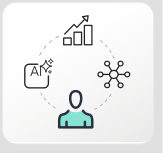
Agents handle execution at scale
Digital agents manage high-volume, data-intensive work. Unlike AI assistants that simply suggest edits, these agents execute complete workflows — from complex talent sourcing to managing global supply chains.

Talent leaders orchestrate from above
Instead of working in the weeds, your recruiters work above the operational layer. When agents handle administrative and repetitive tasks, they become architects and orchestrators — setting strategic direction, making judgment calls, and applying human capabilities.
In your Infinite Workforce, recruiting teams focus on what machines cannot replicate:
The destination: The cognitive enterprise
Your goal in this transition is to become a cognitive enterprise — an organization that doesn’t just use AI but runs on talent superintelligence.
Your cognitive enterprise learns, adapts, and innovates at rates human-only organizations cannot match. Talent is not a static cost to manage, but an infinite asset to liberate.
The WEF projects that 39% of workers’ core skills will change by 2030. Only your cognitive enterprise can respond at this pace — identifying, reskilling, and redeploying talent at market speed rather than manual HR process speed.
Real-world proof: The transformation of talent acquisition
This isn’t theoretical. It’s a $100 billion transformation happening now, with talent acquisition as the proving ground.
Why talent acquisition? It’s traditionally the most constrained department when it comes to scaling. But if your organization is already deploying digital agents, you can achieve unthinkable outcomes:

Dramatic productivity gains:
Agentic solutions save hiring managers and recruiters up to 70% of their time on sourcing activities, freeing them for personalized outreach, coaching, and strategic decisions, according to PwC research. Additionally, 66% of organizations adopting AI agents report measurable productivity value.

Revenue acceleration:
Revenue acceleration: Additionally, PwC analyzed nearly a billion job ads globally and found that AI-exposed industries achieved nearly three times higher revenue growth per employee (27% vs. 8.5%). PwC’s internal deployment of AI agents delivered 50% to 90% productivity gains across functions, proving how AI agents can fundamentally transform workforce capacity.


Closing the talent gap with AI at Eaton.
Eaton was looking for a way to modernize its talent acquisition process. Hiring nearly 15,000 people a year, Eaton’s recruiting teams needed to streamline dozens of systems and processes to better support its hiring process. It’s why their talent leaders turned to a solution powered by AI.
The challenge
Eaton keeps the world running with safe, sustainable power solutions, but to do that, the company needs the right people. Finding and hiring more than 15,000 employees each year was growing increasingly challenging due to its complex talent acquisition technology stack and fragmented recruiting processes
The solution
With AI, Eaton was able to give recruiters intelligent and automated tools to scale efforts, create a smoother candidate experience, and provide visibility into the opportunities employees craved.
These efforts led to a nine-day decrease in time to offer, $2.4 million in cost savings, and a 300% increase in the size of the company’s talent network, helping secure the right talent in a highly competitive marketplace.
The outcomes
4x increase in talent networks.
30-40% increase in candidate velocity.
Double-digit increases in all recruiting metrics: time to market, time to present, time to offer
Your “human scale” era is over. The era of your Infinite Workforce has begun.
The research is clear — the only constraint is how quickly you can rearchitect your organization to harness infinite capacity.

Frequently asked questions
To learn more about Infinite Workforce, here are some questions to get you started.
What is an Infinite Workforce in the context of AI?
An Infinite Workforce is a hybrid operating model where human talent leaders orchestrate AI agents — autonomous digital workers — to execute high-volume recruiting and HR tasks at a scale that no human team could match alone. Rather than adding headcount to increase output, organizations deploy AI agents on demand, breaking the traditional one-to-one relationship between staff size and capacity. The concept is explored in depth in Eightfold AI’s ebook, The Infinite Workforce.
What is agentic AI and how is it different from traditional HR software?
Agentic AI refers to AI systems that can autonomously execute complete workflows — not just assist humans with tasks. Traditional HR software digitizes processes but still requires a human to initiate every action, effectively giving organizations “faster typewriters.” Agentic AI, by contrast, eliminates tasks entirely by doing the work itself. sourcing candidates, conducting interviews, and managing communications without waiting for human input at each step.
What steps should HR leaders take to successfully implement AI transformation?
Eightfold AI research identifies seven pillars organizations need to drive successful AI innovation:
- Ensure leadership alignment between the CHRO and C-suite.
- Nurture an innovation and experimentation culture.
- Set governance and security guardrails for responsible AI use.
- Develop AI talent and skills across the workforce.
- Build a modern data and technology platform.
- Optimize and redesign processes with AI.
- Create a forward-looking vision for how people and machines will work together.
Organizations that address all seven — rather than treating AI adoption as a purely technical project — are significantly more likely to see measurable business impact.
What are the biggest barriers to AI adoption in HR?
Based on an Eightfold AI survey of 700 global organizations, the top barriers to AI innovation in HR are. lack of AI skills and knowledge (cited by 64% of respondents), staff resistance to adoption (55%), and organizational silos that prevent transformation (47%). Notably, these are people and culture challenges — not technology challenges — which is why early CHRO involvement in AI transformation is critical.
Why do general-purpose AI tools like ChatGPT fall short for hiring decisions?
General-purpose large language models (LLMs) are optimized for language fluency, not hiring accuracy. They have no training on actual hiring outcomes, lack built-in fairness mechanisms to prevent demographic bias, and don’t understand the nuanced career physics of skill adjacency and role transitions. In internal research by Eightfold AI, the best general LLM tested scored only 0.773 on an intersectional fairness measure, compared to 0.906 for a purpose-built hiring model — a significant gap with real consequences for candidate equity and legal compliance.
What is skills-based hiring and why does it still matter for AI-era recruiting?
Skills-based hiring is an approach that evaluates candidates on their demonstrated and adjacent capabilities rather than relying on résumés, job titles, or credentials alone. It matters because traditional job descriptions are static — they reflect the past, not future potential. Research cited in The Infinite Workforce shows that more than half the skills required for account executive roles also appear across 175 other occupations, meaning talent pipelines can be dramatically widened by looking beyond obvious candidates. AI-powered talent intelligence makes skills-based hiring practical at scale by mapping billions of real-world career trajectories to identify non-obvious matches human recruiters would miss.
What real-world results have companies achieved with AI-powered talent acquisition?
Several enterprise organizations have reported measurable outcomes after implementing AI-native talent solutions.
- Eaton achieved a 4x increase in talent network size, a 30–40% increase in candidate velocity, a nine-day decrease in time to offer, and $2.4 million in cost savings.
- Softtek integrated 90% of its workforce into an AI platform and saw a 25% improvement in time to candidate and a 30% reduction in time to fulfill.
Why should the CHRO lead AI transformation, not just the CIO?
AI transformation in the enterprise is fundamentally a people challenge. Organizations that involve their CHRO early are 81% less likely to face AI skills gaps, 41% less likely to experience staff resistance, and 36% less likely to be blocked by organizational silos. Organizations that build a strong CHRO-CIO partnership from the start also report 88% higher staff productivity, 84% higher profitability, and 84% higher retention — yet only 1% of organizations just beginning their AI journey recognize this partnership as essential.
What are the three core components of an agentic talent operating system?
According to The Infinite Workforce, an effective agentic talent operating system is built on three layers.
- The Fuel — A 360-degree global talent map trained on billions of real-world career trajectories, providing context that internal-only legacy data cannot supply.
- The Brain — A talent intelligence engine that replaces generalist AI guesswork with domain-specific reasoning, predicting where candidates can go rather than just cataloguing where they’ve been.
- The Hands — The agentic layer of specialized digital workers (AI interviewers, career coaches, manager assistants) that autonomously execute end-to-end workflows at scale.
How can a company start using agentic AI in recruiting without a full system overhaul?
Organizations don’t need a complete transformation to get started. The recommended approach is a focused proof of concept within 30 days. identify one high-volume recruiting process where manual work creates the biggest bottleneck (such as initial phone screens or first-round interviews), deploy an AI agent alongside the existing process, and track four metrics — time-to-fill reduction, recruiter hours saved, interview completion rates, and candidate experience scores. This generates concrete ROI data and builds internal momentum for broader adoption, without requiring enterprise-wide change from day one.
Ready to join the Intelligence Revolution?