

There are jobs where a slow hire is just an inconvenience, and there are jobs where a slow hire is a risk.
A defense contractor short on cleared analysts. A fire department running under minimum staffing. A police department stretching patrol shifts because the academy class won’t graduate for months.
In these environments, hiring delays don’t just frustrate HR teams. They leave critical posts uncovered, put pressure on the people already doing the work, and in some cases, put communities at risk.
That tension — move fast, but don’t get it wrong — has historically felt like a trade-off.
Organizations in military, defense, and public safety have leaned toward rigor over speed, because the cost of a bad hire is higher than the cost of a slow one. But that trade-off is starting to look less like a law of nature and more like a limitation of the tools these organizations have been using.
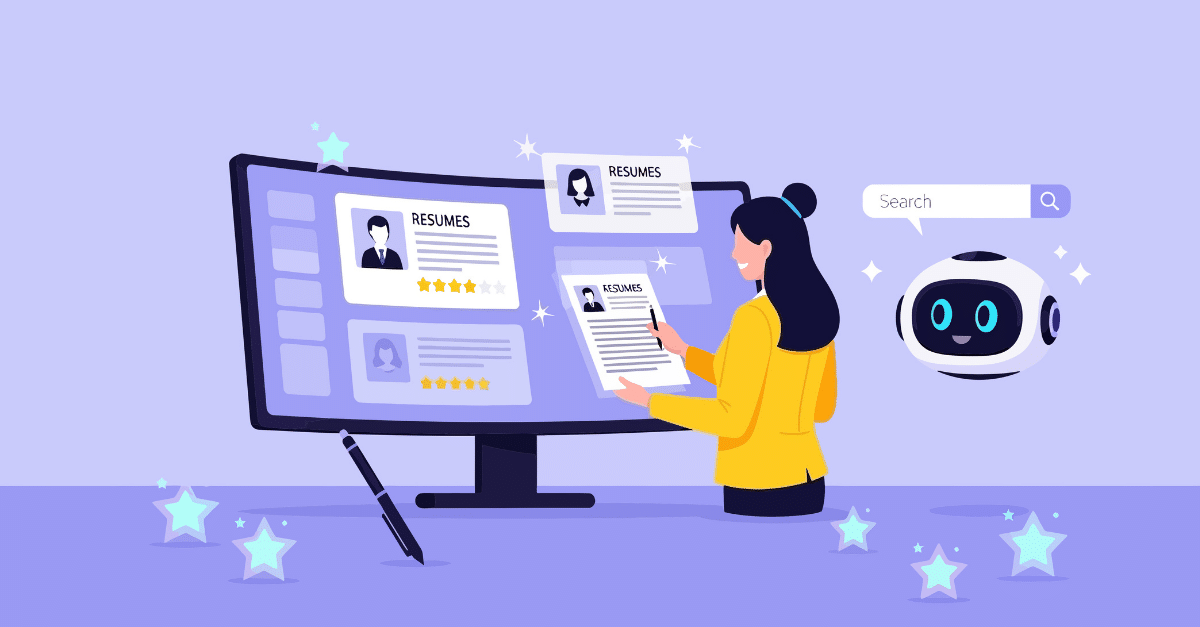
AI interviewing is changing that equation. It gives defense-adjacent employers and public safety agencies a way to move candidates through the early stages of hiring dramatically faster, without loosening the structure, consistency, and documentation these roles have always required. Speed and standards aren’t actually opposites here — they just needed the same tool to solve for both.

What is AI Interviewer? Get to know this agent and how it can improve the hiring process.
Why these sectors face similar hiring challenges
Military and defense civilian roles and public safety positions don’t look alike on the surface, but they’re fighting the same underlying battle.
Both demand a high bar for candidate quality. A contractor supporting a defense program and a paramedic responding to a 3 a.m. call are both roles where there’s little room to learn on the job — the skills and judgment need to be there from day one.
Additionally, these sectors are short on candidates.
Defense and security employers are competing with private industry for cleared and skilled talent. Public safety agencies are facing what many departments now openly call a recruiting crisis, with shrinking applicant pools and rising competition for the people who do apply.
In both cases, every extra day in the pipeline is a day a strong candidate can walk toward a faster-moving employer instead.
Both require a hiring process that can hold up to scrutiny. Inconsistent interviews, undocumented decisions, and evaluator-to-evaluator variation aren’t just bad practice in these sectors — they’re liabilities. Whether it’s an audit, a union grievance, or a public records request, the process has to be defensible after the fact, not just fast in the moment.
That shared ground is exactly where AI interviewing earns its place: it’s built to compress time without compressing rigor.

Military and defense
Defense-adjacent civilian roles — analysts, program support, logistics, cleared contractor positions — sit in a particularly tight intersection. These roles need to be filled quickly to keep programs staffed and missions supported, but they also need a hiring process rigorous enough to survive scrutiny.
Inconsistency in how candidates are evaluated is exactly the kind of gap that becomes a finding in an audit.
This is where an AI interviewer changes the shape of the problem.
Every candidate answers the same structured, role-relevant questions and is scored against the same rubric. There is no variation based on which recruiter happened to run the interview and no gaps in documentation about why one candidate advanced and another didn’t.
The interview happens as soon as the candidate applies, rather than waiting on a scheduling window, and recruiters get a structured summary and score within hours instead of waiting weeks for a full interview loop to complete.
We have already seen this play out with organizations that can’t compromise on process integrity. Constellis, a global defense and security services provider, needed to fill large volumes of security roles without giving up the compliance rigor and audit trail its industry demands and used our AI Interviewer to do it.
Our platform is also built on infrastructure that meets FedRAMP Moderate and ISO 42001 standards, on top of SOC 2 certification, which matters directly to organizations that have to answer for how candidate data is handled and how hiring decisions are made.
Our Talent Intelligence Platform is already trusted by organizations including the U.S. Department of Defense. This isn’t a general-purpose tool being retrofitted for defense use. It’s a platform built with this level of scrutiny in mind from the start.
There’s another layer worth naming here: AI interviewing is also well-suited to surfacing how military experience translates into civilian roles. Skills like crisis management, structured decision-making under pressure, and team leadership often get lost in a résumé built around military job titles.
A structured interview that’s designed to draw those skills out, rather than a keyword scan that misses them, can turn transitioning service members and veterans into visible, competitive candidates instead of overlooked ones.

Public safety: police, fire, and EMS
Public safety agencies are facing a hiring crisis that’s been building for years. Many departments are understaffed relative to their community’s needs, the work is physically and emotionally demanding in ways that shrink the pool of people willing to do it, and every week a role sits open is a week the existing team is stretched thinner.
In this environment, speed isn’t a nice-to-have — it’s a competitive necessity.
Public safety agencies are increasingly competing with private employers for the same labor pool, and a candidate who has to wait weeks for a first-round interview slot is a candidate who may simply accept an offer somewhere else in the meantime.
AI interviewing addresses this directly by removing the scheduling bottleneck from early-stage screening. Instead of waiting for a recruiter’s calendar to open up, candidates can complete a structured interview within days of applying, and hiring teams can see qualified candidates move forward almost immediately.
The consistency piece matters just as much as the speed here.
In roles where the cost of a bad hire is measured in public trust and physical safety, every candidate needs to be evaluated against the same criteria — not whichever criteria a particular interviewer happened to emphasize that day.
Structured, standardized screening gives public safety agencies a defensible foundation for their hiring decisions while freeing their (often small) HR and recruiting teams to spend their limited time where it matters most: final-round interviews and the human judgment calls that shouldn’t be automated.
The bottom line
Military, defense, and public safety hiring have always operated under a real constraint: these organizations can’t afford to choose between moving fast and getting it right. For years, that meant accepting slow, manual processes as the price of rigor.
That trade-off no longer holds. AI interviewing gives these sectors a way to screen candidates faster, more consistently, and more transparently than manual processes ever could, which means the choice between speed and standards isn’t really a choice anymore.
The organizations that recognize this first will be the ones that fill critical roles while their slower-moving peers are still scheduling first interviews.
If you’re evaluating how AI interviewing could fit into your agency’s or organization’s hiring process, schedule a demo with Eightfold to see how it works for mission-critical, high-compliance hiring.