

Picture this: a hiring manager sends you a Slack message on a Monday morning. Her team just lost two senior engineers to a competitor, a third is going on parental leave in six weeks, and the product roadmap requires four new hires by the end of the quarter.
That’s seven open roles — possibly eight if the departures accelerate — landing on a team of two recruiters who are already managing a full slate of open reqs.
Nobody is doing anything wrong here. The recruiters are experienced. The hiring manager is organized. The job descriptions are ready.
But within days, the cracks appear: scheduling delays, inconsistent candidate feedback, a promising finalist who stops responding because she accepted another offer.
The process hasn’t failed because of effort. It has failed because it was never built for this.
This is one of the most common — and least discussed — problems in talent acquisition: hiring workflows that function reasonably well at steady state quietly collapse when demand spikes. The failure isn’t dramatic. It’s incremental. A day here, a missed touchpoint there. But the cumulative effect is real, and the cost compounds faster than most organizations realize.
The tipping point most organizations never see coming
Most hiring processes are built for a predictable rhythm. A few roles open each month, candidates move through stages on a known cadence, and recruiters can give each search the attention it deserves. That rhythm is what makes the process feel manageable. It’s also what makes it fragile.
When volume doubles or triples through a funding round, a reorg, a market shift, or simply a busy Q3, the system doesn’t gradually slow down. It seizes.
Scheduling backlogs pile up as calendar coordination across multiple stakeholders becomes a full-time job on its own. Interview panels get stretched thin, with the same five subject matter experts asked to evaluate every candidate across every role simultaneously. Candidate experiences become inconsistent, varying wildly depending on which recruiter is least underwater that week.
The research underscores the stakes. Our recent talent survey of 700 global organizations found that the majority of organizations struggle to redesign work rather than simply layer more activity on top of existing processes.
For recruiting, this translates directly: when req volume spikes, organizations reach for familiar solutions — more effort, longer hours, faster screening — rather than examining whether the underlying architecture can handle the load. Usually, it can’t.
Where the delays actually compound
It’s worth tracing the sequence, because the problem isn’t one big failure. It’s a chain of small ones that reinforce each other.
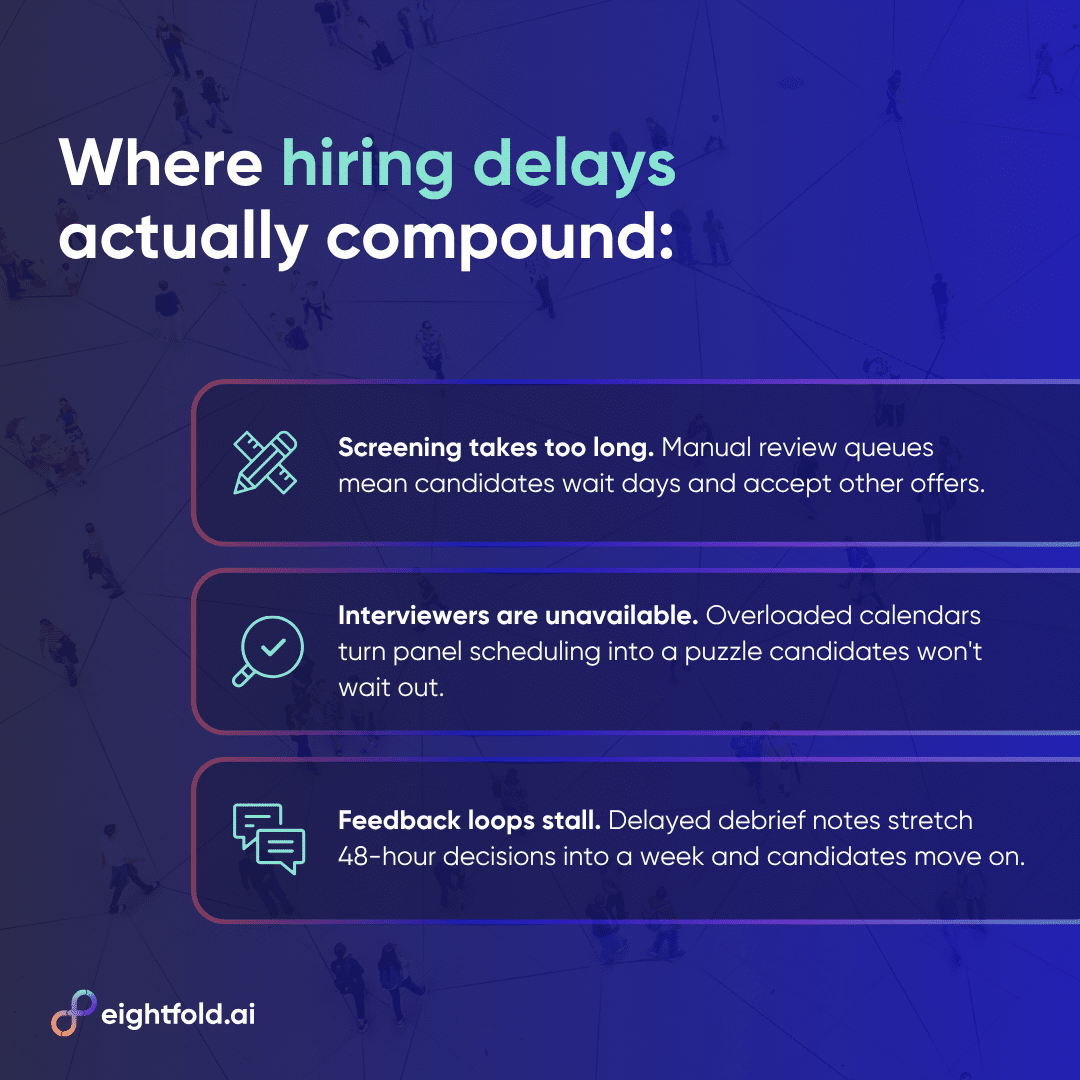
Screening takes too long. When recruiters are managing high volume manually, initial résumé reviews and phone screens get queued. Candidates who applied on Monday may not hear back until Thursday — or later. In a competitive talent market, that window is often enough for a faster-moving competitor to schedule and extend an offer.
Interviewers are unavailable. The same senior engineers, managers, and subject matter experts are needed for every technical role. Their calendars are already full. Coordinating a three-person interview panel for a candidate who has a two-week decision window is, in practice, a scheduling puzzle that often takes longer than the candidate is willing to wait.
Feedback loops stall. Post-interview debrief notes don’t get submitted on time. Hiring managers are stretched across too many searches to give each candidate evaluation the focus it requires. Decisions that should take 48 hours take a week. Meanwhile, the candidate has moved on.
Each of these delays doesn’t just add time to the process in isolation — it triggers the next one. A slow screen means a delayed schedule. A delayed schedule means a compressed decision window. A compressed window means less rigorous evaluation. And throughout all of it, the candidate is also interviewing elsewhere. Top talent rarely waits.
According to PwC research, AI-powered agentic solutions can save hiring managers and recruiters up to 70% of their time on sourcing activities alone. This is a signal of just how much time the manual version currently consumes.
Why hiring more recruiters isn’t the answer
When the process breaks down, the instinct is to add head count. And to be fair, more recruiters do help to a point. But if the underlying workflow is the bottleneck, adding people means adding more people to wait on the same broken steps.
This is one of the key insights from our Infinite Workforce ebook: legacy hiring systems were designed for administration, not action. They track head count, manage compliance, and store records, but they weren’t built to execute at scale.
Software gave organizations faster typewriters, not autonomous authors. Hiring more recruiters to work within an undersized process is the equivalent of adding more people to a factory floor where the assembly line itself is too slow.
The structural problem is this: traditional recruiting is built on a “human-scale speed limit.”
Every step requires a human to initiate it, respond to it, or approve it. Scheduling requires a recruiter to send availability. Screening requires a recruiter to read and evaluate. Feedback requires a hiring manager to document and submit.
When volume spikes, all of those human checkpoints create a compounding bottleneck that more head count can’t fully resolve because the process was designed to require one human to move for another to proceed.
Our research found that despite significant investment in HR technology, more than four in 10 organizations report those investments have failed to meet expectations. The top reason for this failure is that the workforce lacked the capabilities to use the tools effectively. The tools got faster; the process didn’t change.
Learn what scalable hiring actually looks like with AI Interviewer.
What scalable hiring actually looks like
A hiring process that holds up under pressure has a few defining characteristics and none of them are about heroic effort.
First, it’s consistent regardless of volume. Candidates applying for the same role should have the same experience whether you’re processing 20 applications or 2,000. Inconsistency at scale isn’t just a candidate experience problem — it’s a data problem. When screening criteria vary by recruiter, by week, or by bandwidth, you lose the ability to make fair comparisons across the candidate pool.
Second, the early stages move fast. Screening and initial interviewing are where most of the time-to-fill is lost and where the human speed limit bites hardest. A scalable process removes the manual bottleneck at these stages, ensuring candidates hear back quickly and can progress without waiting on a recruiter’s calendar.
Third — and this is the part worth sitting with — it frees your human interviewers to focus where their judgment actually matters. The highest-value moments in a hiring process are the ones that require nuance: assessing culture fit, evaluating leadership potential, building the relationship that converts a finalist into a new hire. Those moments are where your recruiters and hiring managers should be spending their time. Not scheduling. Not routing feedback forms. Not chasing down incomplete interview notes.
This is where AI interviewing enters the picture — not as a replacement for human judgment, but as a digital worker designed to scale.
Rather than helping a recruiter schedule faster, an AI interviewing agent autonomously conducts initial screenings and structured interviews at any volume, 24/7, across languages and time zones.
Early adopters of our AI Interviewer have seen hiring cycles compress from 42 days to under a week, with time to interview reduced by up to 90%. Interview completion rates reach 92.5%. And with up to 80% of manual recruiter work automated at the screening stage, recruiters are freed to focus on the strategic conversations that win top talent.
Critically, this kind of system isn’t built on general-purpose AI. It’s purpose-built for the specifics of hiring, trained on billions of real-world career trajectories, designed to evaluate skills rather than credentials, and structured to reduce bias rather than amplify it.
Our evaluation of LLMs making hiring decisions found that general-purpose large language models significantly underperform purpose-built models on fairness metrics, systematically disadvantaging candidates due to biases in uncurated training data.
Scalable hiring isn’t just about speed; it’s about getting the right answers at speed.
Back to Monday morning
Return to that hiring manager and her seven open roles. In a process built for steady-state volume, that Slack message triggers a scramble. In a process built for scale, it triggers a workflow. Applications start moving immediately. Initial screening happens without waiting on a recruiter’s availability. Qualified candidates are surfaced quickly, consistently, and with documented rationale. By the time a human interviewer enters the conversation, they’re focused on the part of the process that only they can do.
The gap between these two scenarios isn’t about effort or intent. It’s about architecture. Most hiring processes were never designed to absorb volume surges, and recognizing that is the first step toward building one that can.
Download The Infinite Workforce ebook to explore the frameworks, research, and strategies behind building a hiring process that scales without breaking.