

We built entire organizations around rewarding what people know. Now we’re entering an era where knowing things is the least interesting thing about you — especially as AI moves from helpful assistant to semi-autonomous coworker who never sleeps, never forgets, and has memorized your coffee order.
Intelligence has always been prized, but not all intelligence is created equal. As AI becomes more embedded in our workflows and agentic systems begin to act with increasing autonomy, it’s worth revisiting a distinction from psychology that matters more than ever: the difference between crystallized intelligence and fluid intelligence.
Understanding that difference isn’t just academic — it’s strategic.
Two types of intelligence
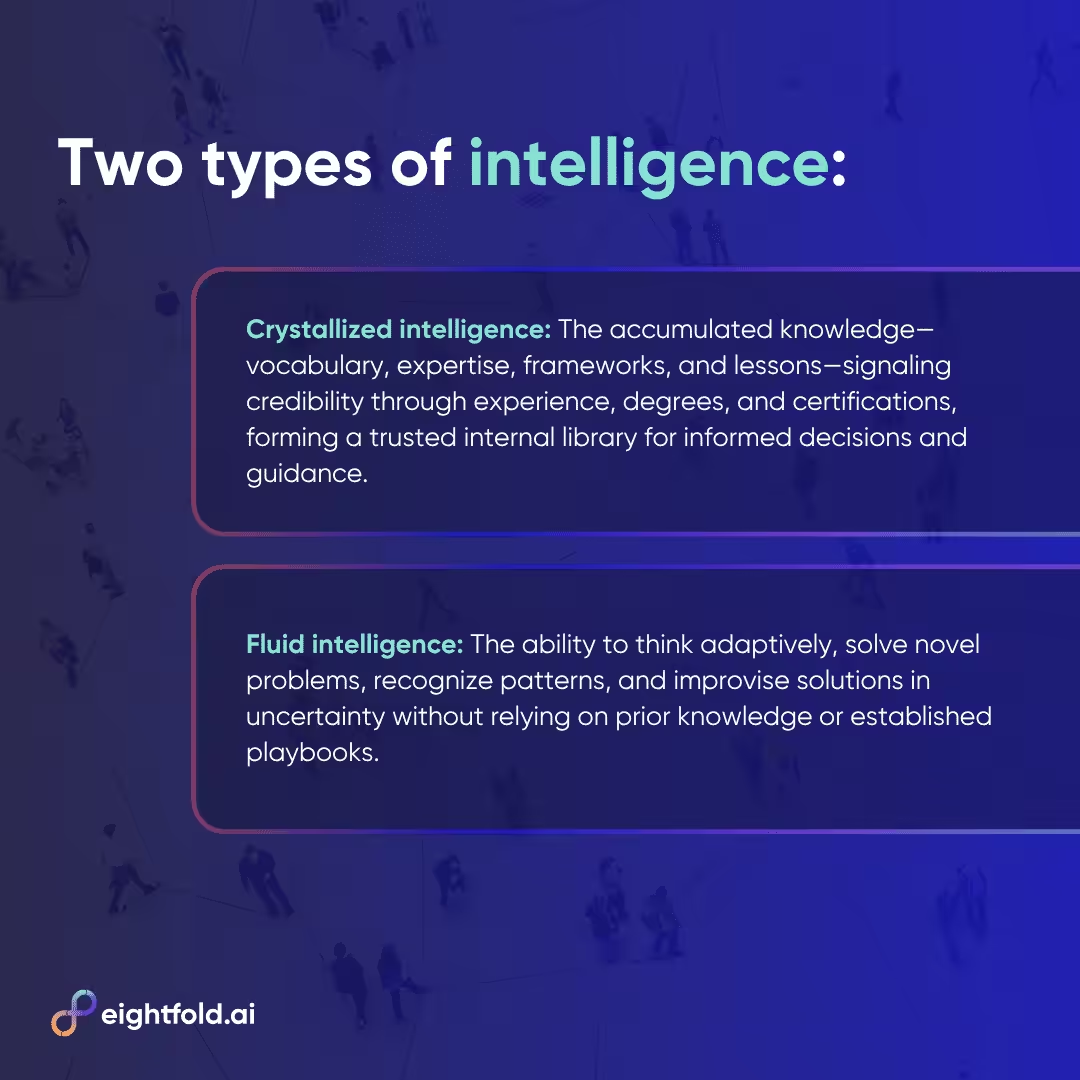
Psychologist Raymond Cattell gave us a useful mental toolbox: crystallized intelligence and fluid intelligence. Think of one as your internal filing cabinet, neatly stacked with years of lessons, frameworks, and expertise. Think of the other as a Tough Mudder course for your brain — messy, unpredictable, full of walls you didn’t see coming.
Crystallized intelligence is what you know. It’s the accumulated knowledge we gather over time — vocabulary, industry expertise, frameworks, lessons learned. It’s your internal library, and in many contexts, it signals credibility and mastery. Degrees, certifications, and years of experience are the neatly labeled folders that say, “I’ve been here before. Trust me.”
Fluid intelligence is how you think. It’s the ability to reason through novel problems, recognize patterns, and adapt when there’s no playbook to follow. It’s spotting patterns in chaos, improvising mid-slide, and landing on solutions that didn’t exist yesterday.
One is stored knowledge. The other is bumpy, exhilarating, grit-fueled adaptability.
Historically, organizations leaned heavily on crystallized intelligence because it’s easy to measure. Degrees are visible. Experience can be counted. Certifications are LinkedIn candy.
Fluid intelligence is trickier — it only shows up when the market pivots, the strategy flips upside down, or someone has to make a decision without precedent.
In a stable environment, that imbalance worked just fine, but the environment today isn’t stable.
The recruiter example
Five years ago, a strong recruiter was often defined by the size of their network and their ability to run structured interviews. They knew the market. They could assess cultural fit. They could close. Lather, rinse, repeat.
That’s crystallized intelligence at work: knowledge of the process, familiarity with the industry, expertise built over time. Solid. Reliable. Predictable.
Today, those are just the table stakes.
Modern recruiters are navigating AI sourcing tools, automated screening systems, evolving compliance requirements, and candidates who are increasingly savvy about technology in the process. They’re asked to interpret AI-generated insights, challenge biased outputs, and advise leaders on talent strategy in a volatile labor market.
That requires fluid intelligence — pattern recognition, adaptive decision-making, and the ability to rethink assumptions on the fly. That’s the mental Tough Mudder in a rainstorm: slippery, exhausting, and full of surprises.
The same shift at the executive level
A CHRO five years ago focused on workforce planning, leadership development, DEI strategy, and HR tech implementation.
Complicated? Absolutely. But largely predictable — the filing cabinet contained most of the answers.
Today’s CHRO still relies on that cabinet, but the terrain is far less stable.
AI governance, skills-based transformation, cross-functional alignment with IT and legal, and the ethical implications of automation decisions all demand navigating obstacles that weren’t even on the course map. Expertise is necessary but no longer sufficient.
Now the role demands continuous reframing, interpreting technological capabilities, anticipating second-order impacts, and guiding the organization through ambiguity. That’s fluid intelligence under pressure — complete with mud in your eyes and slipping on wet data.
Then there’s agentic AI
Agentic systems don’t just sit politely in the corner while humans do all the heavy lifting. They act. They set sub-goals, execute multi-step workflows, and make constrained decisions with minimal oversight. They can surface patterns, simulate reasoning, and propose strategies faster than you can find that one folder labeled “Lessons Learned 2009.”
In a pre-agentic world, a well-stocked filing cabinet, plus some mental Tough Mudder grit, gave humans the edge. In an agentic world, knowledge is widely accessible, and certain analytical processes are augmentable or automated by AI that never complains, never slips, and never forgets to hydrate.
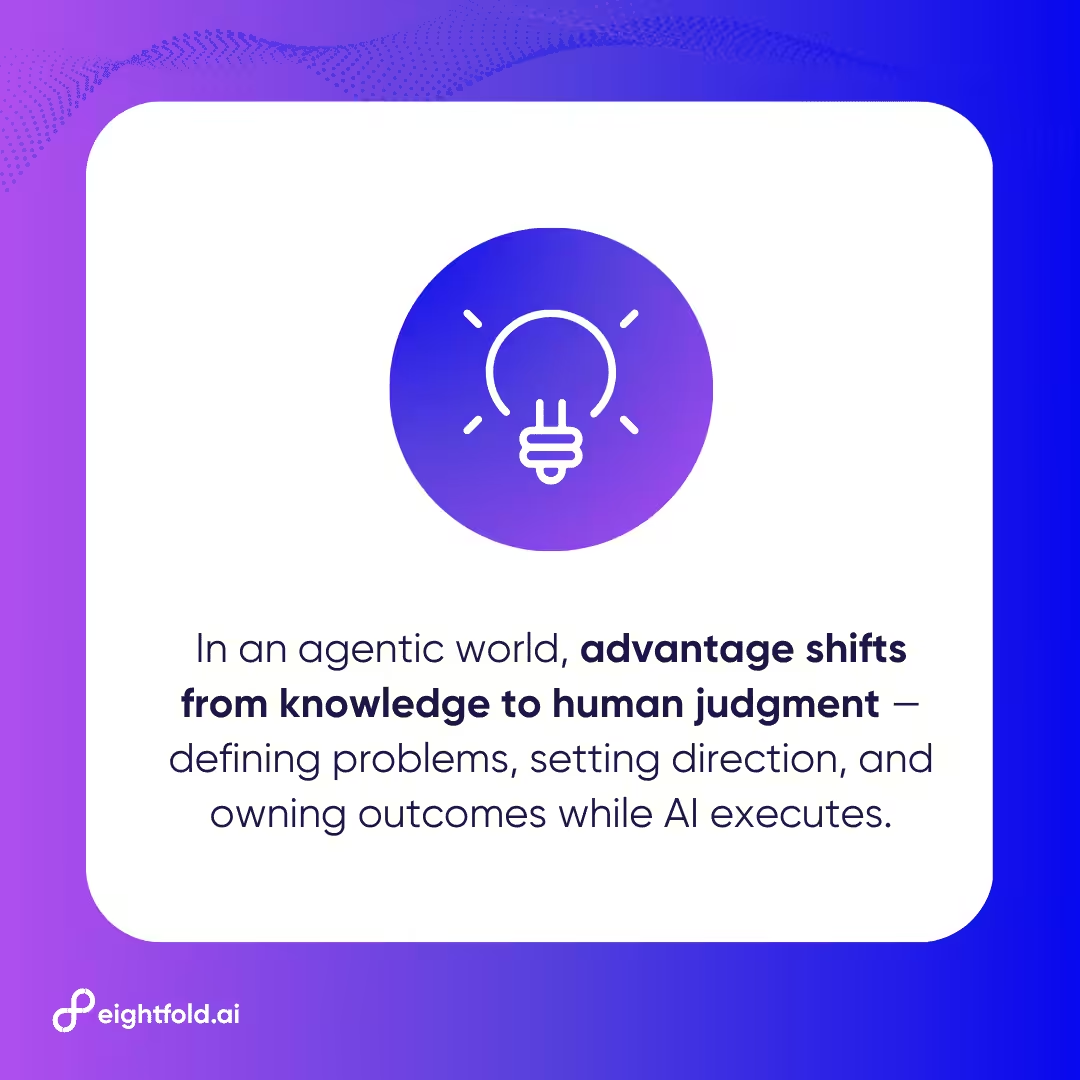
The real advantage shifts to humans who can define problems, frame constraints, oversee automated systems, and assume responsibility for outcomes.
Agentic AI can execute, but humans still decide whether the goal is strategically sound, ethically defensible, and aligned with long-term priorities. AI can act. Humans remain accountable.
The new human differentiator
If organizations continue to over-index on credentials and static expertise, they risk optimizing for yesterday’s environment. If they assume cognitive horsepower alone is enough, they may underestimate the complexity of guiding increasingly autonomous systems.
The more agentic our tools become, the more intentional we must be about how we define, cultivate, and evaluate human intelligence. It’s not just about what people know or how quickly they can process information — it’s about the choices they make, the questions they ask before the system runs, and the guardrails they set.
Picture a recruiter deciding which AI-sourced candidates to prioritize. The dashboard may spit out data, but the judgment about which candidates truly matter lives in the human brain. Think about a CHRO interpreting algorithmic workforce insights before restructuring a function. The system can offer insight, but only the human can weigh strategy, ethics, and consequences.
Crystallized intelligence built the foundation. Fluid intelligence is the mental Tough Mudder keeping us agile, muddy, and unreasonably resilient. And agentic AI changes the terrain entirely.
Once intelligence itself becomes embedded in our tools, the differentiator isn’t how much you know — or even how fast you can think. It’s how wisely you combine the filing cabinet with Tough Mudder grit to make judgment calls machines cannot.
Understanding crystallized and fluid intelligence is just the foundation. Once intelligence itself becomes embedded in our tools, the real conversation is about higher-order human capabilities — and what it means to guide systems that can act on their own.
Download The Infinite Workforce to see why agentic AI makes human judgment, not knowledge, the critical advantage for HR leaders navigating autonomous systems in 2026.