

- AI dynamically identifies employees’ skills and future skill needs, improving everything from recruiting to internal mobility.
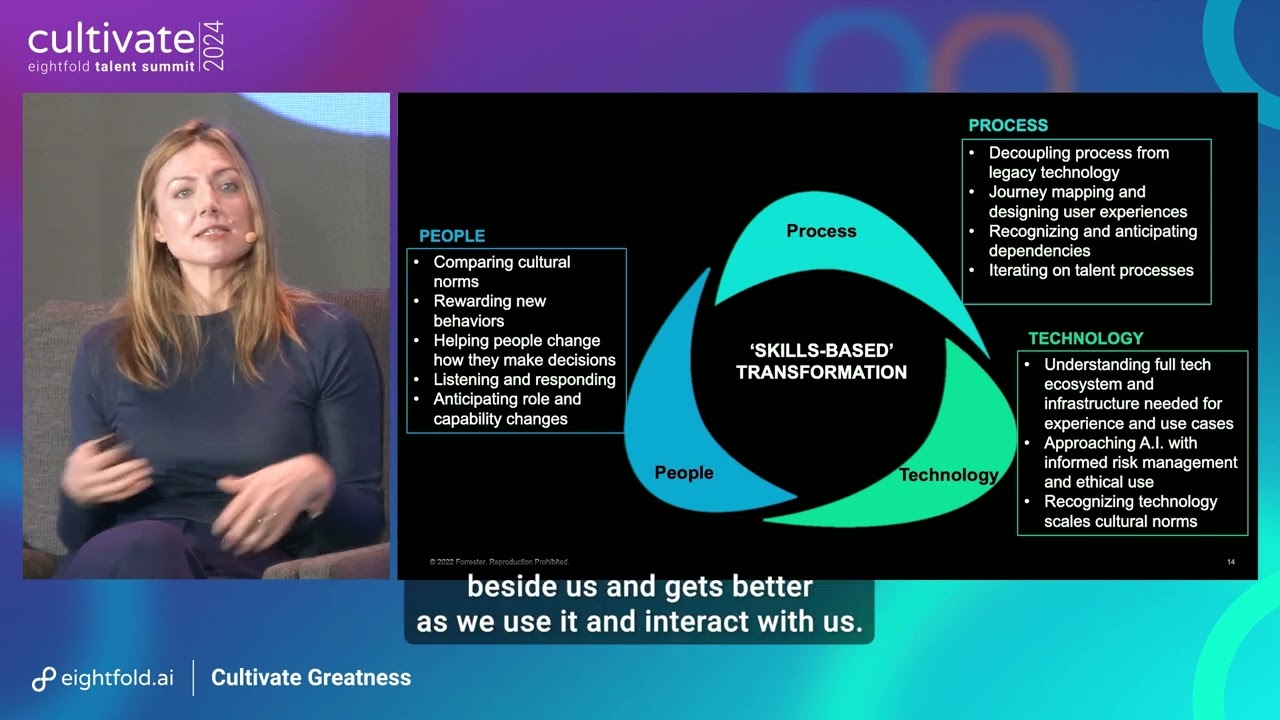
- Becoming skills-based requires more than choosing the right technology — it demands fundamental changes in processes and people.
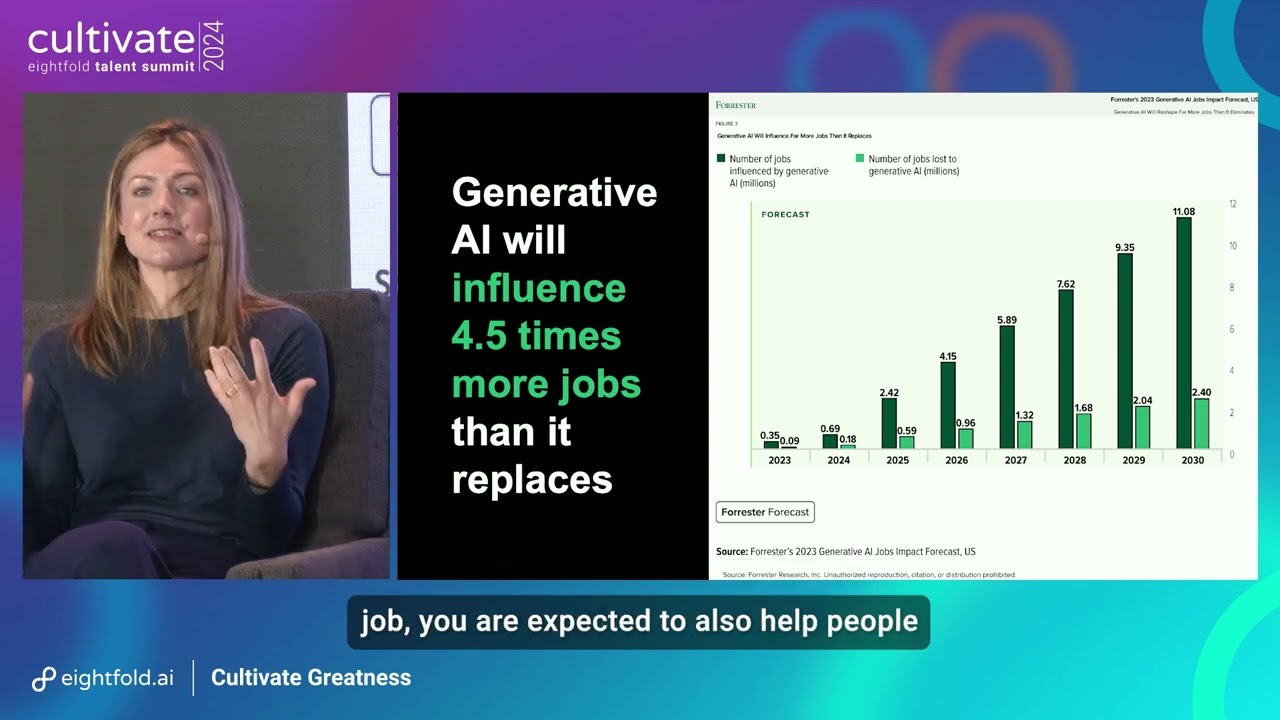
- GenAI is expected to transform 4.5 times more jobs than it will eliminate, including 20-30% of HR jobs
For all the buzz around skills-based hiring and talent management, the concept isn’t new.
“We have always been driving business value based on people’s skills,” said Betsy Summers, Forrester Principal Analyst, at Cultivate 2024. “It’s just that we have not had a good way of measuring and monitoring and tracking all of those skills.”
Until now.
As an analyst, Summers has the rare opportunity to speak with clients about how they’re creating business value through AI and HR transformation. She covers skills intelligence and emerging technologies related to human capital management, talent development, and talent management.
AI is revolutionizing the way we measure and track skills at scale, but its impact goes beyond just the technology or employees’ skills.
“It’s also their engagement, their level of wellness, the capacity, the time, the energy they have,” Summers said. “It’s how they operate. It’s all of the technical and soft skills, or the human skills and leadership skills as well.”
At Cultivate, Summers explained how AI is helping organizations dynamically understand their people and improve workforce outcomes. She also recently joined Ligia Zamora and Jason Cerrato on The New Talent Code podcast to share more on her thoughts about the future of work, AI’s potential impact, and why it’s critical to involve people in the change process.
Related content: Listen to Forrester Principal Analyst Betsy Summers’ appearance on The New Talent Code where she shares an in-depth look at the value of becoming a skills-based organization.
The skills-based workforce is here
Early in her Cultivate talk, Summers shared a dizzyingly dense skills-management spreadsheet used by a head of enterprise architecture at a client company. His question: what was he missing from the spreadsheet to get the most out of his team’s skills?
“I was like, ‘Missing? You’ve got a lot going on! Do you actually run your talent strategy based on this? How is that working for you?’ And, of course, it wasn’t working,” Summers said.
This frustration is one that Summers echoed in her conversation on The New Talent Code, citing how frequently she runs across functional leaders saying they have a skills-based approach to hiring and talent management, only to realize it’s a series of Excel spreadsheets that are too overwhelming for anyone to manage effectively.
“If you want us to make talent decisions based on skills, you better get us accurate and precise enough skills data to actually act on,” Summers said. “That tends to be the biggest disconnect when it comes to HR — really understanding the business problem.”
The good news is that AI is now helping organizations reveal, track, and measure skills in real time. But to become a skills-based organization, leaders must first overcome skepticism.
Related content: Summers talks about why companies need a more agile approach to talent planning at Cultivate ’24.
Overcoming AI skepticism
Skepticism surrounding skill-based management and AI can be a significant impediment to adoption. Summers said perhaps this skepticism comes from “a misunderstanding and assumption that skill-based enterprises are … all going to fractionalize work, [that] we’re all going to break down the work to be done: no more jobs, everything is just people and skills.”
Addressing fears around AI, Summers said that 4.5 times more jobs will be changed than eliminated. Forrester estimates that GenAI will change 20% to 30% of jobs in the HR profession. Forrester also says that leaders expect AI to create jobs over the next 13 to 24 months.
“Given the immense changes ahead, it’s not surprising that many people balk at adopting AI or skill-based processes,” Summers said. “But every organization is always going through some transformation, and this isn’t any different.”
Through that transformation, organizations will learn where to place employees who need to monitor, manage, train, and tune AI to use it effectively. It will be hard work and require shifts in mindsets, but Summers believes it’s worth doing.
“For me, it comes back to this fundamental question: If people really drive your business, which they do … why don’t you know more about them? Why don’t you know more about their capabilities and their skills and how they feel about their work? It’s a rhetorical question, right? It’s like it doesn’t even need answering, but sometimes we do have to give voice to that question because it’s something that sometimes is thrown out with some of the skepticism.”
To overcome skepticism, talent leaders must clearly communicate the value of AI and a skills-based approach. The next step is choosing the right technology.
Related content: Summers talks about how AI will influence jobs during her keynote at Cultivate ’24.
How to start your skills-based transformation
To choose the right addition for your HR tech stack, talent teams must identify a clear problem they want to solve. After identifying this issue, then they should focus on choosing the right technology.
“We need something that learns alongside us and gets better as we use it and interact with it,” Summers said. “And, of course, that is AI. Old AI, deterministic AI, is very good at pattern recognition. But now, with generative AI, there’s so much more in terms of contextual understanding and semantic understanding that it can drive a ton of value when we think about the actual use cases of helping someone be coached through a learning path or upskilling and reskilling, helping managers deal with difficult conversations.”
As with any other tech implementation, the organization also needs to consider its existing infrastructure — not only technological but also cultural. Facilitating this implementation requires what Summers dubbed a value network: the technology provider and an internal cross-functional committee of subject matter experts, services firms, and peer networks.
However, most organizations need help with the change after choosing the technology. In all the transformations, Summers observed that the least-altered processes involved recruiting people, managing performance, and internal promotions.
“You’re changing everything about how they experience work and how you’re bringing value to customers, yet you’re not changing your people process,” she said.
For a skill-based transformation to succeed, new processes are crucial. In examining an organization’s existing talent management process and adapting it to support a skill-based enterprise, Summers highlighted these tactics:
- Decouple the process from the legacy technology.
- Journey map and design user experiences.
- Recognize and anticipate dependencies.
- Iterate successful processes.
Encouraging adoption for managers, employees, and leadership
No matter how efficient new technology and processes are, you will only succeed if your organization’s people have adapted to changes and adopted them.
Encouraging adoption goes beyond training — it requires helping people change how they make decisions, anticipating and facilitating role and capability changes, and rewarding new behaviors.
“No manager is going to want to spend time upskilling and reskilling someone if they’re just going to move away from their team to another team,” Summers said. “You have to incentivize mobilization. You have to incentivize a manager being a talent mobilizer, not a talent hoarder.”
Another way AI can improve skill-based talent management is to look beyond what Summers dubbed the “sometimes relationship-based ways” managers make decisions.

Whether it’s a talent manager who can see only one career path for a particular person or a department manager who fails to see an employee’s potential for upskilling, relationship-based biases, and other preconceptions can muddy the waters. AI provides talent management with greater agility when determining an organization’s skill gaps and how to fill them.
“Are you going to buy those skills, build those skills, borrow those skills, or bot [automate] those skills? And then how are you going to do that?” Summers said. “This is like the Holy Grail when we get into workforce planning and using skills data and infusing it into our workforce planning structure.”
When it comes to employees, the focus should be on empowering them through problem-solving. Managers should also look at employee experience levers that drive engagement, such as finding new and interesting aspects of work, providing an environment where the employee feels productive, and feeling like there is an opportunity to learn and grow.
“We have that end user, the employee or member of the workforce in mind because we want to drive adoption,” Summers said on The New Talent Code. “We want to drive participation. We also want them to give us feedback.”
The final critical element of a successful transformation is the unwavering leadership that guides the way.
“It’s not just a change management of, ‘First we do this, then we do this, and we have a common strategy, and all of our personas,’” Summers said. “It’s about the leadership perspective of setting a vision and [employees] understanding what’s in it for them, making sure that everyone feels like what you’re doing is going to drive value for them. Because if it doesn’t work, they’re not going to come back, and then you don’t have adoption.”
Listen to the full episode of The New Talent Code with Betsy Summers on our website or wherever you listen to podcasts.